




Description
Collector's Note – Why This Issue Matters
August 1925 sits near the absolute peak of the American pulp magazine era. The pulps — named for the cheap wood-pulp paper on which they were printed — had by the mid-1920s become the dominant form of popular fiction in the United States, and none of their many genres burned brighter than the Western. This particular issue of The Lariat Story Magazine is not simply a collection of cowboy yarns. It is a primary document of how millions of Americans in the 1920s imagined the West: not as a lived experience, but as a moral landscape of hard men, clean codes, and meaningful danger. That imaginative construction shaped films, radio serials, and eventually television for decades to come, and the pulps were its engine.
The issue carries particular weight because of the writers it assembles. Walter J. Coburn, who appears twice — with the novelet "Riders of the Purple" and the feature "Cash Prizes for Cowboys" — was among the most prolific and respected contributors to Western pulps of the period, eventually publishing hundreds of stories across dozens of titles before his death in 1971. William Colt MacDonald, whose serial "The Red Raider" opens its first installment here, would go on to create the Three Mesquiteers characters later adapted by Republic Pictures into a long-running film series. Frank Richardson Pierce, Harrison Conrard, and Nels Leroy Jorgensen were similarly established names in the pulp ecosystem, writers whose careers were built issue by issue in magazines exactly like this one. For researchers tracing the lineage of Western fiction, a single issue with this density of named contributors is a meaningful find. Anyone building a serious reference library of magazines from 1925 will recognize immediately how rarely pulps from this year survive with their contents this fully intact and documented.
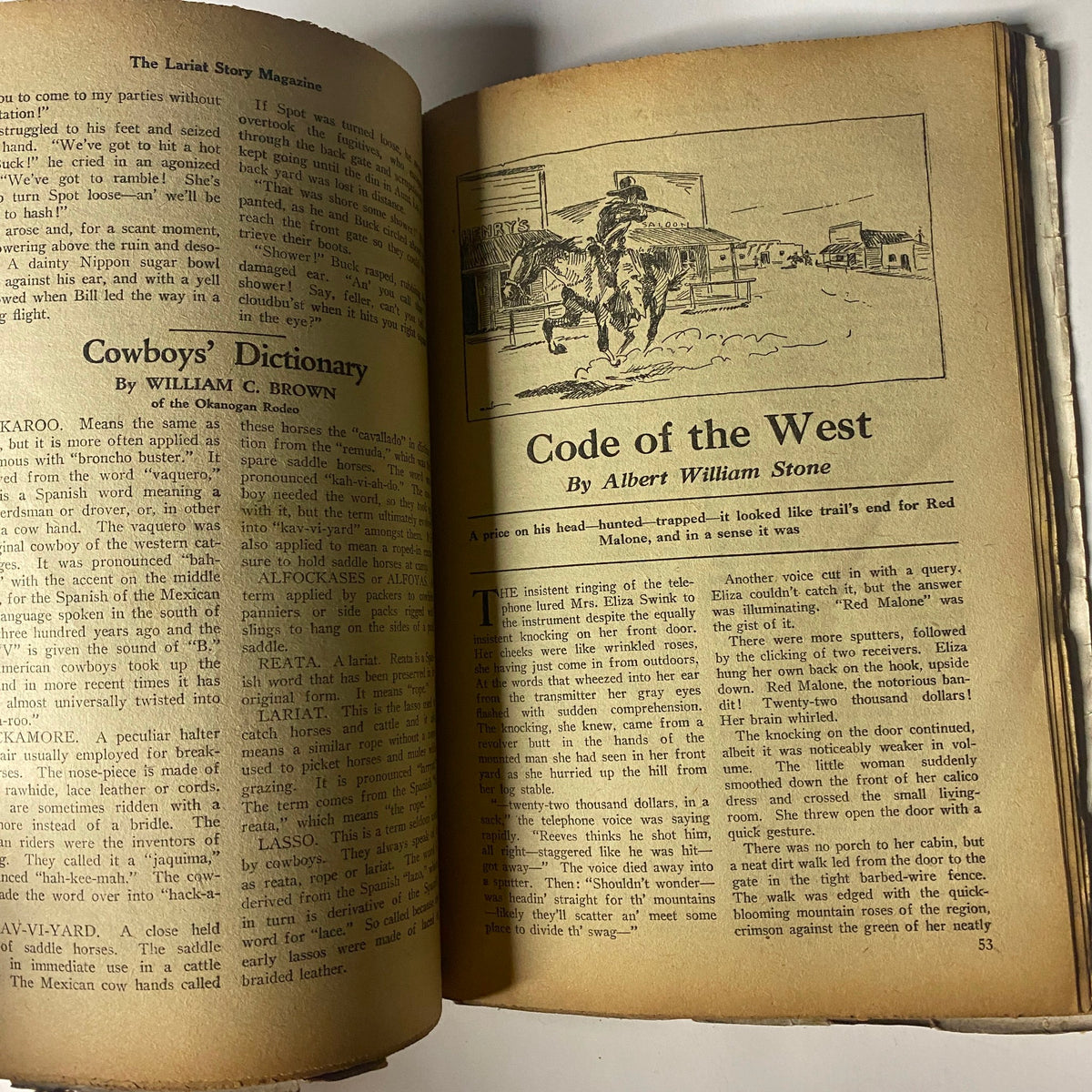
Beyond the fiction, this issue contains something rarer still: non-fiction coverage of the rodeo circuit. "Let 'er Buck!" reports on events in Salinas, "Big Days at Bozeman" and "Frontier Days at Cheyenne" offer period accounts of two of the West's most storied competitions, and "The Future of the Rodeo" attempts a forward-looking analysis of what was then a rapidly professionalizing sport. Together these pieces make this issue a genuine historical record of 1920s rodeo culture alongside its value as a fiction archive.
About the Publication
The Lariat Story Magazine was an American pulp fiction periodical dedicated exclusively to Western stories, published during the 1920s. Like its competitors — Wild West Weekly, Western Story Magazine, and Argosy — it was aimed at a broad working-class readership hungry for escapist adventure fiction delivered at an affordable price point. Its format followed the standard pulp model: a mix of novelets, short stories, serialized novels, and occasional non-fiction features, all organized around a unifying genre identity. The Western pulps of this era served as the primary training ground and income source for a generation of American genre writers, many of whom published under their own names and pseudonyms simultaneously across multiple competing titles. The Lariat Story Magazine occupies a recognized place within that ecosystem, and issues from its run appear with enough regularity in specialist pulp collections to confirm it maintained consistent publication across its active years.
Key Highlights Inside
- "Riders of the Purple" – Walter J. Coburn (Complete Novelet): A self-contained long-form story centered on a stray bull with a suspect brand mark and the violence that follows — a tight example of Coburn's characteristically efficient plotting.
- "The Red Raider, Part I" – William Colt MacDonald: The opening installment of a serialized novel by the writer who would later create the Three Mesquiteers. Collectors of MacDonald's work will note this predates his best-known characters by nearly a decade.
- "Cowboy's Dictionary" and "The Future of the Rodeo" – W. C. Brown: Two non-fiction contributions in a single issue is notable for a Western pulp of this period. The dictionary piece translates range slang; the rodeo essay engages seriously with the sport's commercial trajectory at a moment when it was still finding its national identity.
- Rodeo reportage — Salinas, Bozeman, Cheyenne: Three separate pieces of location-specific rodeo coverage give this issue unusual documentary value. Cheyenne Frontier Days and the Salinas rodeo were among the most prominent competitions of the era, and period accounts of them in print are genuinely scarce.
- "Cash Prizes for Cowboys" – Walter J. Coburn: The title feature, focused on prize money in bronc riding competition, bridges the fiction and non-fiction halves of the issue and gives the cover its lead sell line.
- Editorial "Ride 'im Cowboy" and closing section "The Corral": The bookending editorial matter — an opening address and a closing commentary section — provides a rare window into the editorial voice of the publication itself, something that does not survive in issues where these pages are missing or damaged.
Condition & Rarity
Pulp magazines from 1925 present significant preservation challenges. The wood-pulp paper stock used in their production was acidic by nature, designed for low cost rather than longevity, and a century of off-gassing has left the majority of surviving copies with pronounced tanning, brittleness at the page edges, and spine stress ranging from minor rolling to complete separation. A copy described as good condition for its age, with all pages intact and no label damage, represents the upper tier of what realistically survives from this period and print run. The absence of a mailing label is particularly meaningful — subscriber copies of pulps frequently carry ink-stamped or paper labels that obscure cover art and signal heavy handling; a no-label copy was almost certainly a newsstand or personal purchase copy stored with more care. Protective plastic covering on a surviving 1925 pulp indicates that at some point it passed through the hands of someone who recognized its collectibility. Collectors evaluating any copy of this issue should prioritize page completeness over surface condition: the editorial opener, all fiction contributions, the non-fiction rodeo features, and "The Corral" closing section should all be present, as these are the elements that give this specific issue its documentary and literary value.
Looking for More Issues Like This?
Intact pulp magazines from the mid-1920s are among the more demanding finds in vintage periodical collecting — paper this old and this fragile rarely survives a century in readable condition. If this particular August 1925 issue of The Lariat Story Magazine is unavailable, the best next step is browsing the full 1925 magazine collection at OriginalMagazines.com, where additional pulps, periodicals, and popular press titles from the same year are catalogued. It's a productive place to find contemporaneous context for any serious collection focused on the Jazz Age or the golden era of Western fiction.