
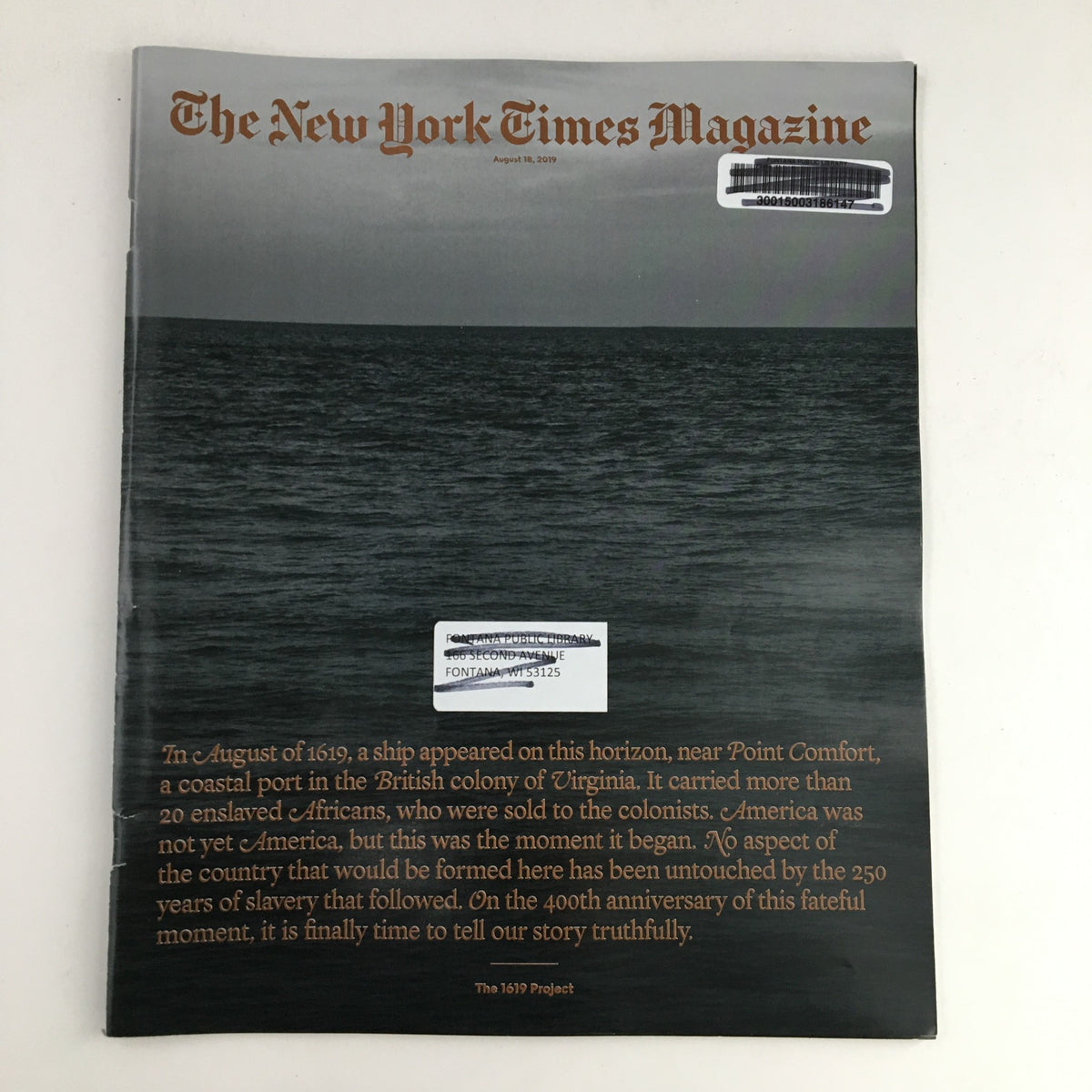

Description
Collector's Note – Why This Issue Matters
The August 18, 2019 issue of The New York Times Magazine, featuring the 1619 Project, is one of the most consequential single issues of any American magazine produced in the twenty-first century. The 1619 Project, conceived by journalist Nikole Hannah-Jones, reframed the narrative of American history by placing the arrival of the first enslaved Africans in colonial Virginia in August 1619 — not the Declaration of Independence in 1776 — as the country's true founding moment. The project argued that slavery and the contributions and struggles of Black Americans were not peripheral to the American story but central to it, and that understanding this centrality was essential to understanding American democracy, capitalism, and culture as they actually developed. The Times dedicated an entire issue of its magazine to the project — an extraordinary editorial commitment that resulted in a publication substantially larger and more ambitious than a standard magazine number — with contributions from major writers, historians, and journalists across its sections. The response was immediate and sustained: the 1619 Project generated the most significant public debate about the teaching and interpretation of American history since the culture wars of the early 1990s, and Nikole Hannah-Jones was awarded the Pulitzer Prize for Commentary in 2020. For collectors of New York Times Magazine issues documenting landmark American journalism, this August 2019 issue is among the most historically significant publications of the decade.
The cultural and political impact of this specific issue extends well beyond its initial publication. The 1619 Project was subsequently developed into a book, a curriculum, a podcast, and a documentary series — but this original magazine issue remains the primary document of the project in its initial, most concentrated form. The debate it generated — involving responses from historians, politicians, educators, and public figures across the ideological spectrum — made it one of the most discussed pieces of American journalism in years, and the subsequent political battles over its use in school curricula gave this original issue a documentary significance that grew rather than diminished after its publication. An issue that sparked congressional resolutions, state legislative responses, and a sustained national conversation about how American history should be taught and understood is a historical artifact in a very specific and meaningful sense. The August 2019 date captures the project before those subsequent developments had accumulated, making this issue the originating document of a still-ongoing cultural conversation.
About the Publication
The New York Times Magazine, the weekly supplement published with the Sunday edition of The New York Times, was by August 2019 one of the most widely read and editorially ambitious magazine supplements in American journalism — a publication that combined long-form feature writing, photography, cultural criticism, and occasional special projects with the institutional authority of the most respected newspaper in the United States. The 1619 Project issue represented an unusual deployment of that authority: the entire magazine dedicated to a single editorial initiative, with the full weight of The Times's journalism infrastructure behind it. Its readership was broad, educated, and nationally distributed, and its dedication of an entire issue to a single historical argument gave that argument a platform of extraordinary scale.
Key Highlights Inside
- The 1619 Project — the complete original publication of Nikole Hannah-Jones's landmark reframing of American history around the 1619 arrival of enslaved Africans, the project that would win Hannah-Jones the 2020 Pulitzer Prize for Commentary and generate one of the most sustained public debates about American historical memory in decades.
- Full magazine dedication to a single editorial initiative — an unusual and editorially significant decision by The New York Times Magazine that concentrated the full resources of its journalism infrastructure around a single historical argument.
- August 18, 2019 publication date — the originating document of a cultural and political debate that would continue for years, preceding the Pulitzer Prize, the book publication, the school curriculum controversies, and the state legislative responses that gave the project its sustained national significance.
- Library sticker and barcode sticker on the front cover — condition factors that confirm this issue's circulation through an institutional library collection, adding provenance documentation while affecting the cover's display presentation.
Condition & Rarity
Very good condition with smooth edges and the confirmed presence of a library sticker and barcode sticker on the front cover is an honest assessment of this specific example. The library stickers are the primary display consideration — they confirm the issue's institutional circulation history but affect the cover's visual presentation for collectors who prioritize clean cover display. The plastic protective covering indicates preservation storage. For a magazine now less than a decade old, the primary condition factors in any surviving copy are cover integrity and the completeness of interior pages — this is a publication recent enough that paper quality is not yet a concern, but the library sticker placement and extent should be assessed from the provided photographs by collectors for whom cover presentation is a priority.
Looking for More Issues Like This?
The August 18, 2019 1619 Project issue is one of the few magazine publications of the past decade that can be described without overstatement as historically significant in its own right — its role in generating a sustained national debate about American history gives this original issue a documentary weight that continues to grow. If this issue has already been claimed, the broader archive of New York Times Magazine issues is worth exploring for other landmark journalism and special projects from across the publication's history.