


Description
Collector's Note – Why This Issue Matters
The June 18, 1972 issue of The New York Times Magazine is a document of American life at one of its most internally fractured and culturally turbulent moments — and its table of contents, read carefully, captures that fracture with a precision that no single news story of the period could match. The issue went to press in the immediate atmosphere of the Vietnam War's most contested phase, the early stirrings of what would become the Watergate scandal, the women's liberation movement at full intensity, and the realignment of American electoral politics that the 1972 presidential campaign was making visible in real time. What makes this specific issue so compelling as a collector's document is not any single blockbuster story but the way its assembled contents — a North Vietnam correspondent's journal, a piece on liberated wives, a congressional redistricting dilemma involving Bella Abzug, and a meditation on a high school junior prom in Connecticut — together constitute a remarkably complete cross-section of where America's attention and anxiety actually resided in June 1972. For collectors building around New York Times Magazine issues from the Vietnam and Watergate era, this issue offers an unusually rich and multidimensional primary document of the period.
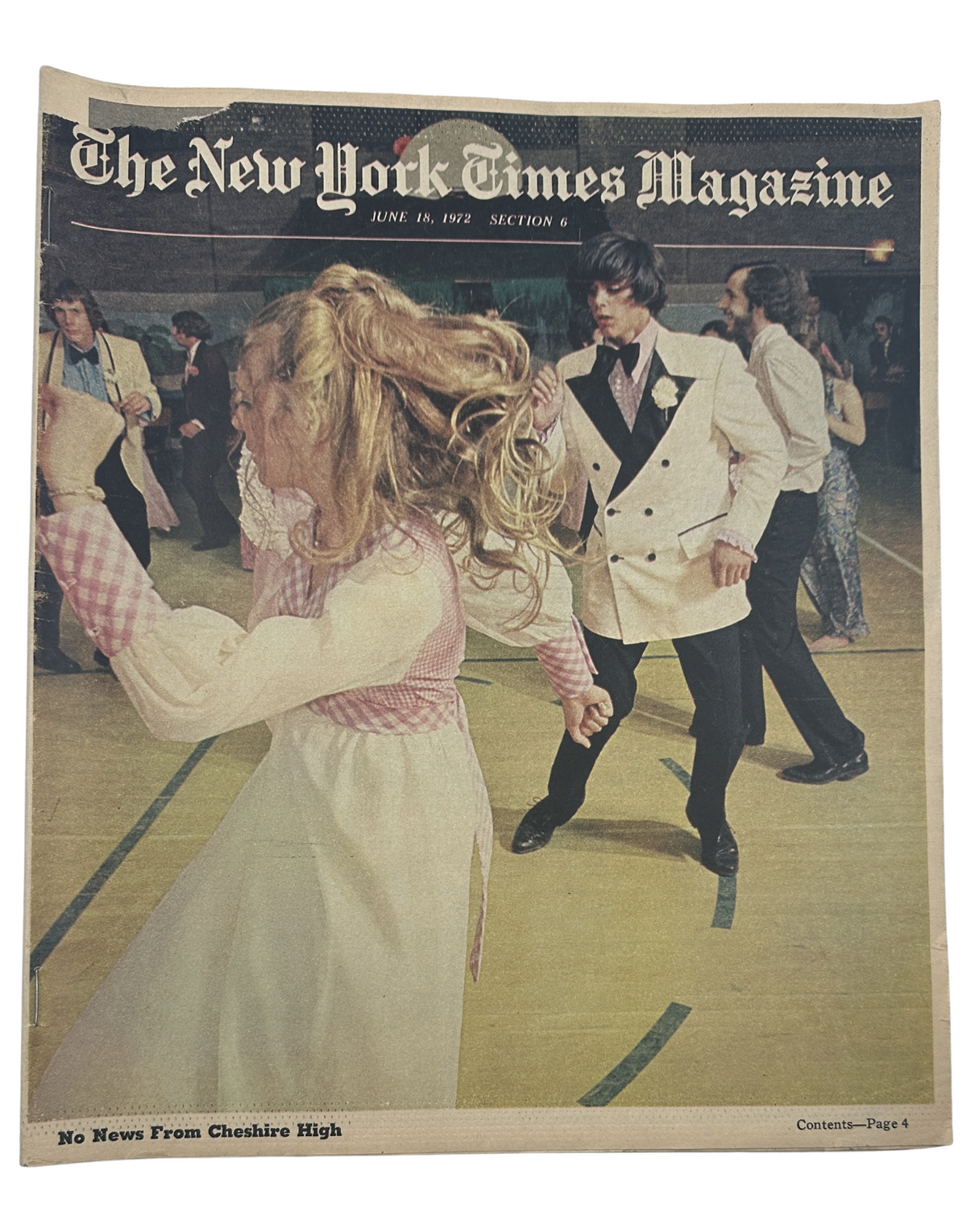
The cover story — Joyce Maynard's "Color My World, Or, No News From Cheshire High School," photographed by Ted Croner — is the editorial centerpiece that gives this issue its most enduring collector significance, and it deserves careful attention. Maynard was eighteen years old when this piece was published, a recent high school graduate who had already attracted extraordinary attention for her precocious writing ability. Her account of the junior prom in Cheshire, Connecticut — framed with the deliberately provocative assertion that there is "no news" from this place, that the homely traditions of the prom retain their luster even as the world around it convulses — is a piece of writing that operates simultaneously as sociology, nostalgia, and cultural provocation. In the context of June 1972, the choice to put a Connecticut junior prom on the cover of the Times Magazine was itself an editorial statement: that the America of Vietnam protests and women's liberation and Nixon's political machinations also contained, quietly and stubbornly, a country of corsages and gymnasium decorations and young people for whom the prom still meant something. Maynard's ability to hold that tension without irony or condescension at age eighteen was remarkable, and this piece launched a writing career that would span decades. For collectors focused on magazines from 1972, this issue represents one of the more genuinely interesting editorial statements the Times Magazine produced during that year.
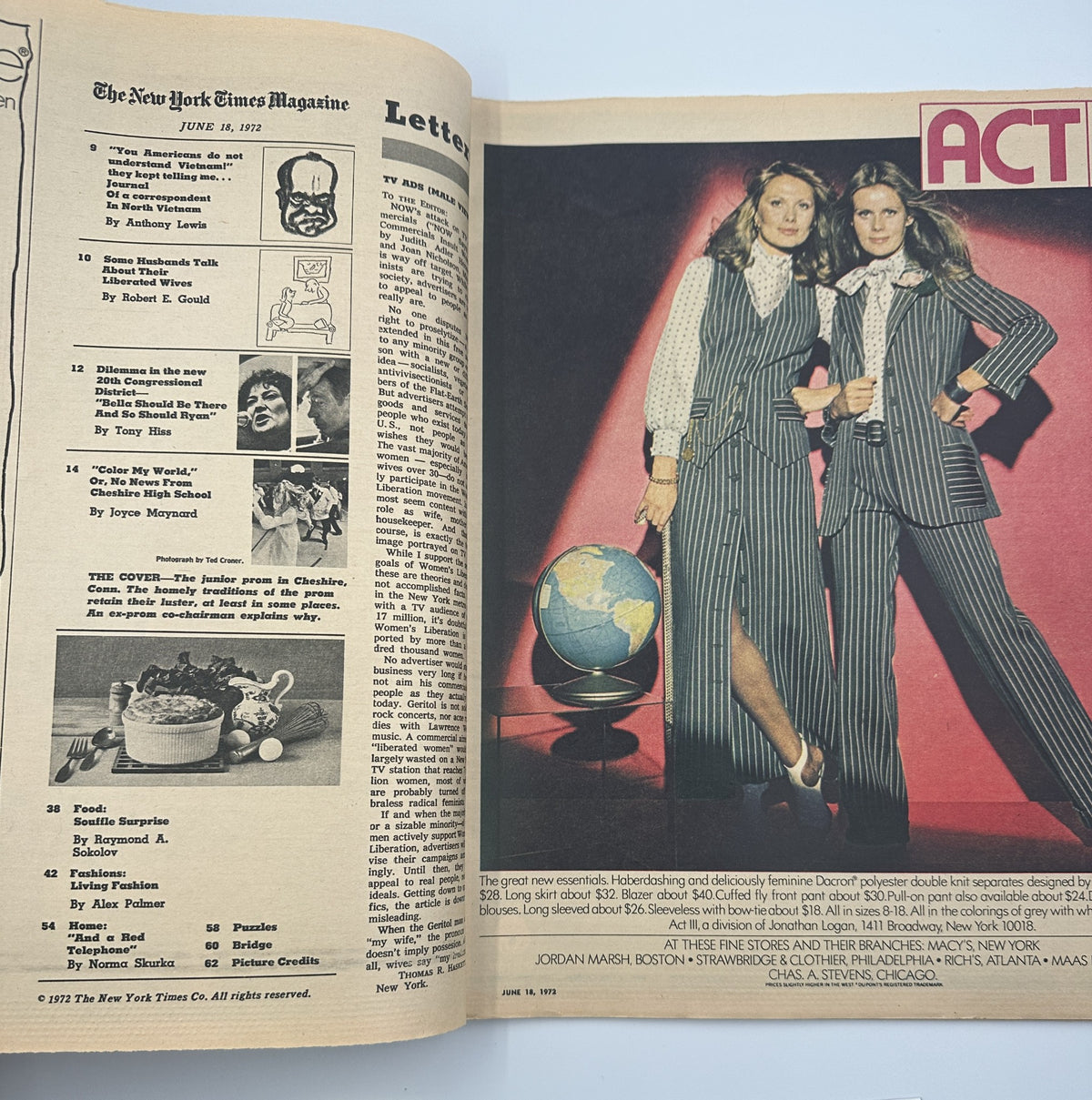
The Anthony Lewis piece — "Journal of a Correspondent in North Vietnam" — adds a dimension of major journalistic significance to an already substantive issue. Lewis was one of the most respected journalists at The New York Times, a two-time Pulitzer Prize winner whose legal and political reporting had defined serious American journalism for decades. A first-person journal from North Vietnam in June 1972, built around the repeated assertion by Vietnamese interlocutors that Americans "do not understand Vietnam," captures the epistemic gulf at the heart of the war with the kind of direct, documentary immediacy that only on-the-ground reporting can provide. Published in the same month that the Watergate break-in occurred — June 17, 1972, one day before this issue's cover date — the Lewis piece exists in a historical atmosphere where the war that was destroying the Johnson and Nixon presidencies was still very much a living, ongoing catastrophe rather than a historical event. The juxtaposition of Lewis's North Vietnam journal with Maynard's Connecticut prom cover, and Robert Gould's piece on liberated wives, and Tony Hiss's Bella Abzug congressional feature, gives this single issue an editorial range that functions as a genuine portrait of a country simultaneously at war abroad and in profound internal negotiation with itself at home.
About the Publication
The New York Times Magazine was established as the Sunday supplement to The New York Times and had evolved by the early 1970s into one of the most authoritative and widely read long-form journalism publications in American life. Unlike standalone newsweeklies, the Times Magazine carried the full institutional weight and journalistic credibility of the most respected newspaper in the country, which gave its features, profiles, and investigative pieces an authority that most independent magazines could not match. Its audience was the educated, civically engaged readership of the Times itself — professional, nationally distributed despite its New York base, and accustomed to writing that assumed both intelligence and genuine curiosity about the world in all its complexity. The magazine's format in 1972 combined major cover features with a range of shorter pieces, cultural coverage, food writing by Raymond Sokolov, design content, and the crossword puzzle. Its contributors during the Vietnam and Watergate era included some of the most consequential journalists, critics, and essayists working in American publishing, and individual issues from this period regularly assembled writing of a quality and historical immediacy that has aged considerably better than most contemporary journalism. The June 18, 1972 issue — with its roster including Anthony Lewis, Joyce Maynard, Tony Hiss, Robert Gould, and Ted Croner — is a strong representative example of the magazine operating at the full range of its editorial ambition during one of the most historically significant years of the twentieth century.
Key Highlights Inside
- "Color My World, Or, No News From Cheshire High School" by Joyce Maynard, photographed by Ted Croner (cover story, page 14): Maynard's cover piece on the junior prom at Cheshire High School in Connecticut is the editorial statement that defines this issue — a deliberate, provocative choice to put the quiet rituals of small-town American adolescence on the cover of the Times Magazine in June 1972, written by an eighteen-year-old with a voice and a sensibility that were already fully formed. Ted Croner's photography accompanies the text with the documentary intimacy that the subject demands. This piece represents an early and significant moment in Maynard's long writing career and is the primary reason this issue commands collector attention.
- "Journal of a Correspondent in North Vietnam" by Anthony Lewis (page 9): A first-person journal by one of the Times's most decorated journalists, reporting from inside North Vietnam at the height of the war and built around the recurring Vietnamese observation that Americans fundamentally misunderstand the conflict. Published one day after the Watergate break-in, this piece captures the Vietnam War's epistemic and moral dimensions with the directness of eyewitness journalism at a moment when the war's human and political costs were at their most acute.
- "Bella Should Be There And So Should Ryan" by Tony Hiss (page 12): Tony Hiss — son of Alger Hiss and himself a distinguished New Yorker writer — examines the dilemma created by New York's new 20th Congressional District, which pitted Bella Abzug against William Fitts Ryan in a redistricting-forced primary. Abzug, the fiercely progressive congresswoman and women's liberation advocate, was one of the most recognizable and polarizing figures in American politics in 1972, and this piece documents a specific electoral conflict that illuminates the broader tensions within the Democratic Party in the year of the McGovern campaign.
- "Some Husbands Talk About Their Liberated Wives" by Robert E. Gould (page 10): A feature that places the women's liberation movement inside the domestic space of marriage, examining how the movement was being experienced and negotiated by the men married to women whose sense of themselves was being transformed by it. Published in June 1972 — the same month the Equal Rights Amendment passed the Senate and was sent to the states for ratification — this piece lands at a precise moment of maximum cultural intensity around questions of gender, marriage, and equality.
- Food, fashion, and home coverage by Raymond Sokolov, Alex Palmer, and Norma Skurka: The cultural and domestic content of this issue — a soufflé feature by Sokolov, fashion coverage by Palmer, and a home design piece by Skurka titled "And a Red Telephone" — provides the period texture and material culture context that makes a complete issue from this era so historically revealing. These departments capture the aesthetic and domestic preoccupations of the educated New York readership of 1972 with the kind of specificity that no historical summary can replicate.
Condition & Rarity
A Good condition rating with moderate signs of age and wear, corner creases, and light surface wear is an honest and precise assessment of what a fifty-plus-year-old Sunday magazine supplement typically presents in the collector market, and collectors who understand the format will read this description accurately. The New York Times Magazine in 1972 was printed on paper stock typical of a newspaper supplement — better than standard newsprint but not the coated stock of a premium standalone magazine — which means that copies surviving at this age with their structural integrity intact have generally benefited from reasonably careful storage even if they were not deliberately preserved as collectibles. Good condition indicates a complete, fully readable copy with visible evidence of its age: corner creases and light surface wear are the expected and honest marks of a document that has survived five decades of storage without significant damage to its content or overall structure. The confirmation that this is a complete copy is the most important single condition attribute for an issue of this editorial significance — all of the Anthony Lewis North Vietnam journal, all of the Joyce Maynard prom cover story, and all of the Bella Abzug congressional piece are present and accessible. The protective plastic sleeve in which surviving copies of this issue ship is the correct preservation format for a Sunday supplement of this age, providing protection against further handling abrasion and environmental exposure. For a Joyce Maynard cover story issue — where the interior text is as central to the collectible value as the cover itself — page completeness and text legibility are the primary condition attributes that matter most to the collectors most likely to seek this specific issue out.
Looking for More Issues Like This?
A June 1972 New York Times Magazine that combines a Joyce Maynard cover story, an Anthony Lewis North Vietnam journal, a Bella Abzug congressional feature, and a Robert Gould piece on the women's liberation movement inside marriage — published the day after the Watergate break-in — represents a density of historical and cultural significance that is genuinely unusual even by the standards of a publication that consistently attracted distinguished contributors during this period. If this particular issue has already been claimed, the broader New York Times Magazine collection at OriginalMagazines.com regularly includes issues from the Vietnam and Watergate years that document the full arc of that extraordinary and consequential period in American history with the editorial authority and journalistic seriousness that the Times brought to American publishing at its most engaged and ambitious. Collectors with a specific focus on the political, cultural, and social atmosphere of 1972 — one of the most historically compressed and consequential years of the entire postwar period — will also find the 1972 magazine archive an exceptionally rich source of primary material from across the major American publications of a year that produced Watergate, the McGovern campaign, Nixon's China opening, the Vietnam peace negotiations, the Equal Rights Amendment, and a cultural conversation about gender, war, and American identity that was as intense and unresolved as any the country had experienced since the 1960s.