



Description
Collector's Note – Why This Issue Matters
The March 26, 1967 issue of The New York Times Magazine is a document of genuine significance for anyone interested in the history of American architecture and the cultural moment in which modernism reached both its creative apex and the beginning of its public reckoning. The cover subject is Paul Rudolph — one of the most consequential and controversial architects of the twentieth century, and in 1967, a figure at the absolute center of American architectural debate. That The New York Times Magazine placed him on its cover that spring speaks directly to how seriously the broader educated public was engaging with questions of built environment, urban form, and the ambitions of high modernism during this period. This was not a trade publication reaching specialists; it was the Sunday supplement of the most influential newspaper in the country, and Rudolph's presence on its cover reflects his standing as a genuinely public intellectual figure as much as a designer.
Paul Rudolph served as chairman of Yale University's School of Architecture from 1958 to 1965, a tenure during which he shaped a generation of architects and completed his most celebrated and debated work — the Yale Art and Architecture Building, finished in 1963. That building, with its dramatically corrugated concrete surfaces and monumental interior spaces, became the defining statement of Brutalist architecture in America and the focal point of intense critical debate about what modernism owed to human experience and urban context. By 1967, Rudolph had left Yale and was operating a private practice producing large-scale civic and government commissions that pushed his formal language even further. A New York Times Magazine cover feature at this precise moment captures him at a pivot point — celebrated, scrutinized, and already being questioned by a younger generation beginning to challenge modernism's foundational assumptions. Collectors with a serious interest in architecture, design history, or the cultural life of the 1960s will find this issue well worth pursuing alongside other material in the New York Times Magazine archive at OriginalMagazines.com.
1967 itself is a year that deserves attention as an architectural and cultural watershed. It was the year Jane Jacobs' influence was fully embedding itself into mainstream urban discourse, the year Robert Venturi's Complexity and Contradiction in Architecture — published the previous year — was beginning to reshape how younger architects thought about modernism's limitations, and a year in which American cities were visibly struggling with the consequences of the urban renewal projects that architects like Rudolph had helped design. A cover feature on Rudolph in this climate was inherently a conversation about more than one man's career. It was a mirror held up to an entire era of American design ambition. For collectors building a broader picture of this pivotal year in American cultural history, the complete 1967 magazine archive at OriginalMagazines.com provides essential surrounding context.
About the Publication
The New York Times Magazine is the weekly supplement published with the Sunday edition of The New York Times, with a continuous publishing history stretching back to 1896. By the 1960s it had established itself as one of the most intellectually serious general-interest magazine platforms in the United States, reaching an educated, culturally engaged readership that included policymakers, academics, artists, and informed general readers who expected substantive long-form journalism alongside the newspaper's daily coverage. Its cover features during this era were carefully chosen to reflect and shape national conversations — architecture, civil rights, foreign policy, arts, and social change all received the kind of extended treatment that the Sunday magazine format uniquely allowed. Unlike standalone newsstand publications, the Times Magazine arrived as part of the Sunday paper, which means surviving newsstand copies — sold separately — are considerably less common than subscription or bundled copies from the same period, adding a layer of scarcity that collectors of this title understand well.
Key Highlights Inside
- Cover feature on architect Paul Rudolph, one of the defining figures of American Brutalism and former chairman of Yale University's School of Architecture, captured at a pivotal moment in his career and in the broader trajectory of postwar American modernism.
- Editorial coverage that almost certainly engaged with Rudolph's architectural philosophy, his major completed works — including the Yale Art and Architecture Building — and his position within the intensifying debate over modernism's legacy in American cities and institutions.
- The broader editorial context of a March 1967 issue of the Times Magazine, which would have included the publication's characteristically wide-ranging coverage of politics, culture, and ideas at a particularly volatile moment in American public life.
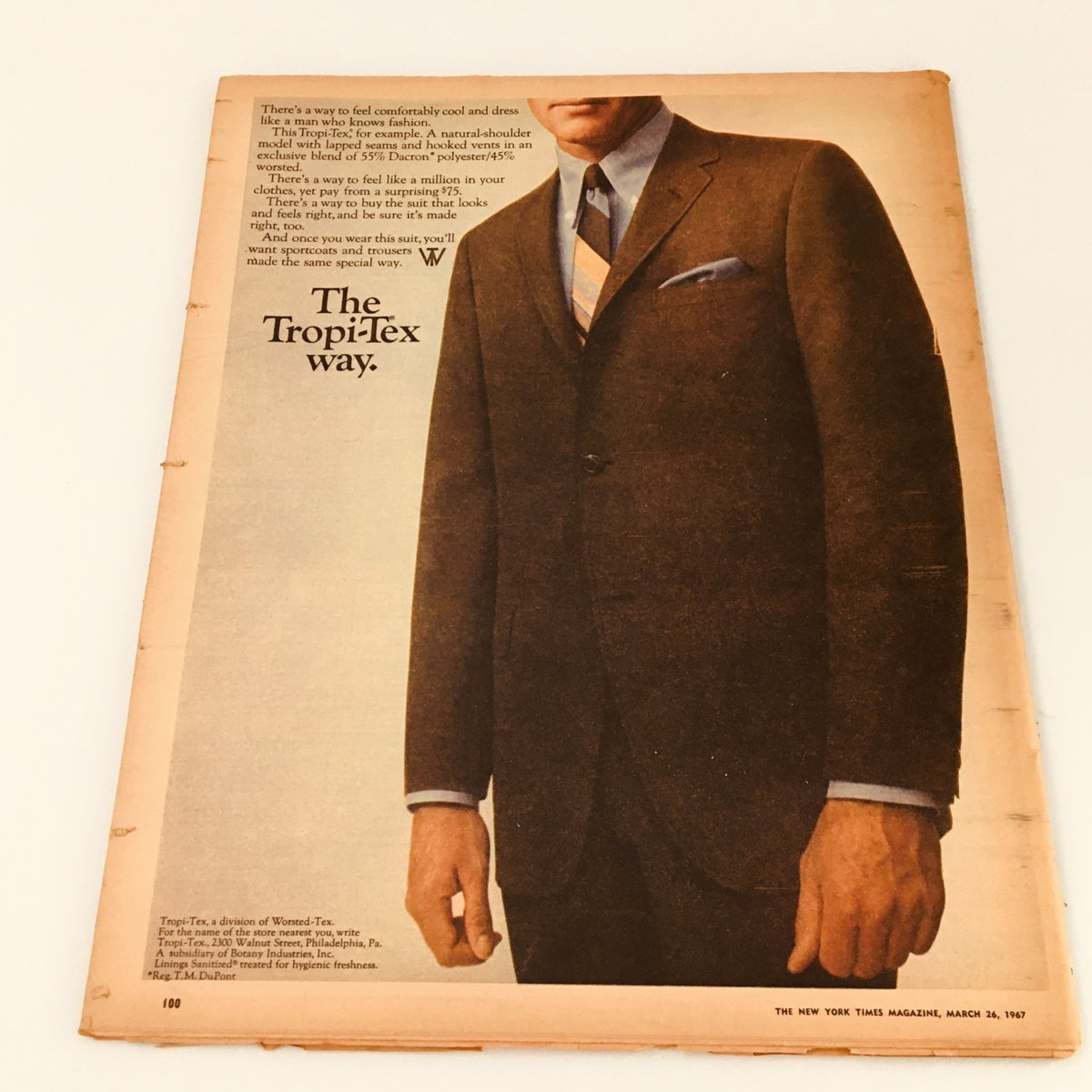
- Period advertising throughout, reflecting the consumer culture and commercial landscape of upper-middle-class American life in early 1967 — a secondary layer of historical documentation that serious collectors of this title consistently find valuable.
- Note: Specific interior article titles, contributing writers, and additional features beyond the Rudolph cover story are unconfirmed for this issue. The above reflects what can be responsibly attributed based on the cover subject, publication format, and date.
Condition & Rarity
Surviving copies of this issue are described as newsstand origin with no mailing label — a meaningful distinction for this particular title. The New York Times Magazine was most commonly encountered as part of the full Sunday newspaper bundle, delivered to subscribers or purchased as a complete package at newsstands, meaning that copies sold and preserved independently as standalone issues represent a smaller subset of total print run survivors. A clean, label-free newsstand copy avoids the address label adhesion and paper damage that permanently reduce the grade of subscription examples. The noted condition — good for age, with minor edge wear and occasional small rips or marks — is honest and expected attrition on a publication now approaching sixty years old, and should be read as confirmation of structural integrity rather than pristine preservation. The addition of a protective plastic covering indicates deliberate archival intervention at some point in the copy's history, helping to stabilize further deterioration and maintain page integrity. When evaluating any surviving copy of this issue, collectors should prioritize the condition of the Rudolph cover image and typography, the completeness of interior pages, the integrity of the spine, and the absence of significant toning or foxing throughout — the standard benchmarks for a collectible copy of any Times Magazine issue from this era.
Looking for More Issues Like This?
A newsstand copy of this specific issue — with its rare architecture cover and strong cultural relevance — is not an easy find, and if this one has already moved on, patience and persistent searching are the realistic path forward. The New York Times Magazine collection at OriginalMagazines.com is the best starting point, with a range of issues from across the publication's long history available to browse. For collectors whose interest extends to the broader cultural and intellectual life of the period, the 1967 magazines collection regularly surfaces material from the same remarkable year — well worth exploring for anyone serious about mid-century American culture, design, and ideas.