


Description
Collector's Note – Why This Issue Matters
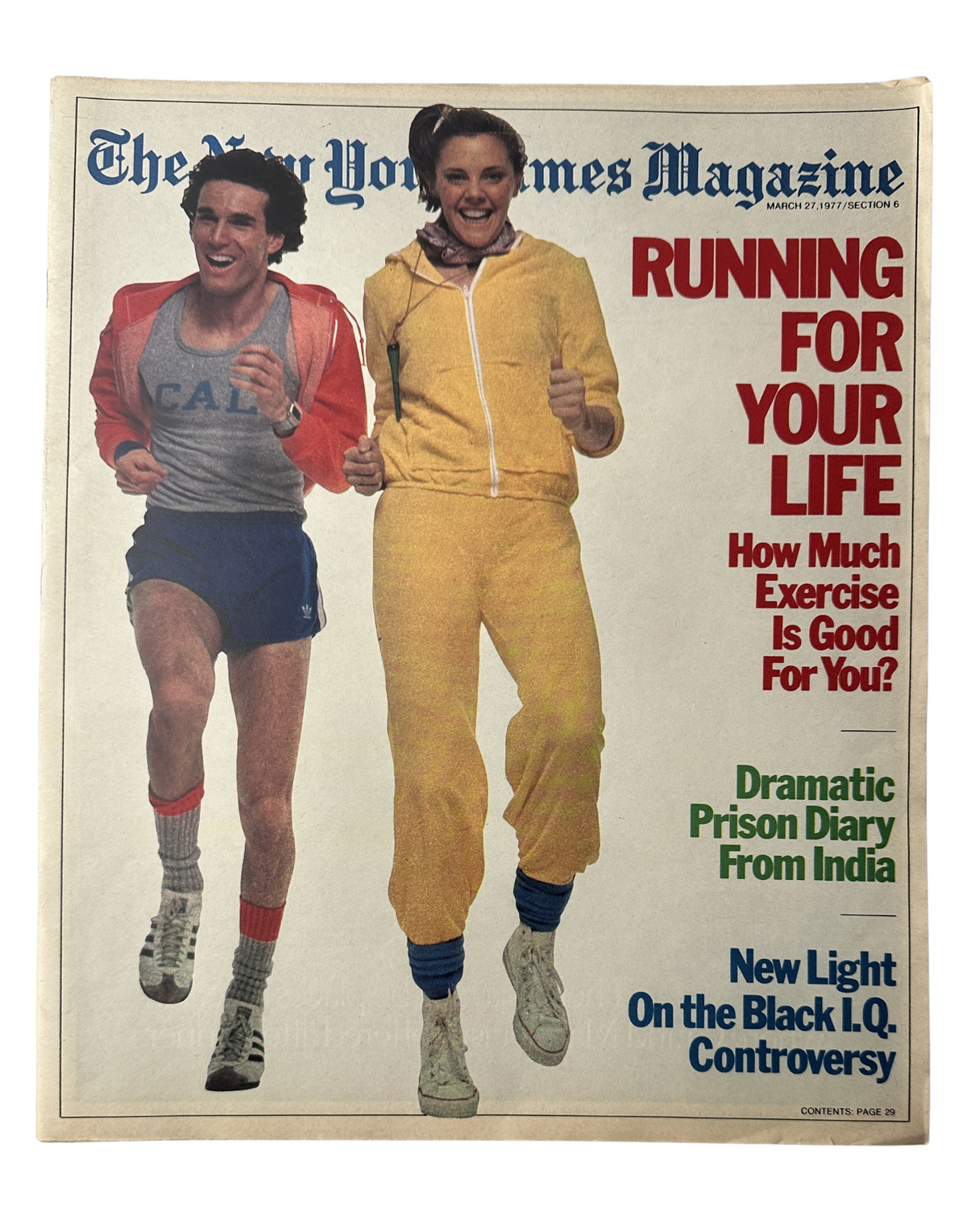
The March 27, 1977 issue of The New York Times Magazine — cover-themed "Running for Your Life" and focused on the American exercise explosion — is a primary document of one of the most consequential cultural shifts in postwar American life: the emergence of mass fitness culture as a mainstream middle-class preoccupation. The timing is precise and historically meaningful. By the spring of 1977, the running boom that had been building through the early and mid-1970s was reaching a critical mass of cultural visibility — Jim Fixx's The Complete Book of Running, the book that would become the defining popular text of the jogging movement, was published later that same year. Frank Shorter's gold medal in the marathon at the 1972 Munich Olympics had ignited American interest in distance running, and by 1977 the activity had spread far beyond competitive athletics into the daily routines of millions of ordinary Americans who had never thought of themselves as athletes. The cover's framing — "Are some forms actually dangerous?" — captures the specific cultural anxiety of the moment: a country newly enthusiastic about exercise but genuinely uncertain about the science, the risks, and the appropriate boundaries of physical exertion for ordinary adults. For collectors who focus on vintage New York Times Magazine issues documenting American cultural history, this cover is a primary document of that transformation at its precise moment of mainstream arrival.
The breadth of the table of contents in this issue is remarkable and makes it a particularly rich artifact of its specific cultural moment. C. P. Gilmore's "Talking Exercise to Heart" and Dena Kaye's "Spring Shape-Up Guide" represent the fitness culture story at its most directly engaged, but the surrounding content illuminates the full texture of the late-1970s American intellectual and cultural landscape with unusual richness. Thomas Sowell's "New Light on Black I.Q." and Edward B. Fiske's "An Issue That Won't Go Away" engage with the ongoing and deeply contested debate about intelligence testing, race, and educational policy that was among the most heated academic and public controversies of the period. Jaya Prakash Narayan's "India, My India!" offers a perspective from one of India's most respected democratic advocates at a moment when Indira Gandhi's Emergency period had just ended and India's democratic future was being anxiously assessed. Russell Baker's Sunday Observer column, Craig Claiborne and Pierre Franey on the flavorful snail, and Robert Daley on the great bargains of Bordeaux fill out a table of contents that is, taken as a whole, a precise portrait of the educated, cosmopolitan, culturally engaged Times Magazine readership of 1977. Collectors building archives around the magazines of 1977 will find this issue a document of that readership's preoccupations with unusual completeness and specificity.
The fashion feature — "Game, Set, Match" — adds a further dimension that connects the fitness cover story to the broader cultural trend it was documenting. Tennis had experienced its own spectacular popularity surge in the early 1970s following Billie Jean King's "Battle of the Sexes" match against Bobby Riggs in 1973, and by 1977 the sport had become one of the defining leisure activities of the American upper-middle class. A Times Magazine fashion feature organized around tennis in the same issue as a major exercise cover story is not coincidental — it reflects the magazine's editorial intelligence about the way fitness, fashion, and aspirational lifestyle were converging in its readership's culture in ways that would define the aesthetic and commercial character of the decade to come. This is an issue that rewards sustained attention not just as a document of the fitness boom but as a portrait of a specific moment in American social history when the relationship between body, health, identity, and class was being renegotiated in ways whose consequences are still felt today.
About the Publication
The New York Times Magazine, published as the Sunday supplement to The New York Times since 1896, had by the mid-1970s established itself as one of the most intellectually serious and culturally influential magazine publications in the United States — a weekly forum for long-form journalism, cultural criticism, and reported essays that reached the most educated and engaged segment of the American newspaper-reading public. Unlike standalone newsweeklies, the Times Magazine benefited from its association with the country's most authoritative daily newspaper and its assumption of a readership already predisposed to serious, substantive engagement with complex ideas. Its contributors in the 1970s represented the full breadth of American intellectual and journalistic life, and its cover stories on social, cultural, and scientific topics consistently shaped public conversation in ways that few other publications could match. The March 1977 issue exemplifies the magazine's characteristic editorial ambition: a cover story on a genuinely important social trend, surrounded by substantive reported pieces on politics, race, food, fashion, and finance that together constitute a remarkably complete portrait of its moment.
Key Highlights Inside
- "Talking Exercise to Heart" by C. P. Gilmore (page 38) — the cover story examining the American exercise explosion of the mid-1970s, asking whether jogging, swimming, tennis, bicycling, and other forms of strenuous exercise are genuinely beneficial, whether some forms are superior to others, and whether some activities carry real risks for ordinary adults — questions that were at the center of the era's emerging fitness culture and that had not yet been resolved by the scientific and medical communities.
- "Spring Shape-Up Guide" by Dena Kaye (page 44) — a practical companion to the cover story providing concrete fitness guidance for the magazine's readership at the moment when mass participation in exercise was transitioning from novelty to established middle-class lifestyle practice.
- "New Light on Black I.Q." by Thomas Sowell (page 56) and "An Issue That Won't Go Away" by Edward B. Fiske (page 58) — a paired engagement with one of the most contentious intellectual and policy debates of the 1970s, featuring economist Thomas Sowell, whose heterodox perspectives on race and intelligence were already making him a significant and controversial figure in American public discourse.
- "India, My India!" by Jaya Prakash Narayan (page 35) — a perspective from one of India's most celebrated democratic advocates, arriving in the immediate aftermath of Indira Gandhi's Emergency period and at a moment of intense international attention to the fate of Indian democracy following the 1977 general election that had ended Congress Party rule.
- "Game, Set, Match" fashion feature (page 90) and "The Flavorful Snail" by Craig Claiborne with Pierre Franey (page 116) — cultural content reflecting the specific leisure and culinary preoccupations of the educated New York metropolitan readership in the late 1970s, when tennis culture and French-influenced American gastronomy were both at their peak of aspirational cultural prestige.
- Russell Baker's Sunday Observer column (page 8) — a consistent and much-read fixture of the magazine's front matter, representing Baker's distinctive blend of political observation and deadpan humor that made him one of the most celebrated regular contributors in the publication's history.
Condition & Rarity
This copy is graded very good condition with only light edge wear — a strong condition assessment for a nearly fifty-year-old magazine supplement that places it at the favorable end of the condition spectrum collectors typically encounter for Times Magazine issues from this period. The very good grade with light edge wear indicates a copy that has been stored carefully rather than frequently handled, with cover presentation and interior page integrity well preserved. The protective plastic sleeve provides ongoing conservation value and indicates deliberate preservation-conscious storage. New York Times Magazine issues from the 1970s were printed on coated stock that ages well under proper storage conditions, retaining color fidelity and page integrity better than uncoated newsprint of the same era, and a very good example from a protected sleeve will typically show the full visual quality of the original printing. The table of contents for this issue has been digitally transcribed for collector research purposes, which adds reference value for buyers researching the specific editorial content — a useful provenance detail that distinguishes this listing from copies offered without content documentation. For an issue with the specific cultural and editorial significance of this exercise boom cover, a very good sleeved copy represents a well-preserved and purposeful acquisition.
Looking for More Issues Like This?
A very good copy of this particular New York Times Magazine issue — with its combination of fitness culture cover story, Thomas Sowell essay, and Craig Claiborne food feature all in the same edition — is a richer find than the individual subject lines suggest, and if this March 1977 issue has already found a home, the broader New York Times Magazine collection at OriginalMagazines.com is an excellent resource for other significant issues from the publication's long and editorially distinguished run. Collectors focused on the cultural, intellectual, and social landscape of the late 1970s will also find it well worth exploring the full 1977 magazine archive, which brings together publications from a year whose combination of post-Watergate political realignment, emerging fitness culture, and shifting social attitudes makes it one of the more rewarding and underappreciated collecting targets of the decade.