
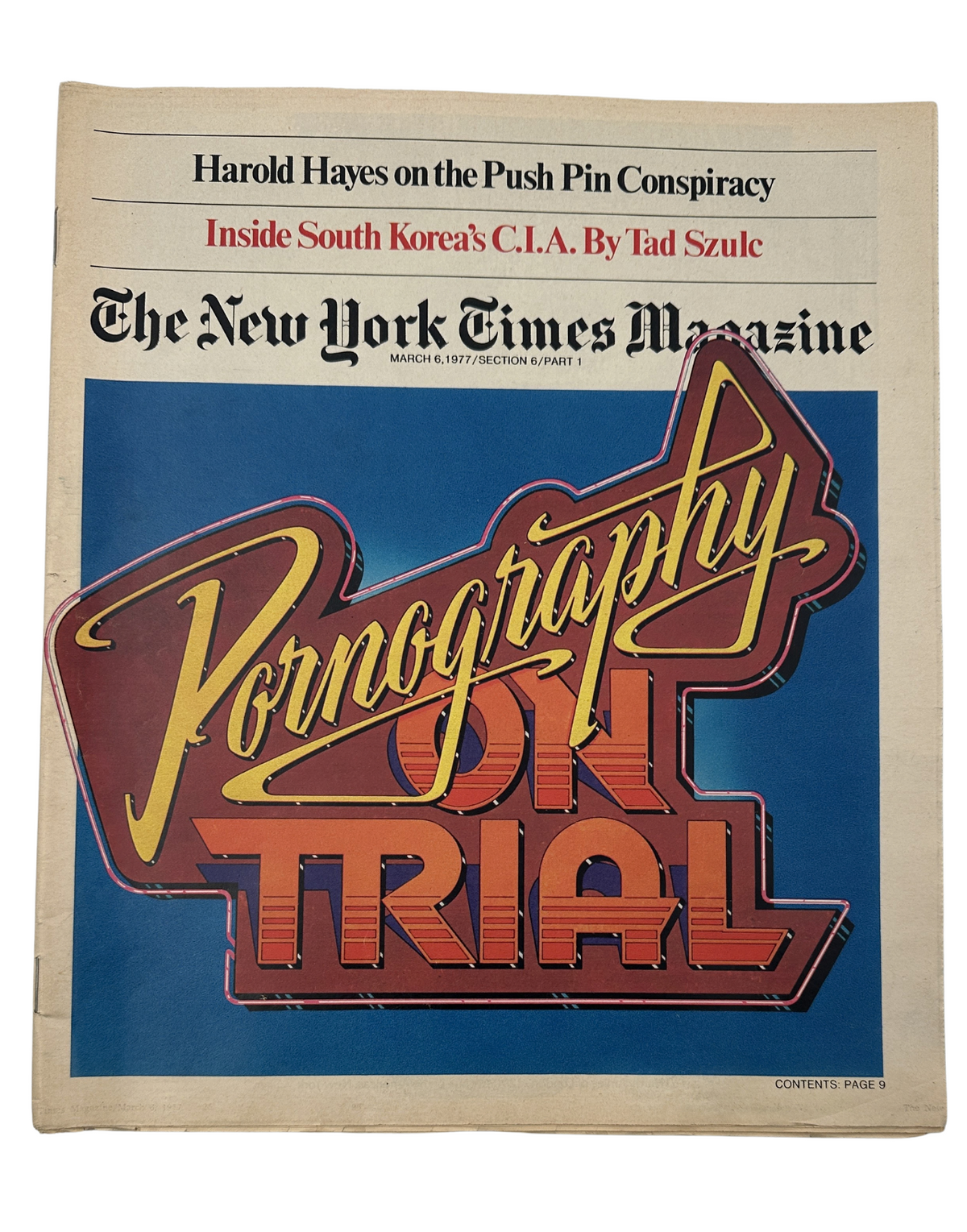


Description
Collector's Note – Why This Issue Matters
The March 6, 1977 issue of The New York Times Magazine is a document of one of the most consequential and genuinely unresolved constitutional debates in American legal history — and it arrives at a moment when that debate had reached a particular intensity that the magazine's editors clearly recognized as historically significant. The cover story on pornography on trial engages directly with the aftermath of the Supreme Court's 1973 decision in Miller v. California, which had attempted to resolve the seemingly intractable question of how to define obscenity under the First Amendment by pressing the determination back to local community standards. Far from settling the matter, the Miller decision had created a new layer of confusion and litigation across the country, as local prosecutors in communities with conservative moral standards attempted to apply the ruling aggressively, while civil libertarians and First Amendment advocates argued that community standards were an inherently unstable and dangerous basis for determining the limits of protected speech. By early 1977, the "potentially landmark trials" referenced in the cover description were demonstrating in concrete, consequential terms just how far the Miller framework had failed to provide the clarity its authors had intended. For collectors building around New York Times Magazine issues with a focus on American legal and constitutional history, this cover story represents exactly the kind of primary document that captures a major legal controversy at its most actively contested and unresolved moment.
The specific articles assembled in this issue demonstrate an editorial ambition that goes well beyond any single legal controversy. The cover story itself is approached from multiple angles — Ted Morgan's "United States Versus The Princes of Porn" provides the ground-level legal narrative of the prosecutions actually underway, while Richard Neville's "Has the First Amendment Met Its Match?" frames the broader constitutional stakes with the kind of pointed analytical directness that the Times Magazine at its best could deliver to an educated general readership. Harold T. Hayes's "The Push Pin Conspiracy" adds a further dimension by engaging with the visual and graphic arts world that was inevitably caught in the crossfire of any serious debate about the regulation of images. Taken together, these three pieces constitute a genuinely comprehensive treatment of the pornography debate from legal, cultural, and artistic perspectives simultaneously — the kind of multi-angle editorial approach that distinguished the Times Magazine from more narrowly focused publications. The CIA piece by Tad Szulc — "Inside South Korea's CIA" — adds a second major investigative thread to an already substantive issue, arriving at a moment when American intelligence agencies were under intense public and congressional scrutiny following the Church Committee revelations of 1975 and 1976. For collectors focused on magazines from 1977, this single issue manages to document two of the most significant ongoing controversies in American public life simultaneously.
The broader cultural context of March 1977 is worth appreciating in full. Jimmy Carter had been inaugurated as president just six weeks earlier, bringing to Washington an administration that had campaigned explicitly on restoring trust in government institutions after Watergate and on a more morally serious approach to public life — a posture that made the ongoing debates about pornography, community standards, and the limits of federal authority feel particularly charged. The civil liberties questions at the center of the cover story were not abstract in 1977; they intersected directly with the question of what kind of country America wanted to be in the post-Watergate, post-Vietnam moment, and who got to decide. The Times Magazine's decision to devote its cover to this debate in the first weeks of the Carter era was a deliberate editorial statement about what questions the new America needed to reckon with. That Jorge Luis Borges — one of the twentieth century's most celebrated literary figures — contributed the Endpaper piece to this same issue adds a further dimension of cultural distinction that collectors of literary periodicals will also recognize and appreciate.
About the Publication
The New York Times Magazine was established as the Sunday supplement to The New York Times and had, by the mid-twentieth century, evolved into one of the most influential and widely read general-interest magazines in American journalism. Unlike standalone newsweeklies, the Times Magazine benefited from the institutional authority and journalistic infrastructure of the most respected newspaper in the country, which gave its long-form features and investigative pieces a credibility and reach that most independent magazines could not match. Its audience in 1977 was the educated, civically engaged readership of the Times itself — professional, urban, nationally distributed despite its New York base, and accustomed to a standard of writing and reporting that assumed both intelligence and genuine curiosity about the world. The magazine's format in this era combined a major cover story with a range of shorter features, cultural coverage, food writing, design, and the crossword puzzle that had become one of the most beloved fixtures in American newspaper culture. Its contributors in the 1970s included some of the most distinguished journalists, critics, and essayists working in the English language, and individual issues from this period regularly assembled writing of a quality that has aged considerably better than most contemporary journalism. The March 6, 1977 issue, with its roster of contributors including Ted Morgan, Richard Neville, Tad Szulc, Craig Claiborne, Joyce Maynard, Stefan Kanfer, and Jorge Luis Borges, is a strong representative example of the magazine at this level of editorial ambition.
Key Highlights Inside
- "Pornography on Trial" cover feature (page 15, illustrations by Gerard Huerta): The cover story engages directly with the constitutional crisis created by the Supreme Court's 1973 Miller v. California decision and the wave of obscenity prosecutions it generated. The cover framing — asking how pornography can be curbed without destroying essential freedoms of speech and press — captures with precision the genuine dilemma at the center of the debate, one that has never been fully resolved in American law.
- "United States Versus The Princes of Porn" by Ted Morgan (page 16): Morgan's piece provides the ground-level legal narrative of the federal obscenity prosecutions underway in 1977, documenting the cases that the cover description identifies as "potentially landmark." Morgan was one of the period's most accomplished narrative journalists, and his treatment of this subject would have combined legal precision with the kind of human detail that made complex institutional stories accessible to a general readership.
- "Has the First Amendment Met Its Match?" by Richard Neville (page 18): Neville — the Australian author and counterculture figure best known for founding Oz magazine and surviving his own landmark obscenity trial in the United Kingdom in 1971 — brings to this question a personal and intellectual authority that no purely academic commentator could match. His contribution to this issue is particularly notable given his direct experience as a defendant in a major First Amendment case.
- "Inside South Korea's CIA" by Tad Szulc (page 41): Szulc was one of the premier investigative journalists of his generation, and his examination of South Korea's intelligence apparatus arrived at a moment of intense scrutiny of both American and allied intelligence agencies following the Church Committee hearings. This piece adds a major investigative dimension to an already substantive issue and speaks directly to the intelligence-related anxieties that defined American public discourse in the mid-1970s.
- "Ulrike" by Jorge Luis Borges (page 94, Endpaper): The presence of Borges — by 1977 widely regarded as one of the greatest living writers in any language — as the issue's closing Endpaper contributor is a mark of the Times Magazine's editorial reach and literary ambition during this period. A Borges contribution to any periodical is, for collectors of literary magazines and twentieth-century literature, a meaningful point of distinction.
- Additional features: The issue also includes Stefan Kanfer's "Soft-shoe routine" (page 12); "The auction crowd" by Stephen Birmingham (page 38); "The $73,000 abandoned babies" by Susan Jacoby (page 55); Joe Baum food coverage by Raymond A. Sokolov (page 64); Craig Claiborne and Pierre Franey on crepes suzette (page 66); design coverage by Norma Skurka (page 68); and Joyce Maynard on skating (page 70) — together constituting a remarkably complete cross-section of the cultural, culinary, and social preoccupations of educated New York readers in early 1977.
Condition & Rarity
A Very Good condition rating for a nearly fifty-year-old weekly Sunday supplement is a genuinely solid result, and the condition description — light edge wear only, with photos confirming the specific state of the copy — reflects the kind of honest, precise condition reporting that serious collectors rely on. The New York Times Magazine was printed on paper stock of reasonable quality for a newspaper supplement, though not to the archival standards of a premium publication like Life or Fortune — which means that copies surviving in Very Good condition at this age have typically benefited from deliberate storage rather than casual retention. Light edge wear is the expected and acceptable mark of a copy that has been handled and stored over five decades without significant damage; it indicates that the cover, spine, and interior pages have retained their structural integrity and that the reading and display experience remains fully intact. The plastic protective sleeve in which surviving copies of this issue ship is the correct preservation format for a publication of this size and age, providing protection against handling damage, dust accumulation, and the humidity fluctuation that accelerates paper deterioration in periodicals stored without enclosure. For an issue of this specific editorial significance — with a cover story on a major constitutional controversy, a major CIA investigation, and a Jorge Luis Borges literary contribution all in the same issue — condition matters not just for display purposes but because the interior content is as much the collectible as the cover itself, and Very Good condition ensures that all of it remains fully legible and intact.
Looking for More Issues Like This?
A March 1977 New York Times Magazine that combines a landmark First Amendment cover story, a major CIA investigation by Tad Szulc, and an Endpaper by Jorge Luis Borges represents a genuinely unusual convergence of legal, political, and literary significance in a single issue — the kind of combination that makes it interesting to collectors from several different directions simultaneously, and correspondingly harder to find when it surfaces. If this particular issue has already been claimed, the broader New York Times Magazine collection at OriginalMagazines.com spans decades of the supplement's run and regularly includes issues from the 1970s that document the constitutional, political, and cultural debates of the post-Watergate era with the depth and editorial seriousness that the Times brought to American journalism at its best. Collectors with a specific focus on the political and cultural atmosphere of the mid-to-late 1970s will also find the 1977 magazine archive a rich source of primary material — a year that captured America navigating the transition from the disillusionment of the mid-1970s toward the contested moral and political landscape of the decade's end, documented across the full range of American print media with an immediacy that no subsequent historical account can fully replicate.