

Description
Collector's Note – Why This Issue Matters
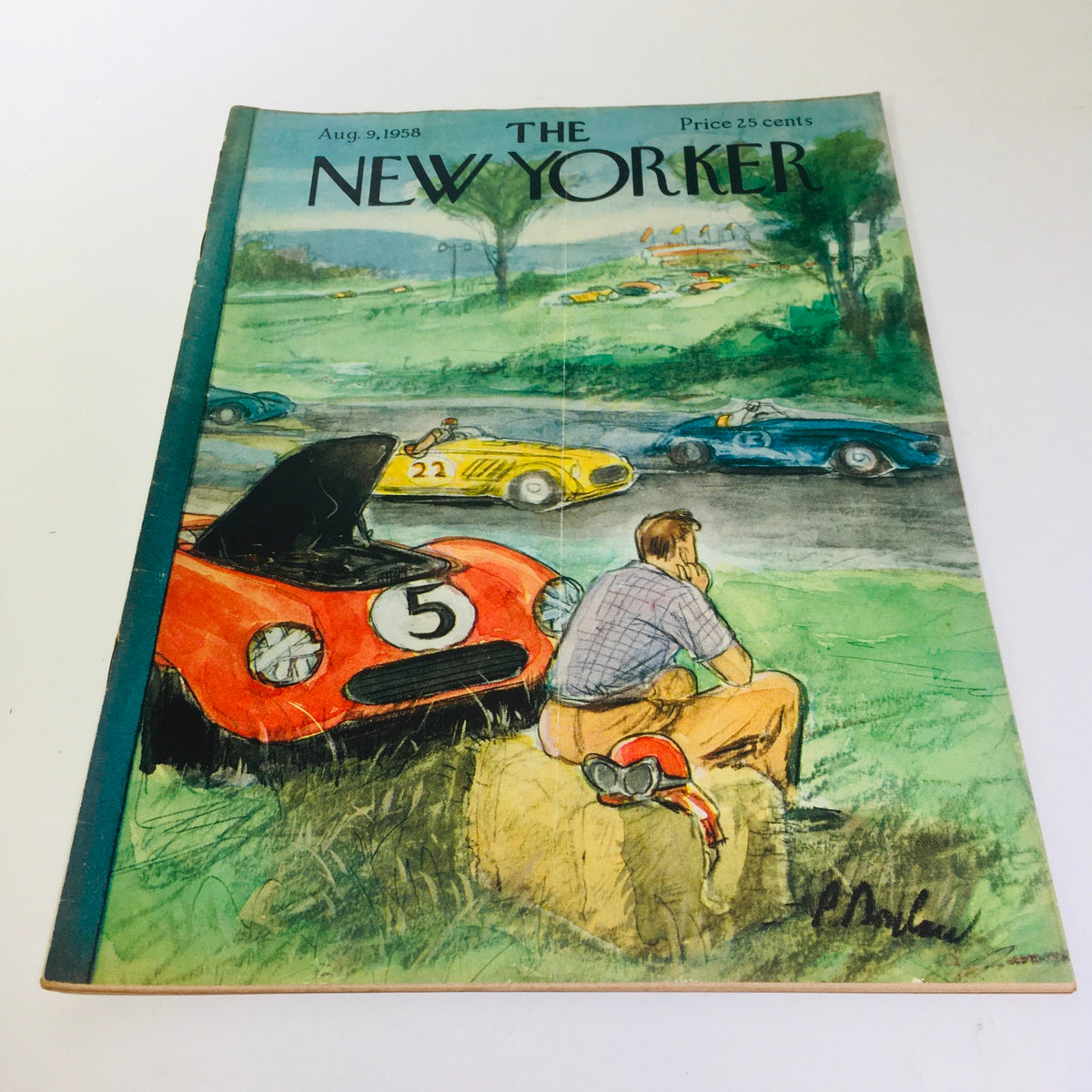
The August 9, 1958 issue of The New Yorker features a cover by Perry Barlow — and an August Barlow cover is one of the more reliably delightful artifacts in the magazine's mid-century visual archive. Barlow had been contributing covers and cartoons to The New Yorker since the late 1920s, making him one of the longest-tenured artists in the magazine's history by the time this issue was published. His work across three decades of covers had established a distinctive visual voice: warmly observed, gently satirical, rooted in the textures of American middle-class life rendered with the kind of affectionate precision that made his scenes feel both specific and universal. An August cover by Barlow would almost certainly have engaged with the summer experience — the particular quality of American leisure in high summer, whether at the beach, in the backyard, or on the road — in ways that his readership recognized and responded to with genuine pleasure. His covers were never aggressive or unsettling; they were the visual equivalent of a perfectly calibrated short story, finding the comedy and humanity in a single observed moment.
August 1958 places this issue at what is now recognized as one of the most artistically distinguished periods in the magazine's long history. William Shawn had been editor since 1952, succeeding founder Harold Ross, and the magazine under his direction was publishing fiction, criticism, and long-form journalism of extraordinary quality — work by writers whose names now constitute a significant portion of the canon of twentieth-century American letters. The late 1950s were a period of cultural ferment that The New Yorker engaged with in its characteristic way: not through overt topicality but through the accumulated intelligence and moral seriousness of its writers' engagement with the world. The magazine was also, in this period, at the height of its commercial success — its combination of literary prestige and affluent readership made it one of the most coveted advertising vehicles in American publishing, and its issues from this era are among the thickest and most content-rich it ever produced. For collectors focused on vintage New Yorker issues from the Shawn era's most creatively fertile years, the 1958 run is essential territory, and a Perry Barlow summer cover is among the more visually appealing entry points into that archive.
The broader American context of August 1958 is worth noting for collectors who approach these issues as historical documents as much as aesthetic objects. The late Eisenhower years were a period of surface prosperity and deep cultural anxiety — the Cold War was at a sustained pitch of tension, Sputnik had been launched less than a year earlier and had fundamentally destabilized American confidence in its technological supremacy, and the civil rights movement was building toward the confrontations of the early 1960s with gathering momentum. The New Yorker of this moment processed those anxieties with characteristic obliqueness — through the quality of its fiction's moral imagination, through the reach and rigor of its long-form reporting, through the very act of attending carefully to the texture of daily life at a time when that texture was under pressure from forces that were not yet fully visible. Among surviving magazines from 1958, issues of The New Yorker reward reading and re-reading in ways that few other publications of the era can match, and Barlow's cover offers an immediate and accessible entry point into a magazine that repays the deeper attention his warmth invites.
About the Publication
The New Yorker, founded by Harold Ross in 1925 and edited by William Shawn from 1952 onward, was by 1958 the most consistently distinguished general-interest literary magazine in America, with a readership that extended far beyond New York City to encompass educated, culturally serious readers across the country and internationally. Its format — fiction, poetry, "Talk of the Town," long-form profiles and reportage, criticism, cartoons, and commissioned cover art — had been refined over more than three decades into something that felt simultaneously entirely stable and continuously vital. The magazine's cover artists, of whom Perry Barlow was among the most beloved and longest-serving, gave The New Yorker an immediately recognizable visual identity built around the principle that a single, wordless illustrated scene could carry as much meaning and give as much pleasure as any of the text inside. Its August issues in particular, arriving in the middle of the American summer, tended toward a lighter tonal register that made Barlow's observational warmth an especially natural fit for the season.
Key Highlights Inside
- Cover illustration by Perry Barlow, one of the longest-serving and most warmly regarded artists in The New Yorker's history, whose summer covers in particular are among the most characteristic and collectible artifacts of the magazine's mid-century visual tradition.
- A complete August 1958 issue from the William Shawn editorial era at one of its most artistically productive moments, containing the full range of the magazine's editorial format: fiction, poetry, "Talk of the Town," long-form profiles or reportage, criticism, and cartoons.
- Period advertising throughout the issue, reflecting the commercial landscape of late-1950s America with the specificity and vividness that New Yorker advertising from this era is known for — a significant number of the era's most prestigious brands advertised exclusively or primarily in its pages, and the ads are period documents in their own right.
- Cartoons from the magazine's mid-century roster of contributors, who collectively represented the highest point of American magazine cartooning and whose individual drawings are independently collected and studied as works of graphic art.
- Note: Specific interior articles, fiction pieces, and named contributors for this issue are unconfirmed beyond what the listing states. Collectors researching the precise editorial contents would benefit from consulting archived New Yorker tables of contents or the magazine's digital archive.
Condition & Rarity
No address label on a New Yorker issue from 1958 is a genuinely meaningful attribute, and it is the less common configuration among survivors from this period — the magazine's subscription-dominant distribution model means that labeled copies vastly outnumber clean newsstand copies in the collector market for any given issue from this era. Good condition with edge wear and possible rips is an honest and realistic assessment for a nearly seventy-year-old staple-bound weekly; the lightweight paper stock The New Yorker used in the late 1950s is prone to tanning, edge brittleness, and surface oxidation over time, and surviving copies in genuinely readable and displayable condition represent the better end of what typically comes to market. The absence of a plastic protective sleeve means the issue has been stored without that additional barrier — a common condition for copies that have spent decades in private collections or bookshelves — and appropriate care in handling is advisable for anyone concerned with long-term preservation. The "full magazine" designation confirms that all pages are present and the cover remains attached, which is always the first completeness check for any issue of this vintage, since New Yorker issues were frequently raided for cartoons, illustrations, or specific articles by original readers who did not anticipate their future value as complete artifacts. When evaluating any surviving copy of this issue, the priority attributes to assess are the color integrity and surface condition of the Barlow cover, the security of the spine staples and the flatness of the binding, the flexibility and tanning level of the interior pages, and the completeness of the page count.
Looking for More Issues Like This?
Perry Barlow covers from the late 1950s are among the most consistently appealing finds in New Yorker collecting — warmly illustrated, seasonally specific, and representative of a visual tradition that the magazine maintained with remarkable consistency across several decades. If this August 1958 issue has already found a home, the New Yorker collection at OriginalMagazines.com regularly surfaces issues from the Shawn era's most productive years and is the best place to continue looking for Barlow covers and late-1950s issues in displayable condition. For collectors with a broader interest in American cultural life during the Eisenhower years, the 1958 magazine collection spans multiple titles and offers a rich cross-section of the year from several different editorial perspectives — well worth exploring if this issue brought you here.