


Description
Collector's Note – Why This Issue Matters
April 11, 1936 places this issue of The New Yorker at a moment of considerable historical and cultural intensity. The spring of 1936 was unfolding against a backdrop of accelerating international crisis — Hitler had remilitarized the Rhineland on March 7, just five weeks before this issue's publication, openly repudiating the Versailles Treaty and exposing the Western powers' unwillingness to enforce it. In the United States, Franklin Roosevelt was in the final year of his first term, and the presidential election of November 1936 was beginning to dominate political conversation. The New Deal had fundamentally reshaped American economic and social policy, and the debates over its direction and constitutional limits were generating the most intense domestic political argument of the decade. For collectors building a serious documentary archive through original magazines from 1936, a mid-April issue captures New York's cultural life at the peak of its spring season, against a political and international backdrop of unusual complexity and urgency.
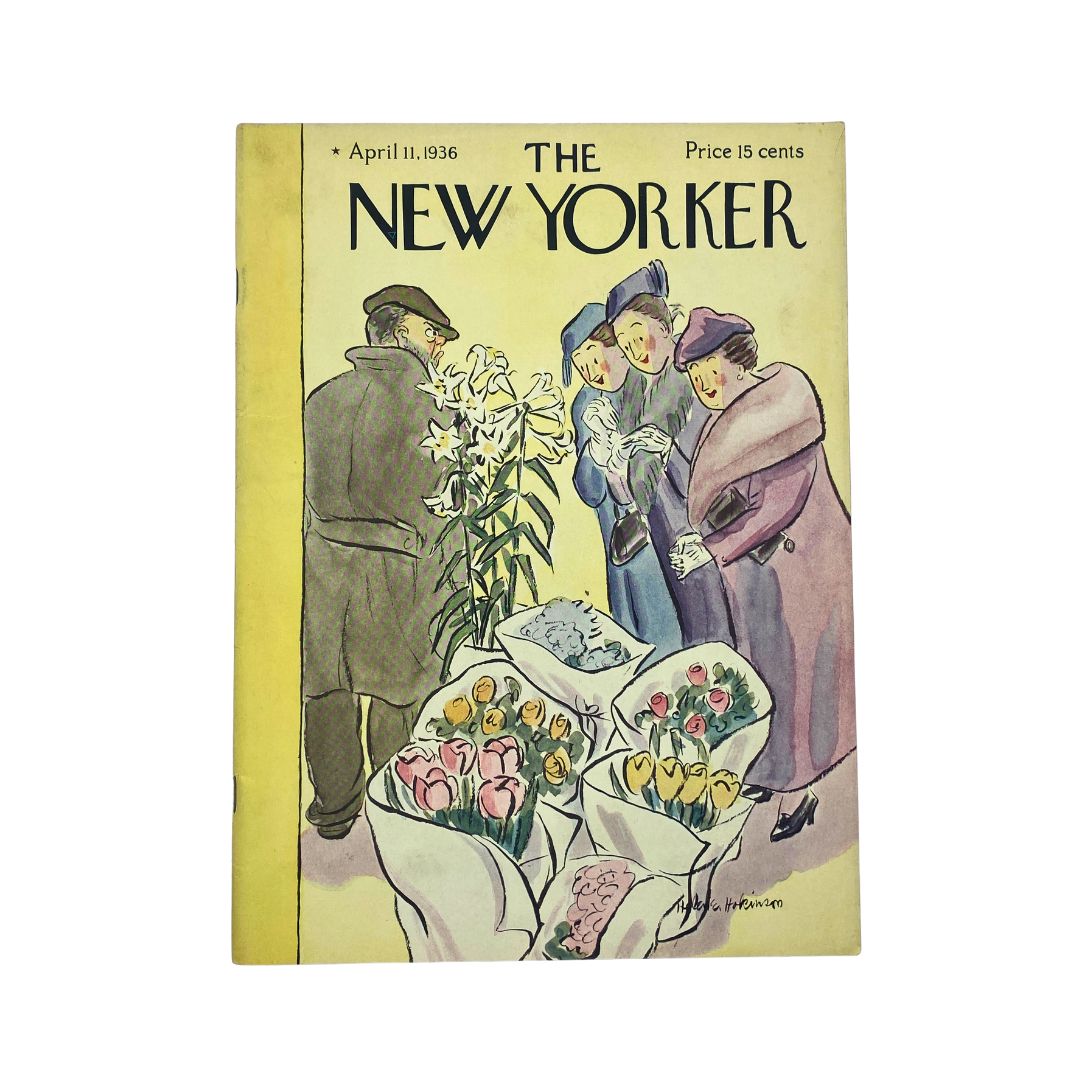
The cover by Helen E. Hokinson makes this issue a particularly distinctive and historically significant object within the magazine's mid-1930s visual archive. Hokinson was one of The New Yorker's most beloved and enduring contributing cartoonists — an artist whose association with the publication spanned from the late 1920s until her death in 1949 and whose "Hokinson women" became one of the most recognizable and affectionately regarded recurring presences in the magazine's visual tradition. Her subject was a very specific and precisely observed type: the well-intentioned, club-going, civically earnest upper-class American woman of a certain age, depicted with a warmth and gentle comedy that was never cruel and always precise. The listing's description of her illustrations as light-hearted yet perceptive captures this balance exactly — Hokinson found the humor in her subjects' self-important earnestness without ever losing her evident affection for them. A Hokinson cover from April 1936 is an artifact of that distinctive and beloved creative vision at the height of its mid-career confidence. For collectors tracing the complete visual history of the publication through original New Yorker issues, Hokinson covers from the mid-1930s represent some of the most warmly regarded and personally distinctive material in the magazine's Depression-era visual archive.
The listing's specific mention that the pages are intact adds a meaningful condition dimension worth noting. For issues from the mid-1930s, page completeness is a primary collector criterion — Depression-era periodicals were not stored with archival intent, and incomplete copies are common enough that intact examples represent a meaningfully better preservation outcome. The combination of Hokinson's beloved artistic presence, the spring 1936 historical context, and intact pages makes this a particularly complete and desirable survivor of its specific date.
About the Publication
Founded in February 1925 by Harold Ross, The New Yorker was by the spring of 1936 a fully established institution of American cultural life, eleven years into its run and operating with the editorial confidence and literary ambition that would define its reputation for generations. Its readership was urban, educated, and expected the combination of wit, critical intelligence, and serious engagement with the world that Ross enforced with unusual editorial discipline. The magazine's format was mature and consistent: "Talk of the Town" commentary opened each issue, followed by reported features, fiction, poetry, and critical reviews spanning theater, books, art, and film, all interwoven with cartoons and spot illustrations that had developed by mid-decade into one of the most celebrated creative traditions in American periodical publishing. Hokinson's contribution to that cartoon tradition was central and beloved — her "Hokinson women" were as recognizable a feature of the magazine's identity as any of its prose.
Key Highlights Inside
- Helen E. Hokinson cover illustration: The cover is the defining collectible and personally distinctive feature of this issue — original artwork by one of The New Yorker's most beloved contributing cartoonists, whose "Hokinson women" — the light-hearted yet perceptive depictions of upper-class American women — became one of the most recognized and affectionately regarded recurring presences in the magazine's visual history.
- Five weeks after the remilitarization of the Rhineland: Published on April 11, 1936 — five weeks after Hitler's remilitarization of the Rhineland on March 7 — this issue appeared in the aftermath of the event that effectively ended the Versailles framework and signaled with unmistakable clarity the direction of German foreign policy.
- Roosevelt presidential election year: The spring of 1936 was the opening of a presidential election campaign that would produce Roosevelt's historic landslide in November — a political atmosphere that pervaded American public life and informed the magazine's commentary and social observation throughout this period.
- Pages intact: The listing specifically notes that the pages are intact — a meaningful positive condition attribute for an issue of this age, where page completeness is a primary collector criterion and incomplete copies are common enough to make fully intact examples genuinely more desirable.
- Spring 1936 New York cultural season: Mid-April issues from this period document the peak of New York's spring theater, gallery, and social calendar — a seasonal rhythm that the magazine tracked with the attentiveness and wit that defined its voice, and that in April 1936 was proceeding against a backdrop of unusual international and domestic urgency.
Note: Specific article titles, bylines, and interior content for this exact issue have not been independently confirmed beyond what appears in the listing. The highlights above reflect only what is verifiable from the cover credit, publication date, condition notes, and the magazine's well-documented editorial format during this period.
Condition & Rarity
A surviving copy of a weekly newsstand magazine from April 1936 presenting in very good condition — with minor edge wear as the only noted imperfection and pages described as intact — is a strong preservation result for a publication now approaching ninety years old. The New Yorker was printed on acidic wood-pulp paper stock standard for weekly periodicals of the era, a material inherently prone to toning, brittleness, and structural degradation over time. Edge wear of the kind described is entirely consistent with honest age and careful storage rather than mishandling or neglect. The specific notation of intact pages distinguishes this from the more typical survival condition for issues of this vintage, where incomplete copies are common enough to make fully intact examples meaningfully more desirable to serious collectors. When evaluating any surviving copy of this issue, the meaningful criteria are the integrity and expressiveness of Hokinson's cover art, the completeness of all interior pages, the absence of subscription label adhesive residue or moisture damage, and the structural soundness of the spine. A copy meeting the full standard described here represents the upper range of what is realistically available for issues from the mid-Depression decade.
Looking for More Issues Like This?
Helen E. Hokinson covers are among the most warmly regarded and personally distinctive objects in the New Yorker collector market — her "Hokinson women" occupy a specific and beloved place in the magazine's visual identity that no other contributor quite replicated — and this specific April 1936 date, at such a charged political and international moment, makes it a particularly complete and meaningful find. If it is no longer available, the extensive original New Yorker collection at OriginalMagazines.com is one of the deepest archives of the magazine accessible to collectors anywhere, spanning many decades of its publishing history. For those drawn to the mid-Depression era at its most historically complex and culturally rich, the full 1936 magazine collection rewards careful and unhurried exploration — it is a year whose historical weight and cultural vitality are present in every issue that has survived to the present day.