

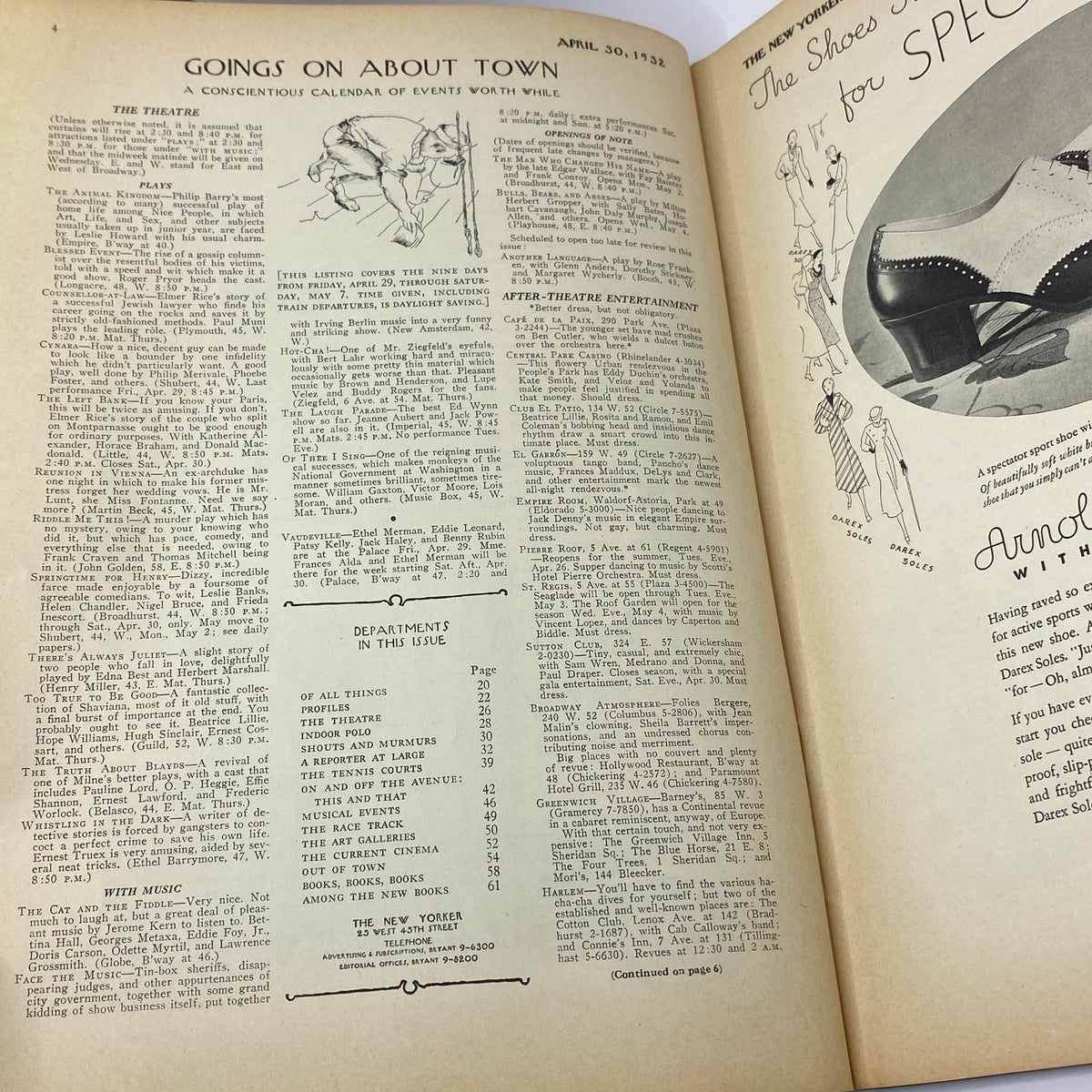
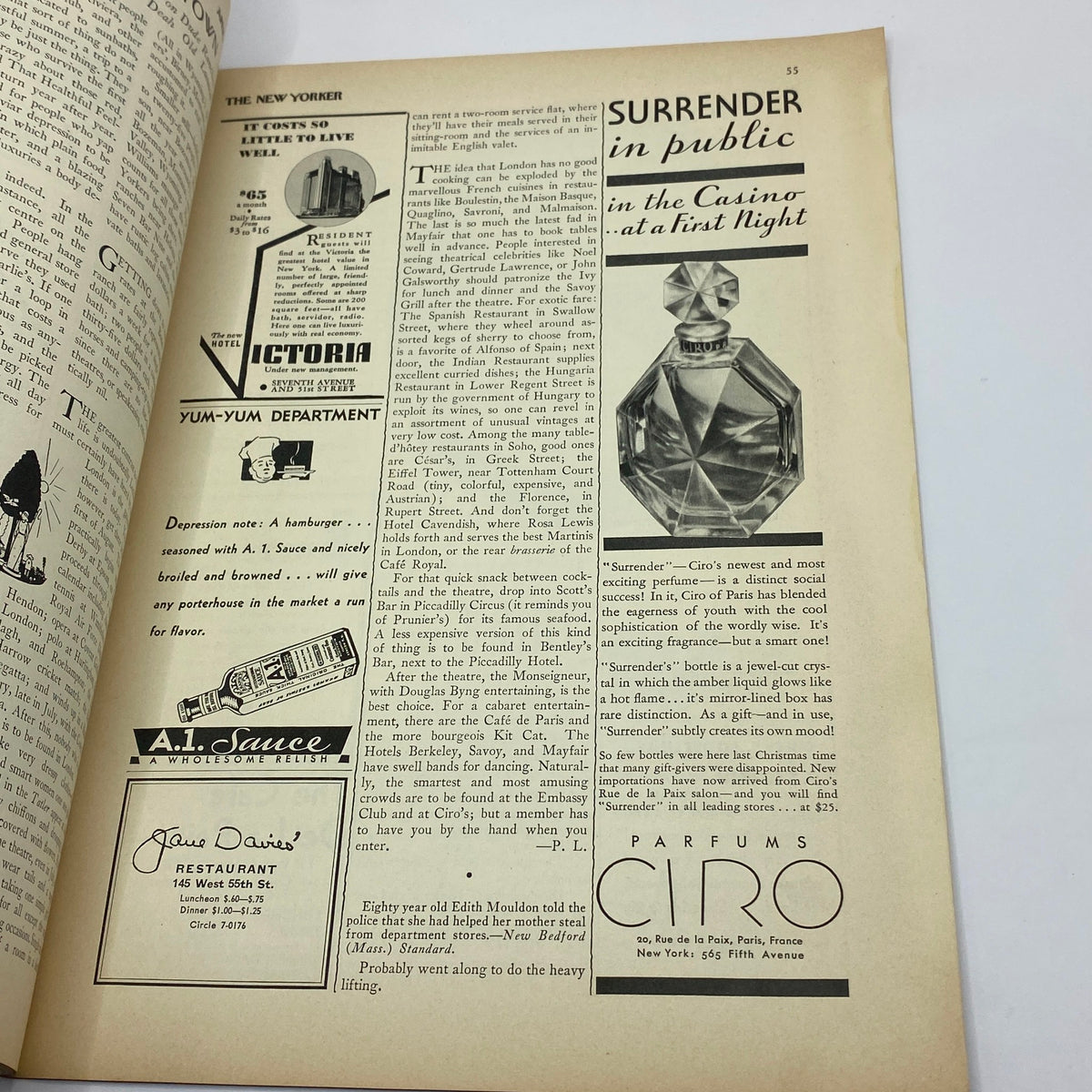


Description
Collector's Note – Why This Issue Matters
The April 30, 1932 issue of The New Yorker featuring a cover by Theodore Haupt arrives in the spring of one of the most consequential years in twentieth-century American history. The Great Depression was at its deepest point: unemployment was approaching its peak, the banking system was under sustained stress, and the presidential election that would bring Franklin Roosevelt to power was six months away. Spring 1932 in New York meant the continuation of bread lines, the proliferation of Hoovervilles in Central Park, and a city whose social geography was being visibly remapped by economic catastrophe. Against this backdrop, The New Yorker's April 30 issue — with its modernist Haupt cover, its fiction, its cartoons, and its urbane critical commentary — functions as a document of how a specific and privileged stratum of New York life maintained its cultural commitments during crisis. That tension between the magazine's characteristic sophistication and the social reality pressing in from outside is part of what makes early-1930s New Yorker issues so historically rich. Collectors building archives of The New Yorker's Depression-era run find that the spring 1932 issues in particular carry an atmospheric charge that is difficult to replicate from any other source.
Theodore Haupt's cover contribution is the visual centerpiece of this issue and warrants attention beyond its decorative function. The listing describes his style as modernist, with bold colors and geometric shapes — an aesthetic vocabulary that connects his New Yorker work to the broader influence of European modernism on American commercial illustration in the late 1920s and early 1930s. The Art Deco movement, Bauhaus-influenced design, and the graphic experimentation of the interwar years were all percolating through American commercial art in 1932, and the New Yorker's cover program under Harold Ross was one of the primary venues through which that aesthetic reached a mainstream educated audience. A Haupt cover from April 1932 is, in that context, a primary document of modernist visual culture reaching the American newsstand — not in a gallery or a design journal, but in a weekly magazine. For anyone assembling a picture of 1932 American print and visual culture, this issue offers a convergence of editorial substance and visual history that serious collectors will recognize immediately.
About the Publication
The New Yorker was founded by Harold Ross in 1925 with an editorial mandate to produce sophisticated urban humor and commentary for a literate, cosmopolitan readership. By April 1932 — seven years into its existence — the magazine had fully consolidated the format and editorial identity that would define it for the rest of the century: a distinctive full-color illustrated cover, "Talk of the Town" commentary, short fiction and poetry, long-form journalism, cultural criticism, and the cartoons and spot illustrations that were as central to its identity as its prose. The early 1930s represent one of the most creatively fertile periods in the magazine's history, with the social pressures of the Depression sharpening the satirical intelligence that had always been its core asset and attracting the most accomplished writers, critics, cartoonists, and illustrators working in America. Issues from 1932 are consistently among the most sought in the magazine's nearly century-long publishing archive.
Key Highlights Inside
- Cover illustration by Theodore Haupt: Haupt's modernist visual approach — described in the listing as bold colors and geometric shapes — connects this cover to the broader influence of European modernist and Art Deco aesthetics on American commercial illustration in the early 1930s, making it a document of visual cultural history as well as a collectible magazine cover.
- Late April 1932 Depression context: Published at the nadir of the Great Depression, approximately six months before the Roosevelt-Hoover election, this issue documents New York cultural life at one of the most economically severe moments in the city's and nation's modern history — a context that permeates the fiction, commentary, and cartoons of any issue produced in this window.
- Complete spring 1932 issue: A complete late-April New Yorker would contain the full range of the magazine's editorial content — fiction, verse, theatre and film criticism, book reviews, "Talk of the Town" commentary, and the cartoons of artists working at what illustration historians consider a particularly rich period for the American magazine cartoon form. Specific authors and titles featured in this issue are unconfirmed beyond the Haupt cover attribution.
- Modernist visual design on the American newsstand: The Haupt cover's geometric, boldly colored modernist aesthetic represents the European design avant-garde filtering into mainstream American commercial publishing — a historically significant moment in the visual culture of the interwar years, preserved in a weekly magazine format.
Condition & Rarity
Very good condition on an April 1932 New Yorker — now approaching its centenary — is a substantive grading claim that requires direct assessment from the listing photographs. The magazine's uncoated interior stock from this era ages to significant tanning under average long-term storage, and lightly toned, structurally stable interior pages in a copy of this age indicate either exceptional original storage conditions or deliberate archival preservation at some point in its history. The cover's coated stock holds color and surface integrity better than interior pages, making the two distinct grading considerations. Complete page integrity is the paramount attribute for any issue from this era: intact, unabridged copies are far less common than partial survivors, since cartoons, cover art, and fiction pages were routinely removed for framing or scrapbooking across the nine decades since publication. When evaluating any surviving copy of this issue, completeness, cover surface condition and color retention, spine attachment, and degree of interior toning are the four primary variables. A genuinely very good, complete copy of a 1932 New Yorker with a visually distinctive modernist cover is an uncommon find by any honest reckoning.
Looking for More Issues Like This?
Complete New Yorker issues from the spring of 1932 in very good condition — particularly those with visually distinctive cover art from the modernist tradition — are among the more demanding and rewarding finds in the vintage magazine hobby, sitting at the intersection of Depression-era cultural history and the visual legacy of interwar American commercial design. If this one has already found a home, the full archive of The New Yorker issues is the essential destination for collectors working through the magazine's remarkable run. The 1932 magazine collection is also worth exploring for anyone building a broader documentary picture of American print and visual culture during one of the most consequential years of the twentieth century.