



Description
Collector's Note – Why This Issue Matters
August 12, 1939 sits at one of the most dramatic fault lines in modern history. Europe was three weeks away from the invasion of Poland that would trigger the Second World War. The Molotov-Ribbentrop Pact — the non-aggression agreement between Nazi Germany and the Soviet Union that shocked the world and cleared Hitler's path westward — was signed just ten days after this issue's cover date, on August 23rd. For American readers picking up The New Yorker that week, the summer still held the surface appearance of normalcy, but the sense of foreboding was unmistakable. An issue dated August 12, 1939 is, in the most literal sense, a document from the last weeks of the prewar world.
The cover was illustrated by Perry Barlow, one of the quiet mainstays of The New Yorker's visual roster during the 1930s and 1940s. Barlow was not a flashy presence in the magazine's art history — he worked in the tradition of warm, closely observed domestic comedy, capturing the minor absurdities of middle-class American life with an affectionate precision that suited the magazine's particular sensibility perfectly. His covers tend to reward the kind of unhurried attention that the best New Yorker illustration has always demanded. For collectors building a thorough record of New Yorker cover art across the magazine's prewar decades, Barlow's contributions represent a distinct and underappreciated thread in that larger tapestry.
August issues of The New Yorker from the late 1930s carry a specific texture that winter and spring issues do not. The magazine reflected its city's rhythms, and August was the height of the New York summer — a season the publication treated with its own particular brand of wry observation. That seasonal quality, combined with the extraordinary historical pressure of this specific August, makes the August 12, 1939 issue a more layered artifact than its modest cover subject might initially suggest. For anyone assembling a collection around American print culture from the last year of peace, this issue occupies a position that no other date in the magazine's run can replicate.
About the Publication
The New Yorker, founded in 1925 by Harold Ross, was by August 1939 the unquestioned standard-bearer of American literary magazine publishing. Its weekly format brought together original cover art, cartoons, fiction, poetry, criticism, and the "Talk of the Town" section in a package aimed squarely at the educated, culturally engaged urban reader. The magazine made no apologies for its sophistication and considerable demands on its audience — a stance that, paradoxically, gave it a loyal and expanding readership throughout the Depression years. By the late 1930s, its contributors included E.B. White, James Thurber, A.J. Liebling, John O'Hara, and Wolcott Gibbs, among others, and its art department — shaped by founding art editor Rea Irvin — had developed a visual identity that was instantly recognizable and widely imitated. Each weekly issue functioned as a self-contained cultural artifact, and the covers, commissioned from a rotating roster of accomplished illustrators, remain among the most collectible examples of American commercial art from the twentieth century.
Key Highlights Inside
- Cover illustration by Perry Barlow, a regular New Yorker contributor throughout the 1930s and 1940s known for his warmly comic portrayals of American domestic and social life.
- Published August 12, 1939 — three weeks before Germany's invasion of Poland on September 1st and ten days before the Molotov-Ribbentrop Pact, making this one of the final issues of the magazine published in an unambiguously prewar America.
- A summer issue, reflecting the particular editorial and visual texture the magazine brought to the New York August — a season it covered with consistent wit and observational precision throughout the late 1930s.
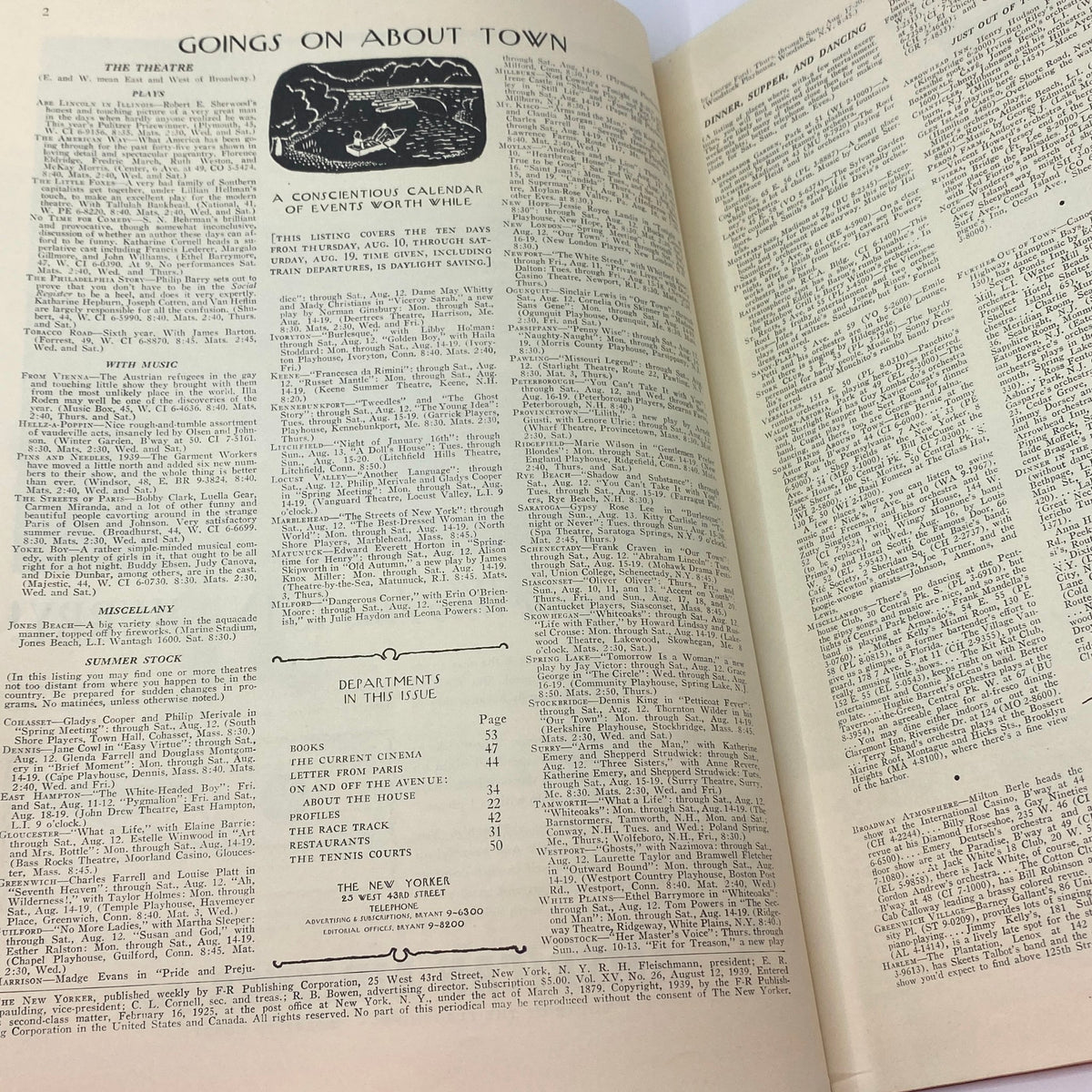
- As a complete issue, it preserves the full editorial and advertising record of its date, including the cartoons, fiction, criticism, and period commercial content that collectively document American cultural life at this precise moment.
- Note: Specific interior articles, fiction, and features for this issue have not been confirmed from available listing details. Complete interior contents would require direct examination of a surviving copy.
Condition & Rarity
Surviving copies of this issue are graded Very Good — a strong designation for a magazine now approaching ninety years of age. Minor edge wear is noted, which is entirely consistent with a publication of this vintage and does not compromise the Very Good grade provided the cover art remains clean and unobscured, the spine is intact, and the interior pages show no significant brittleness, toning, clipping, or moisture damage. For periodicals from the late 1930s, the primary condition concerns are paper stability — the wood-pulp stock used by The New Yorker in this era is inherently acidic and vulnerable to environmental deterioration over time — and cover integrity, which is the first point of evaluation for any collector. A complete, unclipped issue with no address label compromising the cover illustration represents the optimal surviving form for a magazine of this age and type. Copies that have been stored away from sustained heat, light, and humidity tend to retain their structural and chromatic integrity significantly better, and it is that subset of survivors that constitutes the true collector-grade pool for 1939 issues of this publication.
Looking for More Issues Like This?
A complete Perry Barlow cover from August 1939 — the last summer before the war — is a specific enough target that it doesn't surface in collectible condition with any regularity. If this one has found a home, the New Yorker archive at OriginalMagazines.com is the most comprehensive single-title resource available for tracking down issues from the magazine's prewar run, and it's worth checking back as inventory turns over. The 1939 magazine collection is also a strong resource for collectors building across publications from that pivotal year — one of the richest and most historically charged in the entire twentieth-century American press record.