

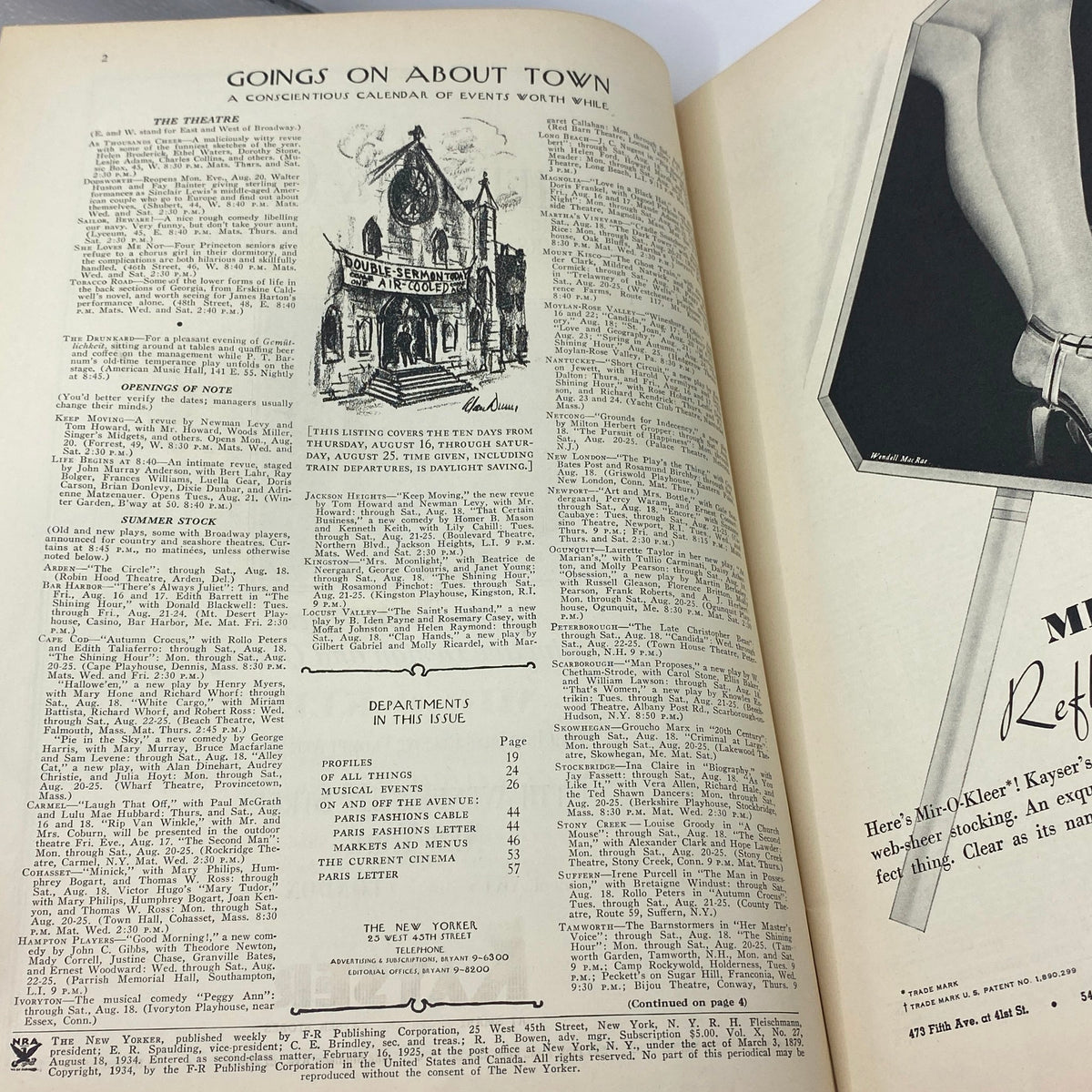


Description
Collector's Note – Why This Issue Matters
August 18, 1934 places this issue of The New Yorker at a specific and historically significant moment in the mid-Depression decade. The summer of 1934 was one of the most politically consequential of the entire 1930s — in Germany, Hitler had assumed the title of Führer just two weeks earlier on August 2, following the death of President Hindenburg, consolidating absolute power in a single figure for the first time and removing the last constitutional check on Nazi rule. In the United States, the midterm elections of November 1934 were approaching, and the New Deal was the dominant subject of political debate, with Roosevelt's program generating fierce opposition from both the left and the right. New York in the summer of 1934 was a city simultaneously energized by cultural activity and shadowed by economic hardship, producing the particular atmosphere of determined vitality against adversity that characterized Depression-era Manhattan at its most characteristic. For collectors assembling a serious historical archive through original magazines from 1934, a mid-August issue carries exceptional historical weight — published in the fortnight immediately following Hitler's assumption of absolute power in Germany, a development whose implications were not lost on the attentive, internationally minded readership that The New Yorker had always assumed it was addressing.
The cover by Ilonka Karasz makes this issue a particularly distinguished object within the magazine's visual archive. Karasz was one of the most formally accomplished and historically significant artists ever to contribute cover work to The New Yorker — a Hungarian-American modernist whose background in the European design tradition set her apart from virtually all of her contemporaries at the magazine. She brought to her covers a formal intelligence shaped by Central European modernism, resulting in work that was bolder, more abstract, and more design-forward than the social observation humor that characterized most of the magazine's other cover artists of this period. Her contributions to The New Yorker spanned from the late 1920s through the 1960s, making her one of the longest-serving cover artists in the publication's history, and her work from the mid-1930s represents a particularly vital phase of her engagement with the magazine's format. A Karasz cover from August 1934 is an artifact of European modernist design sensibility operating within one of the most prestigious editorial contexts in American publishing. For collectors tracing the complete visual history of the publication through original New Yorker issues, her covers from this decade are among the most formally interesting and least widely recognized treasures in the magazine's long visual archive.
The intersection of Karasz's modernist aesthetic and the specific historical moment of August 1934 gives this issue a layered quality worth dwelling on. A cover defined by formal innovation and artistic confidence, produced in the same fortnight that witnessed the final consolidation of Nazi totalitarianism in Germany — with all that implied for the European modernist tradition from which Karasz herself had emerged — is a document that rewards attention from multiple angles simultaneously. That complexity is precisely what makes issues from this specific summer among the most interesting in the magazine's Depression-era archive.
About the Publication
Founded in February 1925 by Harold Ross, The New Yorker was by the summer of 1934 a fully established institution of American cultural life, operating with the editorial confidence and literary ambition that would define its reputation for generations. Its readership was urban, educated, and expected the combination of wit, intellectual seriousness, and serious engagement with the world that Ross enforced with unusual editorial discipline. The magazine's format was mature and consistent: "Talk of the Town" commentary opened each issue, followed by reported features, fiction, poetry, and critical reviews spanning theater, books, art, and film, all interwoven with cartoons and spot illustrations that had developed by mid-decade into one of the most celebrated traditions in American periodical publishing. Covers were individually commissioned works of illustration and design, produced by a rotating roster of contributing artists whose collective Depression-era output constitutes a remarkable visual record of American cultural life during one of its most complex and creative periods.
Key Highlights Inside
- Ilonka Karasz cover illustration: The cover is the defining artistic and collectible feature of this issue — original work by one of the most formally distinguished and historically significant artists in The New Yorker's cover archive, a Hungarian-American modernist whose design sensibility was shaped by the European tradition and whose covers stand apart from virtually all of her contemporaries at the magazine.
- Hitler assumes absolute power: Published two weeks after Hitler's assumption of the title of Führer on August 2, 1934 — the event that completed the Nazi consolidation of power in Germany — this issue appeared at a moment whose international implications were fully visible to the magazine's attentive, internationally minded readership.
- New Deal midterm summer: The summer of 1934 was defined domestically by the approaching midterm elections and the intensifying debate about the New Deal's direction and constitutional limits — a political atmosphere that pervaded the magazine's commentary and cultural observation throughout this period.
- Mid-Depression New York cultural life: By August 1934, New York's cultural institutions had adapted to Depression conditions with the resilient vitality that characterized the decade, and The New Yorker's summer editorial content reflected that adaptation with characteristic wit and precision.
- Period cartoons and advertising: Issues from the mid-1930s are consistently valued by collectors and cultural historians for the cartoons, spot illustrations, and advertising that together provide an irreplaceable record of everyday life, consumer culture, and social observation in Depression-era New York.
Note: Specific article titles, bylines, and interior content for this exact issue have not been independently confirmed beyond what appears in the listing. The highlights above reflect only what is verifiable from the cover credit, publication date, and the magazine's well-documented editorial format during this period.
Condition & Rarity
A surviving copy of a weekly newsstand magazine from August 1934 presenting in very good condition — with minor edge wear as the only noted imperfection and charm and character described as intact — is a genuinely strong preservation result for a publication now approaching ninety years old. The New Yorker was printed on acidic wood-pulp paper stock standard for weekly periodicals of the era, a material inherently prone to toning, brittleness, and structural degradation over time. Issues from the mid-1930s represent some of the oldest surviving material in the magazine's collector market, and the attrition of nine decades means that well-preserved copies from this period are meaningfully less common than equivalent grades from the postwar years. Edge wear of the kind described is entirely consistent with honest age and careful storage rather than mishandling. When evaluating any surviving copy of this issue, the meaningful criteria are the integrity and color fidelity of Karasz's cover art — her formally complex, design-forward covers are particularly sensitive to fading and toning — the completeness of all interior pages, the absence of subscription label adhesive residue or moisture damage, and the structural soundness of the spine. A copy meeting the standard described represents the preservation grade that serious collectors of Depression-era periodicals actively pursue.
Looking for More Issues Like This?
Ilonka Karasz covers from the mid-1930s are among the most formally distinguished and historically resonant objects in the entire New Yorker collector market, and this specific August 1934 date — arriving in the immediate aftermath of Hitler's assumption of absolute power — makes it a find of unusual depth and significance. If it is no longer available, the extensive original New Yorker collection at OriginalMagazines.com is one of the deepest archives of the magazine accessible to collectors anywhere, spanning many decades of its publishing history. For those drawn to the particular complexity of the Depression years, the full 1934 magazine collection rewards patient and careful exploration — it is a year that sits at the precise midpoint of the 1930s, and every issue that has survived from it carries the full weight of that position.