


Description
Collector's Note – Why This Issue Matters
August 22, 1936 places this issue of The New Yorker at one of the most historically charged moments of the entire interwar period. The Berlin Olympics had concluded just days earlier — the Games had closed on August 16 — after two weeks of international attention that had simultaneously showcased Nazi Germany's propaganda ambitions and witnessed Jesse Owens's four gold medals, one of the most celebrated athletic performances in history. The Spanish Civil War was in its fifth week, having begun on July 17-18, and was already drawing international volunteers, including many American writers and intellectuals closely associated with The New Yorker. Franklin Roosevelt's landslide re-election campaign was in full swing ahead of November's historic vote. The summer of 1936 was, in retrospect, one of the most event-saturated and historically consequential of the decade. For collectors building a serious documentary archive through original magazines from 1936, a late August issue from this year captures the precise intersection of the Olympic aftermath, the opening weeks of the Spanish Civil War, and the height of the presidential campaign — a convergence of historical events that gives this specific date an unusual density of significance.
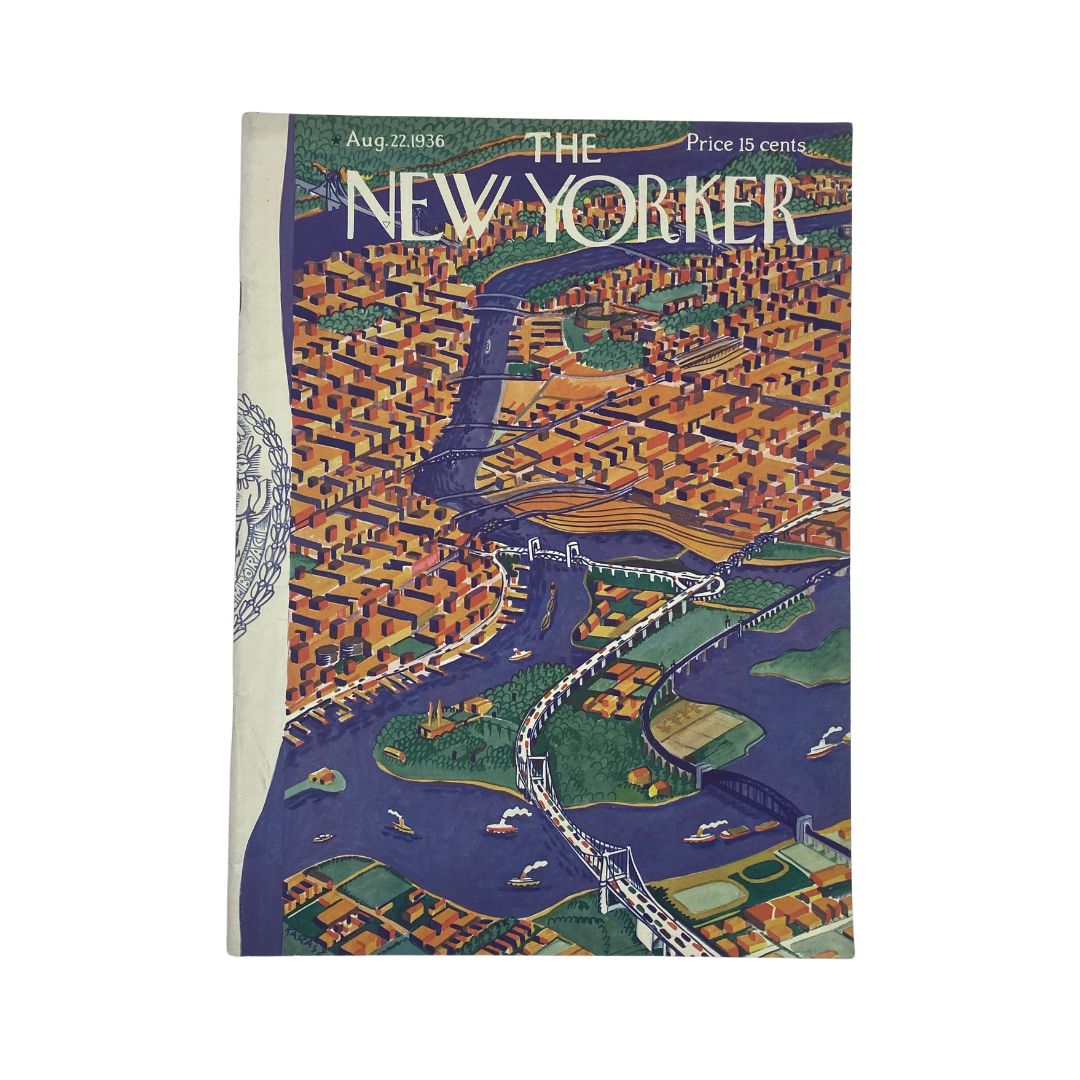
The cover by Ilonka Karasz makes this issue among the most formally distinguished and historically significant in the magazine's mid-1930s visual archive. The listing notes that Karasz created over 180 covers for The New Yorker throughout her career — a figure that, if accurate, would make her one of the most prolific cover contributors in the publication's history, and that in any case reflects a creative partnership of extraordinary duration and depth. Karasz was a Hungarian-American modernist whose background in Central European design gave her covers a formal sensibility unlike that of virtually any of her contemporaries at the magazine — bold, geometrically inventive, more design-forward than illustrative, carrying the influence of the modernist movements she had absorbed before emigrating. Her work for The New Yorker spanned from the late 1920s through the 1960s. An August 1936 cover is from the productive heart of that long tenure — mature, confident, and formally accomplished. For collectors tracing the visual history of the publication through original New Yorker issues, Karasz covers from this specific mid-decade period represent some of the most visually distinctive and historically layered material in the magazine's entire archive.
The Hungarian-American dimension of Karasz's biography carries an additional resonance for this specific date. The Central European modernist tradition she embodied was under visible and accelerating pressure from the same regime whose propaganda the Berlin Olympics had just been used to stage. A Karasz cover from the week after the Berlin Olympics closed — at the opening of the Spanish Civil War, at the height of the American presidential summer — is a document that rewards attention from multiple historical perspectives simultaneously.
About the Publication
Founded in February 1925 by Harold Ross, The New Yorker was by the late summer of 1936 a fully established institution of American cultural life, eleven years into its run and operating with the editorial confidence and literary ambition that would define its reputation for generations. Its readership was urban, educated, and expected the combination of wit, critical intelligence, and serious engagement with the world that Ross enforced with legendary editorial discipline. The magazine's format was mature and consistent: "Talk of the Town" commentary opened each issue, followed by reported features, fiction, poetry, and critical reviews spanning theater, books, art, and film, all interwoven with cartoons and spot illustrations that had developed by mid-decade into one of the most celebrated creative traditions in American periodical publishing. Covers were individually commissioned works of illustration, and Karasz's contributions — among the most formally ambitious in the publication's history — were a central strand of its visual identity across four decades.
Key Highlights Inside
- Ilonka Karasz cover illustration: The cover is the defining collectible and artistically significant feature of this issue — original artwork by one of the most prolific and formally distinguished artists in The New Yorker's history, a Hungarian-American modernist whose Central European design sensibility produced covers unlike those of any other contributor to the publication.
- Six days after the Berlin Olympics closed: Published on August 22, 1936 — six days after the Berlin Olympics concluded — this issue appeared in the immediate aftermath of the most politically charged international sporting event of the decade, an event whose propaganda dimensions and athletic drama had dominated global attention for two weeks.
- Fifth week of the Spanish Civil War: By August 22, the Spanish Civil War was five weeks old — the conflict that would become the defining international cause for American intellectuals and writers, many of them closely associated with the magazine, was in its opening phase.
- Roosevelt re-election summer: August 1936 was the height of Roosevelt's re-election campaign ahead of his historic November landslide — a political atmosphere that pervaded American public life and informed the magazine's commentary and social observation throughout the period.
- Mid-career Karasz at full maturity: An August 1936 cover represents Karasz's work approximately a decade into her long association with the magazine — mature, confident, and fully expressive of the modernist design sensibility that made her one of its most visually distinctive contributors.
Note: Specific article titles, bylines, and interior content for this exact issue have not been independently confirmed beyond what appears in the listing. The highlights above reflect only what is verifiable from the cover credit, publication date, and the magazine's well-documented editorial format during this period.
Condition & Rarity
A surviving copy of a weekly newsstand magazine from August 1936 presenting in very good condition — with minor edge wear as the only noted imperfection — is a strong preservation result for a publication now approaching ninety years old. The New Yorker was printed on acidic wood-pulp paper stock standard for weekly periodicals of the era, a material inherently prone to toning, brittleness, and structural degradation over time. Edge wear of the kind described is entirely consistent with honest age and careful storage rather than mishandling or neglect. When evaluating any surviving copy of this issue, the meaningful criteria are the integrity and color fidelity of Karasz's cover art — her geometrically precise, design-forward compositions are particularly sensitive to fading or toning that diminishes the formal clarity of their elements — the completeness of all interior pages, the absence of subscription label adhesive residue or moisture damage, and the structural soundness of the spine. A copy meeting the standard described — visually strong at nearly ninety years of age, with wear confined to the margins — represents the preservation grade that serious collectors of Depression-era and pre-war periodicals, and particularly of Karasz-associated material, actively seek.
Looking for More Issues Like This?
An Ilonka Karasz cover from the week after the Berlin Olympics and the opening of the Spanish Civil War — at the height of Roosevelt's re-election summer — is one of the most historically layered and formally distinguished objects in the mid-1930s New Yorker collector market, and August 22, 1936 is a date whose multiple dimensions of significance reward the collector who takes the time to understand them. If it is no longer available, the extensive original New Yorker collection at OriginalMagazines.com is one of the deepest archives of the magazine accessible to collectors anywhere, spanning many decades of its publishing history. For those drawn to the charged mid-Depression and pre-war years, the full 1936 magazine collection rewards careful and unhurried exploration — it is a year whose historical density and cultural richness are present in every issue that has survived to the present day.