


Description
Collector's Note – Why This Issue Matters
August 31, 1940 is a date that sits at one of the most dramatic and consequential moments of the entire Second World War. The Battle of Britain was at its absolute peak intensity — August 1940 was the month of the Luftwaffe's most concentrated assault on RAF airfields and radar installations, the period that Fighter Command's historians would later identify as the most critical phase of the entire campaign. On August 31 specifically, the RAF suffered some of its heaviest losses of the battle. In the United States, the debate between interventionists and isolationists was reaching a new level of urgency, with the Destroyers for Bases Agreement — trading American destroyers to Britain in exchange for base rights — signed by Roosevelt just two days earlier on August 29. New York in the final days of August 1940 was a city acutely aware that the outcome of the Battle of Britain would determine whether democratic civilization survived in Europe. The New Yorker's editorial staff was among the most attentive observers of that unfolding drama. For collectors building a serious historical archive through original magazines from 1940, a late August issue from this year occupies a position of extraordinary documentary weight — produced at the precise peak of the Battle of Britain, days after a landmark act of American quasi-intervention.
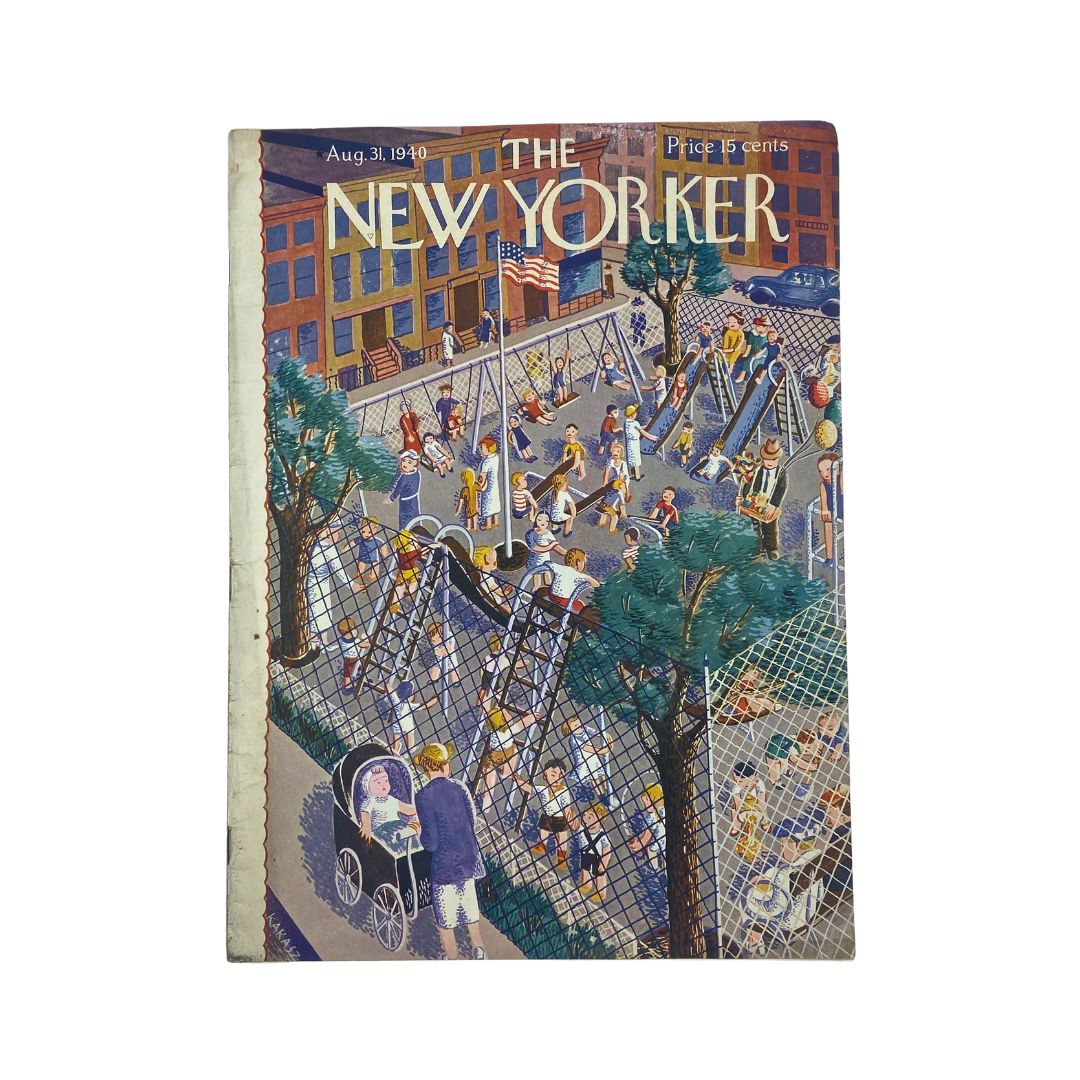
The cover by Ilonka Karasz gives this issue a significance that extends well beyond its historical moment. Karasz was one of the most remarkable figures in The New Yorker's visual history — a Hungarian-American artist and designer whose contributions to the magazine spanned from the late 1920s through the 1960s, making her one of its longest-serving cover artists. Her background was in the European modernist design tradition, and she brought to her New Yorker covers a sensibility shaped by that training — bold, formally inventive, often more abstract and design-forward than the work of her American contemporaries at the magazine. She was also a pioneering figure in American textile and decorative arts, and the formal intelligence she brought to those disciplines informed the visual quality of her magazine work throughout her career. The listing's description of her covers as characterized by vibrant colors and intricate details is consistent with what is documented about her approach. A Karasz cover from August 1940 is an artifact of both her mature artistic vision and a specific and irreplaceable historical moment. For collectors tracing the visual history of the publication through original New Yorker issues, Karasz covers from the wartime period represent some of the most formally distinguished work in the magazine's entire cover archive.
It is also worth noting what a late August issue represents within the magazine's annual publishing rhythm. End-of-summer numbers from this period tend to carry a transitional quality — the lighter editorial register of the summer months giving way to the more intensive engagement of the autumn season — but the summer of 1940 was categorically unlike any that had preceded it. The fall of France in June, the evacuation of Dunkirk, and now the Battle of Britain had compressed an extraordinary amount of historical weight into a single season. Any issue from this specific August carries that compression, and Karasz's formally inventive cover art holds it in productive tension with the magazine's characteristic refusal to sacrifice aesthetic quality even in the darkest of times.
About the Publication
Founded in February 1925 by Harold Ross, The New Yorker was by the late summer of 1940 one of the most editorially distinguished and internationally attentive weekly publications in the English-speaking world. Its readership was urban, educated, and expected the combination of wit, literary quality, and serious engagement with world affairs that Ross enforced with legendary editorial discipline. The magazine's format was fully mature: "Talk of the Town" commentary opened each issue, followed by reported features, fiction, poetry, and critical reviews spanning theater, books, art, and film, all interwoven with cartoons and spot illustrations that had developed into one of the most celebrated creative traditions in American periodical publishing. Covers were individually commissioned works of illustration and design, produced by a rotating roster of contributing artists whose collective wartime output constitutes one of the most visually significant bodies of American periodical art from the twentieth century.
Key Highlights Inside
- Ilonka Karasz cover illustration: The cover is the defining collectible and artistic feature of this issue — original work by one of The New Yorker's longest-serving and most formally distinguished cover artists, a Hungarian-American modernist whose design sensibility set her apart from virtually all of her contemporaries at the magazine.
- Peak of the Battle of Britain: Published on August 31, 1940 — one of the RAF's most costly single days of the entire Battle of Britain campaign — this issue appeared at the precise apex of the most consequential aerial battle in history, the outcome of which was still genuinely uncertain.
- Destroyers for Bases Agreement: Signed by Roosevelt two days before this issue's publication date, the Destroyers for Bases Agreement represented a significant step toward American intervention in the European war — a development whose implications the magazine's editorial staff was positioned to assess with unusual clarity.
- End-of-summer transitional issue: Late August numbers capture The New Yorker at the threshold between its lighter summer register and the more intensive editorial engagement of the autumn season — a transition that in 1940 was taking place against one of the most dramatic backdrops in the magazine's entire publishing history.
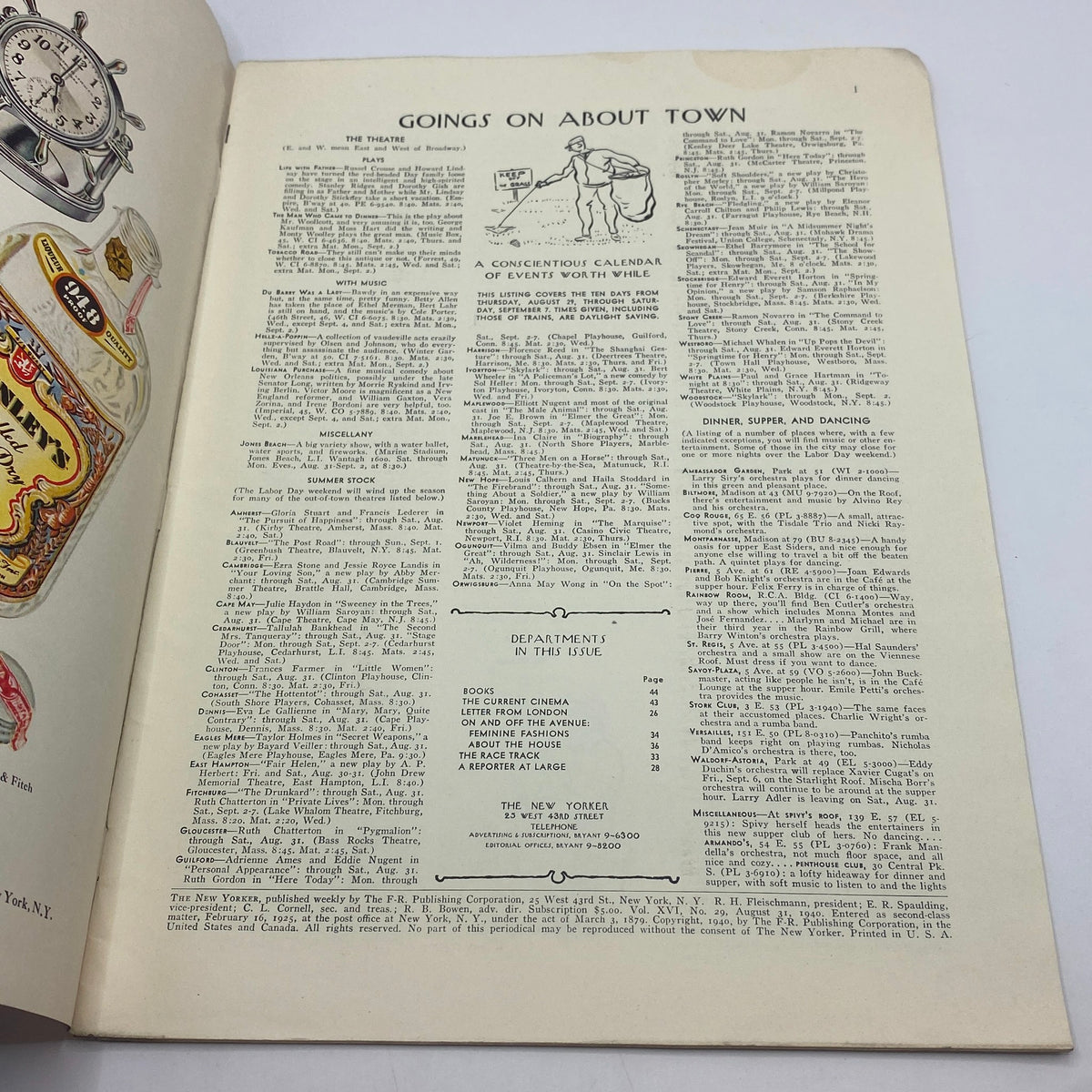
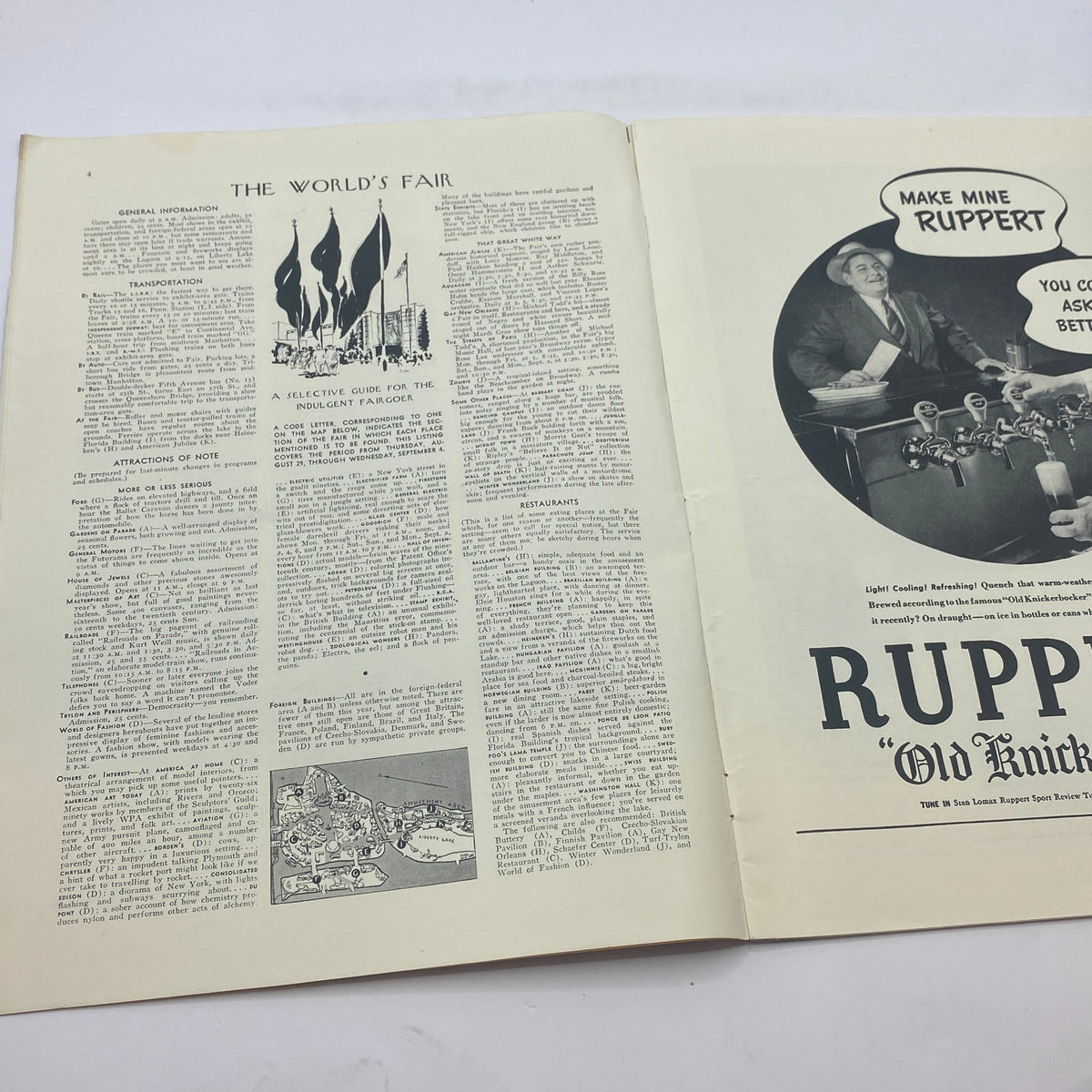
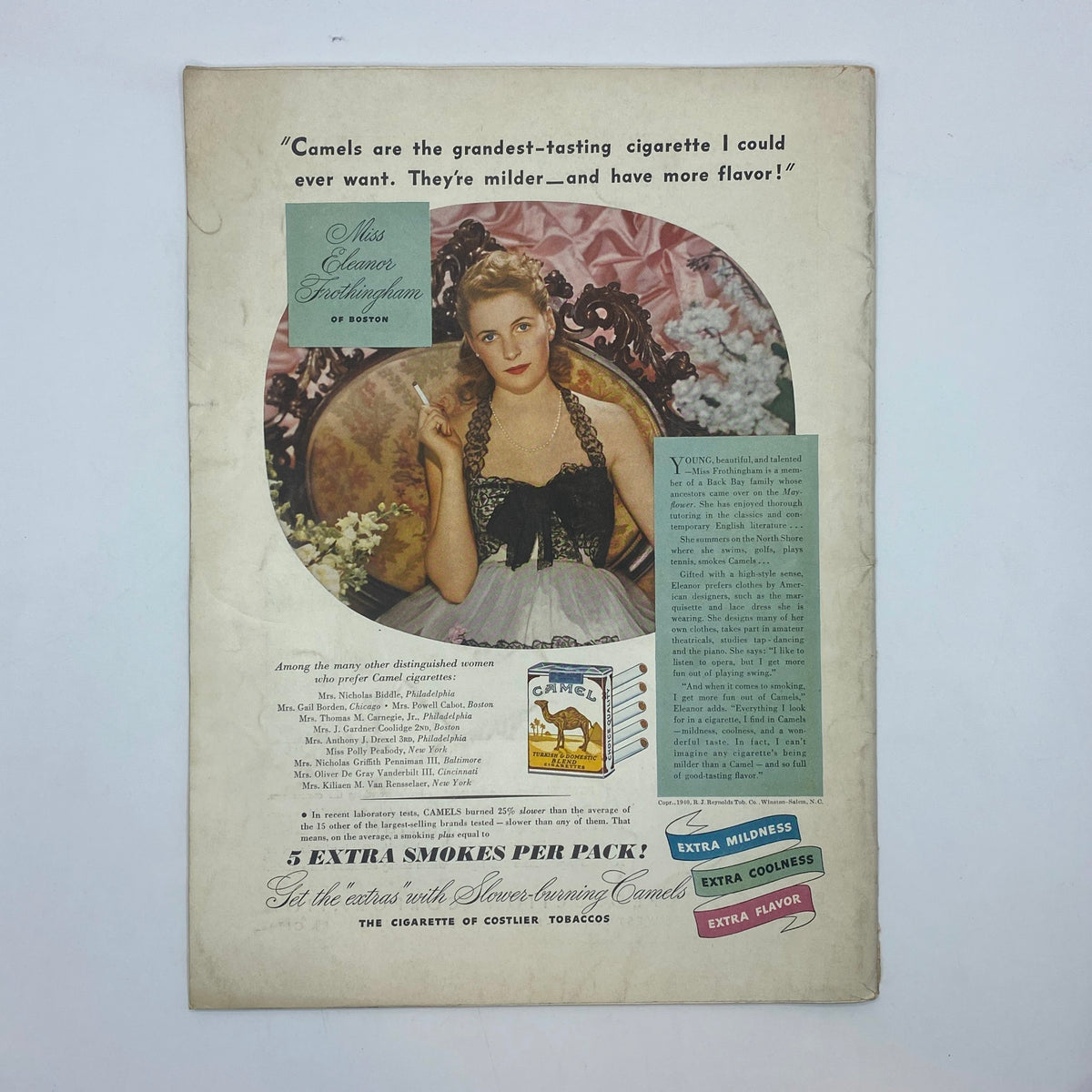
- Period cartoons and advertising: Issues from the late summer of 1940 are among the most historically precise documents of American civilian life available in any periodical format — produced at the exact moment when the question of American entry into the war was most urgently and publicly in debate.
Note: Specific article titles, bylines, and interior content for this exact issue have not been independently confirmed beyond what appears in the listing. The highlights above reflect only what is verifiable from the cover credit, publication date, and the magazine's well-documented editorial format during this period.
Condition & Rarity
A surviving copy of a weekly newsstand magazine from August 1940 presenting in very good condition — with minor edge wear as the only noted imperfection — is a sound and genuinely desirable preservation result for a publication now eighty-five years old. The New Yorker was printed on acidic wood-pulp paper stock standard for weekly periodicals of this era, a material inherently prone to toning, brittleness, and structural fatigue over time. Edge wear of the kind described is entirely consistent with honest age and careful storage. When evaluating any surviving copy of this issue, the meaningful criteria are the integrity and color fidelity of Karasz's cover art — her characteristically vibrant and formally complex covers are particularly sensitive to fading and toning — the completeness of all interior pages, the absence of subscription label adhesive residue or moisture damage, and the structural soundness of the spine. A copy meeting the standard described represents the preservation grade that serious collectors of wartime-era periodicals actively seek, particularly for a cover artist of Karasz's stature and historical significance.
Looking for More Issues Like This?
Ilonka Karasz covers are among the most formally distinguished and historically resonant objects in the entire New Yorker collector market, and this specific August 31, 1940 date — at the peak of the Battle of Britain and days after the Destroyers for Bases Agreement — makes it one of the most precisely significant issue dates in the magazine's wartime archive. If it is no longer available, the extensive original New Yorker collection at OriginalMagazines.com is one of the deepest archives of the magazine accessible to serious collectors, spanning many decades of its publishing history. For those drawn to the charged and irreplaceable atmosphere of this particular summer, the full 1940 magazine collection rewards the most careful and unhurried exploration — it is a year whose historical weight is present in every issue that has survived to the present day.