




Description
Collector's Note – Why This Issue Matters
August 9, 1941 places this issue of The New Yorker at one of the most consequential and psychologically complex moments in modern American history. The United States was four months away from Pearl Harbor, still formally neutral but with that neutrality wearing thinner by the week. The Atlantic Charter — the foundational joint declaration between Roosevelt and Churchill defining Allied war aims — was being drafted at a secret meeting off the coast of Newfoundland on precisely these dates, signed on August 14. The German invasion of the Soviet Union, launched in June, had transformed the war's scale and stakes entirely. American destroyers were already engaged in an undeclared naval war in the Atlantic. The country knew, at some level, that full entry into the conflict was a matter of when rather than whether. The New Yorker of this summer was publishing journalism and commentary of unusual gravity and precision, produced by a staff watching events unfold in real time with the attentiveness of people who understood what they were seeing. For collectors building a documentary archive through original magazines from 1941, issues from this particular August sit at the precise hinge point between American neutrality and American belligerence — a historical threshold that gives every surviving issue from this summer an extraordinary documentary weight.
The cover by Rea Irvin gives this issue a layered significance within the magazine's own institutional story. By August 1941, Irvin had been The New Yorker's founding art editor for sixteen years — the person who designed the masthead typeface that defined the magazine's visual identity, who established the aesthetic conventions of its covers and interior illustrations, and who created Eustace Tilley, the monocled dandy of the inaugural 1925 issue who had become the publication's enduring mascot and cultural emblem. A cover from this late stage of Irvin's active tenure represents the full maturity of that foundational vision, refined across more than a decade and a half of continuous work. For collectors assembling a visual history of the magazine through original New Yorker issues, an Irvin cover from the summer of 1941 — his last full year as the dominant creative force in the magazine's art department before the wartime period began to reshape the publication in more fundamental ways — holds a specific and irreplaceable position in that record.
There is also something worth noting about the particular atmosphere of an August issue from this year. Summer numbers from The New Yorker characteristically carried a somewhat lighter editorial register, but the summer of 1941 was not an ordinary one. The magazine's characteristic blend of cultural observation and sophisticated humor was being produced against a backdrop of mounting international crisis, and the tension between those two registers — the cultivated pleasures of the magazine's usual voice and the gravity of the world it was observing — gives any surviving issue from this summer a quality that is genuinely difficult to locate in any other period of the publication's history.
About the Publication
Founded in February 1925 by Harold Ross, The New Yorker was by the summer of 1941 one of the most editorially distinguished and internationally attentive weekly publications in the English-speaking world. Its readership was urban, educated, and accustomed to the combination of wit, literary quality, and serious journalism that Ross enforced with legendary editorial discipline. The magazine's format was consistent and fully mature: "Talk of the Town" commentary opened each issue, followed by reported features, fiction, poetry, and critical reviews of theater, books, art, and film, all interwoven with cartoons and spot illustrations representing one of the most celebrated traditions in American periodical art. Covers were individually commissioned works of illustration, each a complete artistic statement, produced by a rotating roster of contributing artists whose collective interwar and wartime output constitutes one of the most significant bodies of American periodical art from the twentieth century.
Key Highlights Inside
- Rea Irvin cover illustration: The cover is the defining collectible feature of this issue — original artwork by the magazine's founding art editor, the creator of Eustace Tilley, and the central figure in establishing The New Yorker's visual identity across its first three decades of publication.
- Atlantic Charter week: This issue went to press during the same days that Roosevelt and Churchill were meeting secretly off Newfoundland to draft the Atlantic Charter, signed August 14 — one of the foundational documents of the Allied cause and the postwar international order.
- Final summer of American neutrality: Published four months before Pearl Harbor, this issue captures the magazine's voice at the last full summer of formal American non-involvement in the war — a moment whose end was already clearly visible to the attentive observers The New Yorker employed.
- Irvin's late pre-war cover work: By August 1941, Irvin was in the final chapter of his most active period as the magazine's dominant visual voice — making covers from this year a particularly significant artifact of his contribution to American periodical art.
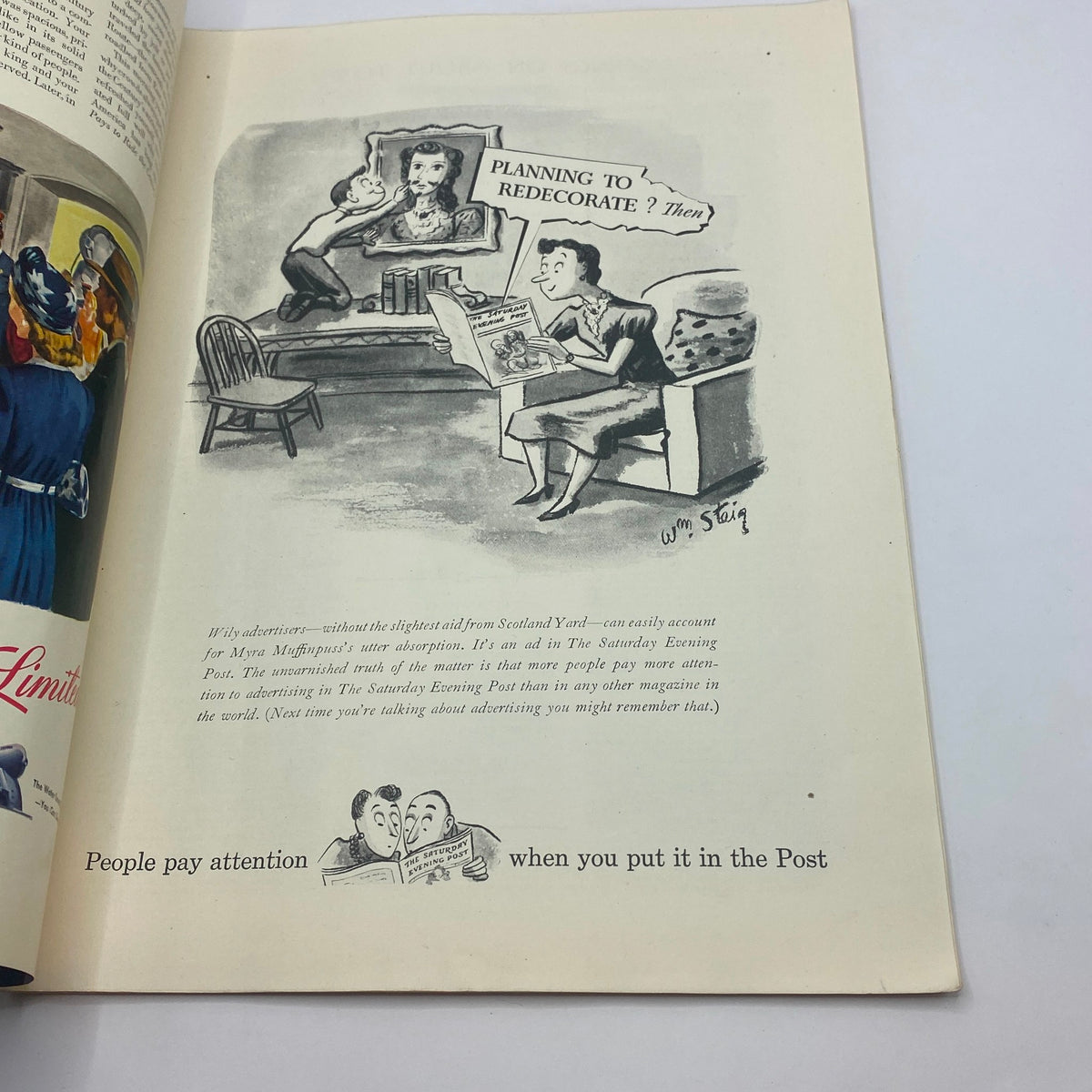
- Period cartoons and advertising: Issues from the summer of 1941 are valued by collectors and cultural historians for the cartoons, illustrations, and advertising that together document American civilian life in the months immediately preceding the country's entry into World War II.
Note: Specific article titles, bylines, and interior content for this exact issue have not been independently confirmed beyond what appears in the listing. The highlights above reflect only what is verifiable from the cover credit, publication date, and the magazine's well-documented editorial format during this period.
Condition & Rarity
A surviving copy of a weekly newsstand magazine from August 1941 presenting in very good condition — with minor edge wear as the only noted imperfection — is a sound and desirable preservation outcome for a publication now more than eighty years old. The New Yorker was printed on acidic wood-pulp paper stock standard for weekly periodicals of this era, a material inherently prone to toning, brittleness, and structural fatigue over time. Edge wear of the kind described is entirely consistent with honest age and careful storage; it does not suggest neglect or mishandling. When evaluating any surviving copy of this issue, the meaningful criteria are the integrity and color fidelity of Irvin's cover art, the completeness of all interior pages, the absence of subscription label adhesive residue or moisture staining, and the structural soundness of the spine. A copy meeting the standard described — visually striking at over eight decades of age, with wear confined to the margins — represents the preservation grade that serious collectors of wartime-era periodicals actively seek.
Looking for More Issues Like This?
Rea Irvin covers from the final pre-war summer are among the most historically resonant objects in the entire New Yorker collector market, and this specific August 1941 date — arriving at such a pivotal moment in American and world history — makes it a particularly meaningful find. If it is no longer available, the extensive original New Yorker collection at OriginalMagazines.com is one of the deepest archives of the magazine accessible to serious collectors, spanning many decades of its publishing history. For those drawn to the charged atmosphere of the months before American entry into World War II, the full 1941 magazine collection rewards careful and unhurried exploration — it is a year whose historical significance deepens the closer you look at any issue that has survived it.