




Description
Collector's Note – Why This Issue Matters
December 10, 1938 is a date that carries one of the most devastating historical contexts of the entire interwar period. The Munich Agreement had been signed on September 30, just ten weeks earlier — the capitulation that handed Hitler the Sudetenland and exposed the Western powers' unwillingness to confront Nazi aggression through anything other than appeasement. Neville Chamberlain had returned to Britain promising "peace for our time," and the hollow nature of that promise was already becoming visible. More immediately and horrifyingly, the Kristallnacht pogrom had taken place on November 9-10 — just one month before this issue's publication — the coordinated Nazi assault on Jewish communities across Germany and Austria that burned synagogues, destroyed businesses, and arrested thousands of Jewish men. The international press had covered it with varying degrees of outrage, and the implications were unmistakable to anyone who had been following events in Germany. For collectors building a serious historical archive through original magazines from 1938, a December 10 issue — published one month after Kristallnacht and ten weeks after Munich — documents the American cultural and editorial moment at one of the most morally charged specific dates in the entire pre-war decade.
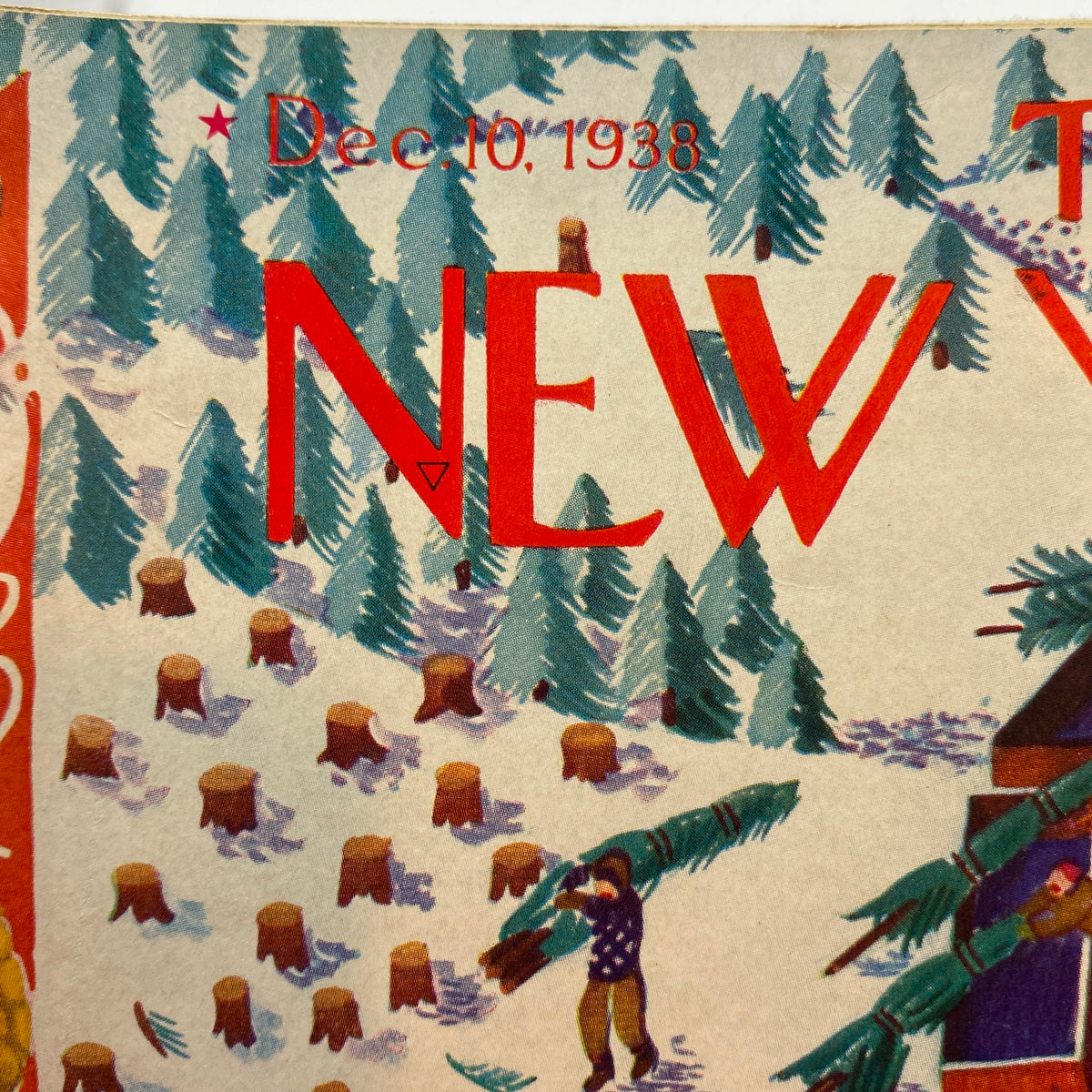
The cover by Ilonka Karasz makes this issue a particularly distinguished and historically resonant object within the magazine's late pre-war visual archive. Karasz was one of the most remarkable artists ever to contribute cover work to The New Yorker — a Hungarian-American modernist whose background in Central European design gave her covers a formal sensibility unlike virtually any of her contemporaries at the publication. The listing's description of her work as blending traditional folk art with geometric patterns in a modernist style captures something important about what distinguished her from other contributors: she brought both the decorative richness of Central European folk traditions and the formal boldness of modernist design movements to her covers, a combination that produced work of unusual visual complexity and cultural depth. A December 1938 cover is additionally significant because it is a Christmas-adjacent number — a seasonal position within the annual publishing calendar that invited Karasz to bring her distinctive blend of folk-derived ornamental sensibility and modernist formal invention to the magazine's holiday visual tradition. For collectors tracing the visual history of the publication through original New Yorker issues, a late December Karasz cover from 1938 represents one of the most layered and historically resonant intersections of artistic vision and documentary significance in the magazine's pre-war archive.
The Hungarian-American dimension of Karasz's biography carries a specific and devastating resonance for December 10, 1938. She had come from a Central European world that was, by the winter of 1938, living under the most extreme pressure. Hungary was within the German sphere of influence. The Jewish communities of Germany and Austria had just survived Kristallnacht. The Central European modernist traditions she had absorbed and brought to America were being systematically destroyed by the same regime whose aggression had been accommodated at Munich six weeks before this issue. A Karasz cover on December 10, 1938 is a document whose biographical, historical, and artistic dimensions are inseparable from one another.
About the Publication
Founded in February 1925 by Harold Ross, The New Yorker was by the winter of 1938 one of the most editorially distinguished and internationally attentive weekly publications in the English-speaking world, thirteen years into its run and operating with full editorial confidence and literary ambition. Its readership was urban, educated, and expected the combination of wit, literary quality, and serious engagement with the world that Ross enforced with legendary editorial discipline. The magazine's format was mature and consistent: "Talk of the Town" commentary opened each issue, followed by reported features, fiction, poetry, and critical reviews spanning theater, books, art, and film, all interwoven with cartoons and spot illustrations representing the full flowering of the magazine's interwar visual tradition. Late December issues were produced with the awareness that they would be given as gifts, kept longer than ordinary weekly numbers, and received as seasonal artifacts as much as current journalism.
Key Highlights Inside
- Ilonka Karasz cover illustration: The cover is the defining collectible and artistically significant feature of this issue — original artwork by one of the most formally distinguished artists in The New Yorker's visual history, a Hungarian-American modernist whose blend of Central European folk art traditions and geometric modernism produced covers of unusual visual complexity and cultural depth.
- One month after Kristallnacht: Published on December 10, 1938 — one month after the Kristallnacht pogrom of November 9-10 — this issue appeared as the international community was absorbing the full horror and implications of the most visible act of Nazi antisemitic violence to that point, an event whose significance was unmistakable to any attentive reader.
- Ten weeks after the Munich Agreement: Published ten weeks after the Munich Agreement of September 30 — the capitulation that handed Hitler the Sudetenland and made war effectively inevitable — this issue appeared as the hollowness of Chamberlain's "peace for our time" was already becoming visible to informed observers.
- Christmas-adjacent seasonal cover: A December 10 issue occupies a position in the magazine's annual calendar just two weeks before Christmas — a seasonal context that invited Karasz to bring her distinctive folk-derived ornamental sensibility to the holiday visual tradition, with results that carry an additional layer of historical poignancy given the events of the preceding weeks.
- Late 1938 pre-war editorial atmosphere: Issues from December 1938 document The New Yorker's editorial voice in the final weeks of a year that had transformed the international situation with devastating speed — Munich in September, Kristallnacht in November — leaving readers and editors alike navigating the implications of what had just occurred.
Note: Specific article titles, bylines, and interior content for this exact issue have not been independently confirmed beyond what appears in the listing. The highlights above reflect only what is verifiable from the cover credit, publication date, and the magazine's well-documented editorial format during this period.
Condition & Rarity
A surviving copy of a weekly newsstand magazine from December 1938 presenting in very good condition — with minor edge wear as the only noted imperfection — is a sound and desirable preservation result for a publication now approaching ninety years old. The New Yorker was printed on acidic wood-pulp paper stock standard for weekly periodicals of this era, a material inherently prone to toning, brittleness, and structural fatigue over time. Edge wear of the kind described is entirely consistent with honest age and careful storage rather than mishandling or neglect. When evaluating any surviving copy of this issue, the meaningful criteria are the integrity and color fidelity of Karasz's cover art — her characteristically complex combinations of folk-derived ornamentation and geometric modernism are particularly sensitive to fading or toning that diminishes the formal precision of her designs — the completeness of all interior pages, the absence of subscription label adhesive residue or moisture damage, and the structural soundness of the spine. A copy meeting the standard described represents the preservation grade that serious collectors of pre-war periodicals, and particularly of Karasz-associated material, actively seek.
Looking for More Issues Like This?
An Ilonka Karasz cover from one month after Kristallnacht and ten weeks after Munich — in the Christmas season of 1938's devastating final chapter — is one of the most historically layered and personally resonant objects in the late pre-war New Yorker collector market, and December 10, 1938 is a date whose multiple dimensions of significance reward the collector who takes the time to understand them fully. If it is no longer available, the extensive original New Yorker collection at OriginalMagazines.com is one of the deepest archives of the magazine accessible to collectors anywhere, spanning many decades of its publishing history. For those drawn to the charged and rapidly darkening atmosphere of the pre-war years, the full 1938 magazine collection rewards careful and patient exploration — it is a year that begins with cautious anxiety and ends in the shadow of Munich and Kristallnacht.