





Description
Collector's Note – Why This Issue Matters
The December 21, 1940 issue of The New Yorker with a cover by Robert Day is a Christmas issue published during one of the most somber and uncertain holiday seasons in American history. By December 1940, the Second World War had been underway for fifteen months. France had fallen in June. The Battle of Britain had raged through the summer and autumn, with the Luftwaffe bombing London nightly. Churchill's government was surviving, but barely, and the outcome of the war was genuinely uncertain. The United States was officially neutral but increasingly engaged — the Lend-Lease Act, which would formalize American material support for Britain, was being debated in Congress and would be signed in March 1941. New Yorkers reading their Christmas issue in December 1940 were doing so in a city that had large populations of European immigrants and refugees, that felt the war's reality more acutely than most of America, and that was beginning to understand that neutrality might not be a permanent option. A Christmas New Yorker from this moment is not a straightforwardly festive document — it is a holiday publication produced under the shadow of a world catastrophe, by a magazine whose sophisticated readership understood exactly how dark that shadow was. The full range of the magazine's visual and editorial program across this period is documented throughout the New Yorker collection at OriginalMagazines.com.
Robert Day was one of The New Yorker's most consistently employed illustrators and cartoonists across the 1930s and 1940s, known for the warm observational humor that the listing describes. His covers and cartoons depicted the comedy of ordinary American life — domestic situations, social interactions, the small absurdities of daily existence — with an affectionate precision that made him a natural fit for the magazine's particular brand of humanist wit. A December 21 cover by Day would have been a deliberate editorial choice for the Christmas week issue: his warm, humorous visual sensibility was well suited to the holiday season, and the decision to place his work on the penultimate issue of 1940 reflects the magazine's ongoing effort to maintain its characteristic lightness and urbanity even as the world outside grew darker. The broader print culture surrounding this extraordinary year is documented in the 1940 magazines collection, which captures a country moving, however reluctantly, from the neutrality of the interwar years toward the global conflict it would formally enter in December 1941.
About the Publication
The New Yorker was founded in New York in 1925 by Harold Ross with the explicit intention of creating a magazine of sophisticated urban wit and literary quality aimed at a cosmopolitan readership rather than the rural mainstream. By December 1940, under Ross's continued editorship, the magazine had been publishing for fifteen years and had fully established its editorial identity — the combination of literary fiction, cultural criticism, long-form reporting, Talk of the Town observations, cartoons, and carefully selected cover art that defined the publication for decades. Its readership was educated, urban, and internationally minded, making it a particularly significant document of how America's intellectual class was experiencing the second Christmas of the Second World War. The Christmas week issue was among the most carefully produced of the year, with cover art selection reflecting the magazine's desire to balance holiday warmth with its characteristic sophisticated tone.
Key Highlights Inside
- Robert Day Christmas cover — A holiday week cover by one of The New Yorker's most consistently employed cartoonists and illustrators of the 1930s and 1940s, selected for the penultimate issue of a year in which the Second World War had reached its most critical and uncertain phase.
- December 21, 1940 — Christmas week of the second year of the war — Published as France had already fallen, the Battle of Britain was ending, and American entry into the war remained a matter of active political debate, the issue documents the particular quality of American civilian life in a holiday season shadowed by global catastrophe.
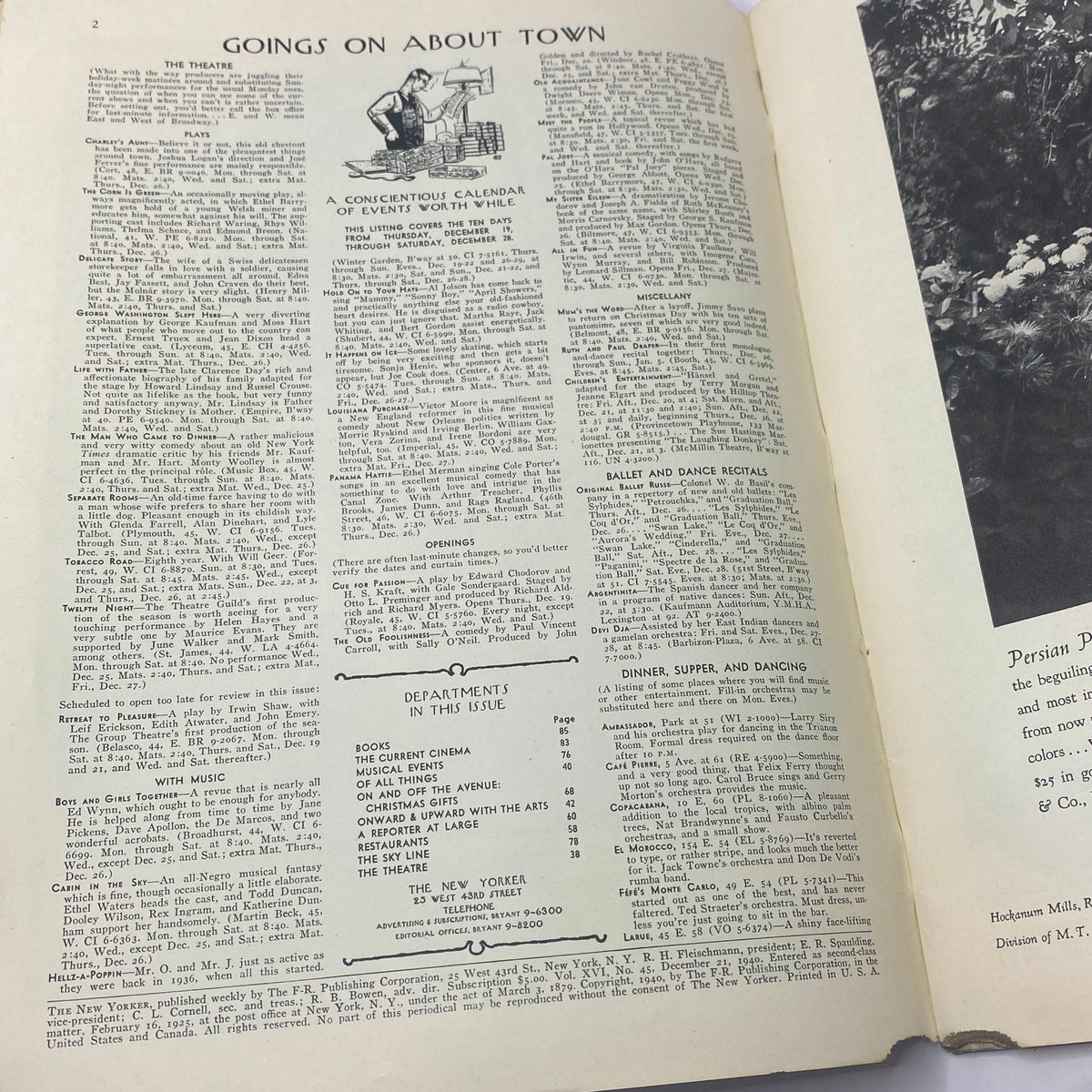
- Wartime holiday editorial content — Consistent with the magazine's well-documented format, the Christmas week issue would have included fiction, poetry, cultural criticism, humor, and Talk of the Town observations calibrated to the holiday season while reflecting the realities of a world at war.
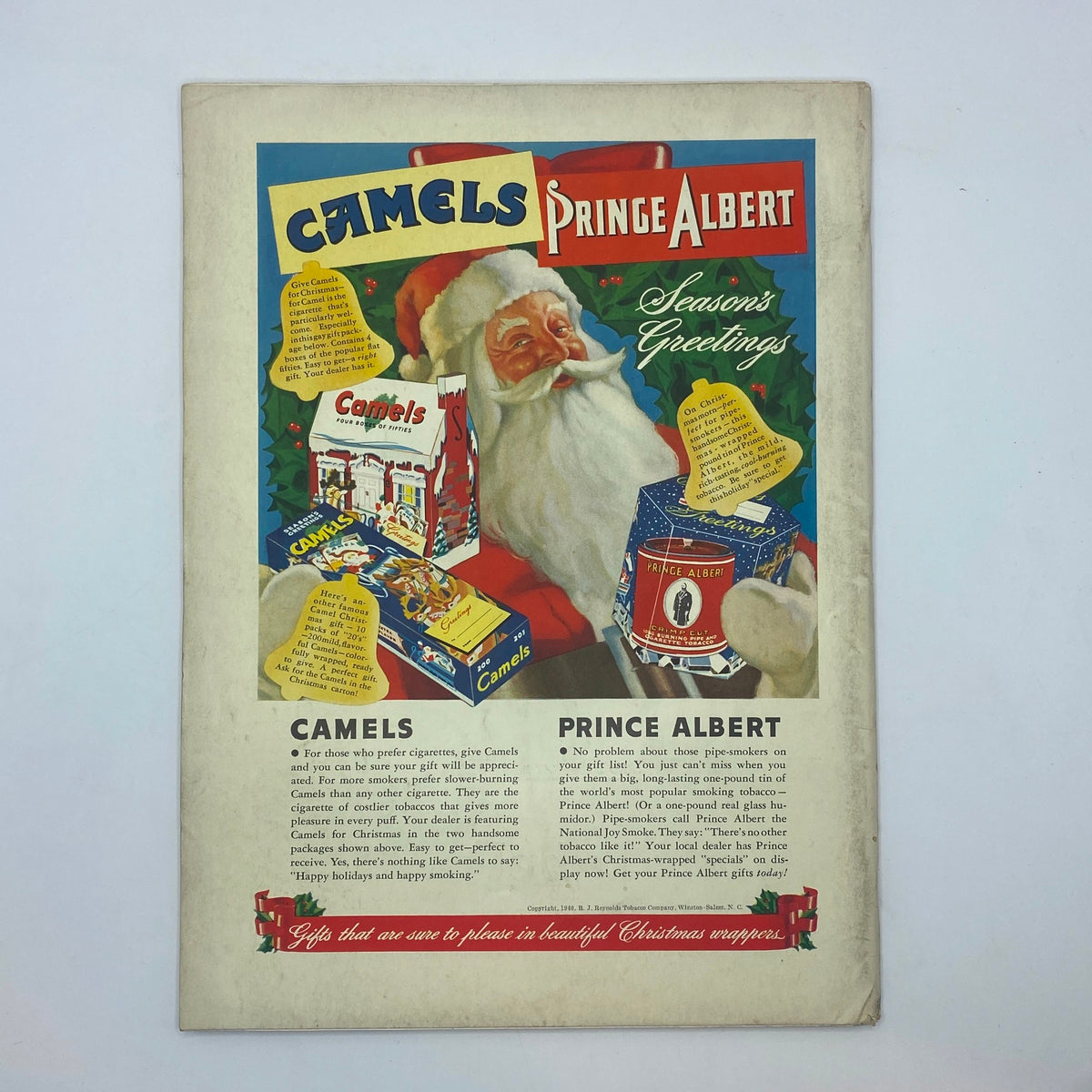
- Minor water damage noted — The issue exhibits minor water damage, a condition attribute relevant to collectors evaluating the legibility and integrity of the cover art and interior pages through available photographs.
- Note: Specific interior article titles, fiction contributors, and additional content have not been independently confirmed for this issue. The highlights above reflect the well-documented editorial format of The New Yorker during this period and the verifiable identity of the cover artist and historical moment.
Condition & Rarity
Issues of The New Yorker from December 1940 are eighty-five years old, and the paper stock used in the magazine's weekly production during this era was not manufactured with archival longevity in mind. When evaluating any surviving copy of this issue, the attributes that matter most to serious collectors are the condition of the Robert Day cover art — its color integrity, surface cleanliness, and freedom from significant staining, tearing, or fading — the structural integrity of the spine and staple binding, and the completeness of interior pages. The minor water damage noted in the listing is a condition attribute that collectors should evaluate carefully through the provided photographs, as water damage on paper of this age varies considerably in its visual impact and extent. The overall good condition noted for a publication of this age indicates a survivor in the better range of what typically circulates for early-1940s New Yorker issues. Any edge wear or tanning consistent with authentic age is an expected characteristic and does not inherently disqualify a copy from serious collector consideration.
Looking for More Issues Like This?
Christmas week issues of The New Yorker from the early years of the Second World War are historically situated documents that collectors of both the magazine's visual history and the period's cultural record actively seek out, and the December 21, 1940 Robert Day cover is a particularly evocative example. If it is currently unavailable, the New Yorker collection at OriginalMagazines.com is the best place to browse what has recently surfaced from across the magazine's long publishing history. Collectors with a broader interest in the print culture of this extraordinary year should also explore the 1940 magazines collection for a wider view of American media during the second year of the Second World War.