


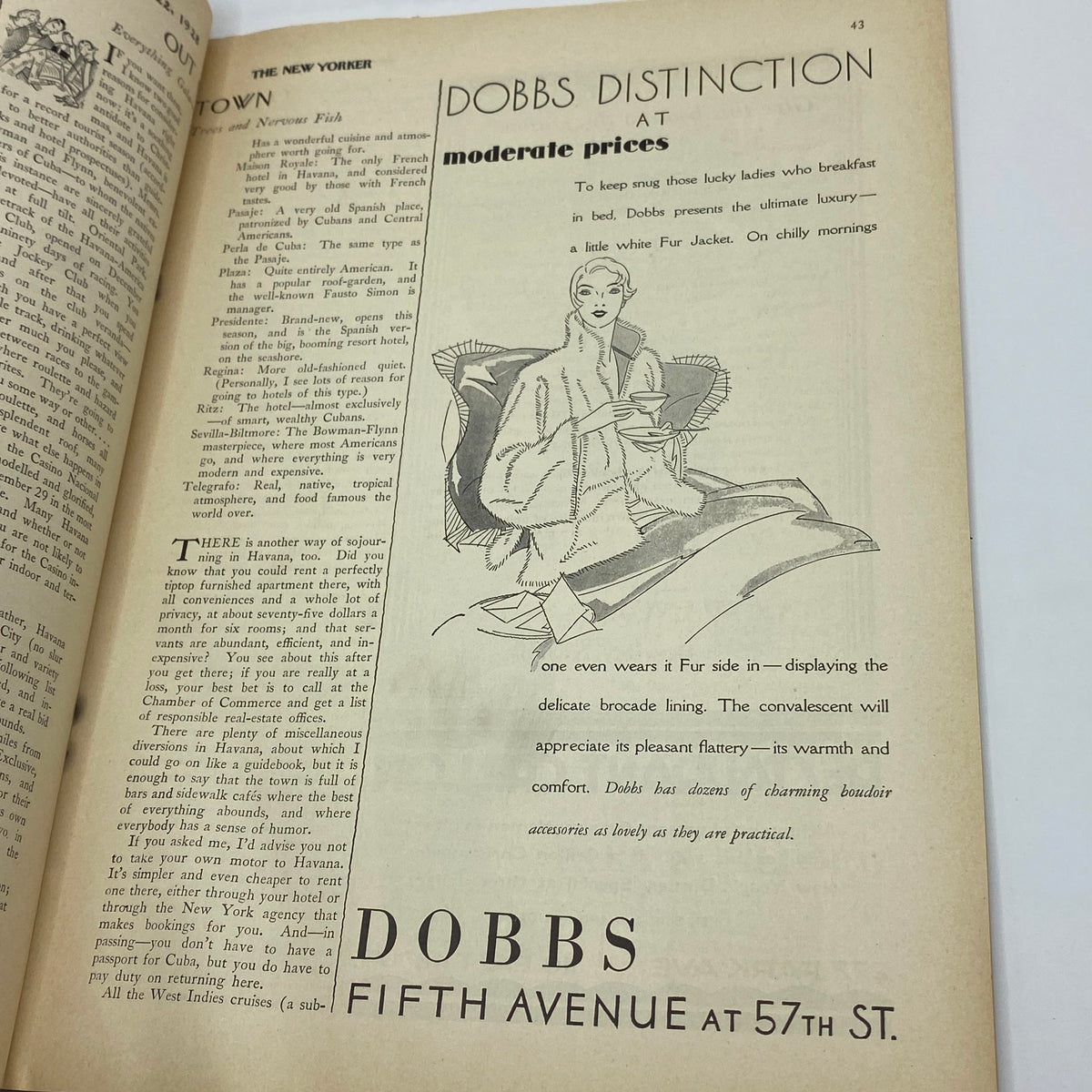


Description
Collector's Note – Why This Issue Matters
The December 22, 1928 issue of The New Yorker arrives at a moment of dual significance: it is a Christmas-week issue from the magazine's fourth year of publication, and its cover was created by Rea Irvin — the man more responsible for The New Yorker's visual identity than any other single person in its history. Irvin served as the magazine's first art editor from its February 1925 founding, and it was he who designed the Eustace Tilley image that appeared on the very first cover and has anchored the magazine's anniversary issues ever since. His influence extended far beyond his own cover contributions: he established the typographic standards, the illustrative tone, and the overall visual register that defined what a New Yorker cover could and should be. A cover bearing Irvin's own name as illustrator is therefore not simply a strong cover — it is a document of the magazine's visual philosophy executed by its primary architect. Collectors building a comprehensive archive through The New Yorker's original issues recognize Irvin covers from the founding era as among the most historically loaded in the magazine's entire run.
December 22, 1928 also carries the particular editorial weight of a pre-Christmas issue from the height of Jazz Age prosperity. The New Yorker's Christmas and holiday issues of the late 1920s reflected a New York in full cultural flower — the city's theaters, restaurants, galleries, and social calendar were at their most active in December, and the magazine's holiday covers of this period tend toward the festive and visually rich end of Irvin's considerable range. This issue appeared just ten months before the stock market crash of October 1929 that would end the decade's prosperity and fundamentally alter both New York's social landscape and The New Yorker's editorial tone. That proximity to the crash gives late-1928 issues a particular documentary poignancy — they capture the final full expression of the culture the magazine had been built to reflect. Researchers exploring original magazines from 1928 will find this December issue a richly layered artifact: a holiday document, a founding-era visual statement, and an inadvertent record of the last months before a world-changing disruption.
Irvin's broader career is worth understanding as context for this cover's place in design history. He had studied art in Europe and worked as an illustrator and cartoonist before joining The New Yorker at its founding, and his taste — shaped by both European graphic tradition and American commercial illustration — gave the magazine's visual identity a sophistication that was genuinely unusual for American periodicals of the 1920s. The typeface he designed for the magazine's title lettering, now known as Irvin type, remains in use to this day. A cover he illustrated himself, in the magazine's fourth year, is a primary document of that design legacy at one of its earliest and most formative moments.
About the Publication
The New Yorker was founded by Harold Ross and first published on February 21, 1925, with financial backing from Raoul Fleischmann. Aimed from the outset at a sophisticated urban readership with cosmopolitan tastes and a tolerance for genuine wit, it developed a distinctive editorial blend of humor, fiction, criticism, and long-form journalism that set it apart from every other American magazine of its era. By December 1928 it had stabilized its editorial and visual identity under Ross's editorship and Irvin's art direction, and its covers were already recognized as a distinct category of American illustration — collected, discussed, and imitated in ways that no other magazine's covers were. The magazine's Christmas issues of the late 1920s are among the most visually celebrated in its pre-Depression run.
Key Highlights Inside
- Rea Irvin Cover Illustration: The cover was created by The New Yorker's founding art editor — the designer of Eustace Tilley, the originator of Irvin type, and the primary architect of the magazine's entire visual identity. An Irvin-illustrated cover from the founding era is among the most historically significant in the magazine's run.
- Christmas Week Issue: Published on December 22, 1928, this is a holiday issue from the magazine's fourth year — a document of Jazz Age New York at its most festive, appearing less than a year before the stock market crash that would transform the city and the decade.
- Fourth Year of Publication: This issue falls within The New Yorker's early founding era, placing it in the small and scarce category of pre-Depression issues that collectors treat as foundational documents of the magazine's history.
- Complete Issue: The listing confirms this as a complete magazine — a critical attribute for a publication of this age, where partial copies and issues with missing pages occasionally circulate and completeness cannot be assumed.
- Interior Content: Specific articles, fiction, and additional features within this issue are not confirmed from available listing information. Collectors seeking a full table of contents are encouraged to cross-reference with New Yorker digital archives or periodical databases indexing the magazine's 1928 run.
Condition & Rarity
Good condition on a magazine from December 1928 is a meaningful achievement for paper stock now approaching a century in age. The New Yorker of the late 1920s was printed on quality coated stock suited to the era's premium periodicals — superior to newsprint but not archival — and nearly a hundred years of environmental exposure, handling, and storage takes a considerable toll on even well-preserved examples. The listing does not specify label presence or absence, so cover surface condition should be assessed directly from available photographs, with particular attention to the Irvin cover illustration, which is the primary aesthetic and identification value of this specific issue. Spine integrity and interior completeness are equally important evaluation criteria for a publication of this vintage, as binding degradation is among the most common condition failures in pre-Depression magazine survivorship. When assessing any surviving copy of the December 22, 1928 New Yorker, collectors should treat honest age-related wear as inherent to the vintage rather than a condition deficiency, and should prioritize cover image integrity, structural cohesion, and interior page completeness as the primary grading criteria.
Looking for More Issues Like This?
Fourth-year New Yorker issues from late 1928 — particularly holiday covers by Rea Irvin himself — occupy a rare tier in American periodical collecting, and complete copies in good condition surface infrequently enough that serious collectors pursue them deliberately when they appear. If this issue is currently unavailable, the New Yorker collection at OriginalMagazines.com is the most comprehensive place to explore original issues spanning the magazine's century-long run. Collectors focused on the visual culture and literary energy of the final years of Jazz Age New York will also find the 1928 magazine collection a valuable source of primary documents from one of the most consequential years of the decade.