



Description
Collector's Note – Why This Issue Matters
The December 23, 1939 issue of The New Yorker lands during one of the most consequential winters in modern history. Europe had been at war since September. Britain and France had declared against Germany following the invasion of Poland, and the United States was maintaining an uneasy neutrality while the country debated, loudly and bitterly, what its role in the conflict should be. Against that backdrop, a Christmas-week issue of The New Yorker carried particular cultural weight — the magazine's characteristic wit and urbanity functioning not as escapism exactly, but as a kind of civilizational assertion. This is what we are. This is what we're defending.
The cover by Perry Barlow anchors the issue firmly in that tradition. Barlow was a staff contributor to The New Yorker from the late 1920s through the 1960s, and his illustrations are among the most recognizable visual signatures of the magazine's interwar identity. His style — warm, gently comic, rooted in the everyday domestic and social observations of upper-middle-class New York life — was ideally suited to holiday covers, and his December appearances became something collectors now actively seek out. For anyone assembling a serious run of vintage New Yorker issues, a Barlow Christmas cover represents one of the most characteristically period-perfect finds the magazine produced.
The late 1930s also mark a transitional moment in The New Yorker's editorial history. The magazine was deepening its commitment to long-form journalism and war correspondence — a shift that would accelerate dramatically through the 1940s — while still maintaining the humor, cartoons, and light cultural commentary that had defined its early decades. An issue from the pivotal year of 1939 sits exactly at that fault line, making it valuable not just as a collectible but as a document of American cultural life on the eve of its transformation.
About the Publication
The New Yorker was founded by Harold Ross in 1925 and quickly established itself as the defining literary and cultural magazine of twentieth-century America. Aimed at a sophisticated urban readership, it published fiction, poetry, long-form reportage, criticism, and humor alongside its celebrated single-panel cartoons and illustrated covers — each cover an original commissioned artwork, never a photograph. By 1939, under Ross's continued editorship, the magazine had assembled a roster of contributors that included E.B. White, James Thurber, John O'Hara, and Dorothy Parker, among many others. Its editorial standard was meticulous to the point of legend, and its fact-checking and copy-editing departments set a benchmark the rest of the industry measured itself against. Weekly issues from the late 1930s reflect the full expression of that editorial vision before the war reshaped both the magazine and the world it covered.
Key Highlights Inside
- Original Perry Barlow cover — A commissioned holiday illustration in Barlow's signature style, representing one of the most collectible visual formats the magazine produced across its interwar run.
- Complete issue — All pages present, meaning the full editorial package is intact: fiction, commentary, cartoons, criticism, and advertising, none of which can be evaluated in isolation from the whole.
- Christmas week editorial context — Holiday issues of The New Yorker consistently attracted the magazine's strongest contributors and most ambitious layouts; the December 23 date places this squarely in that tradition.
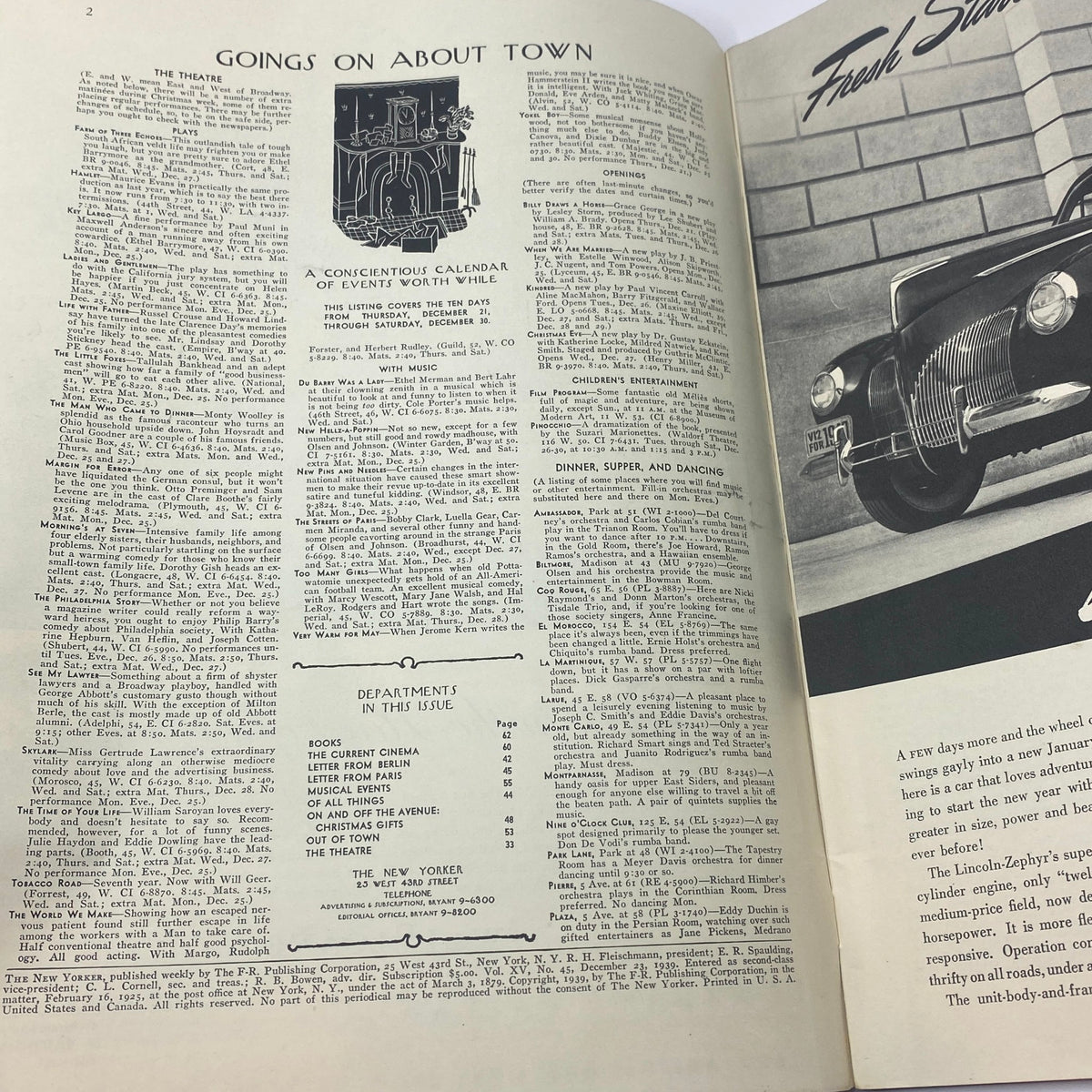
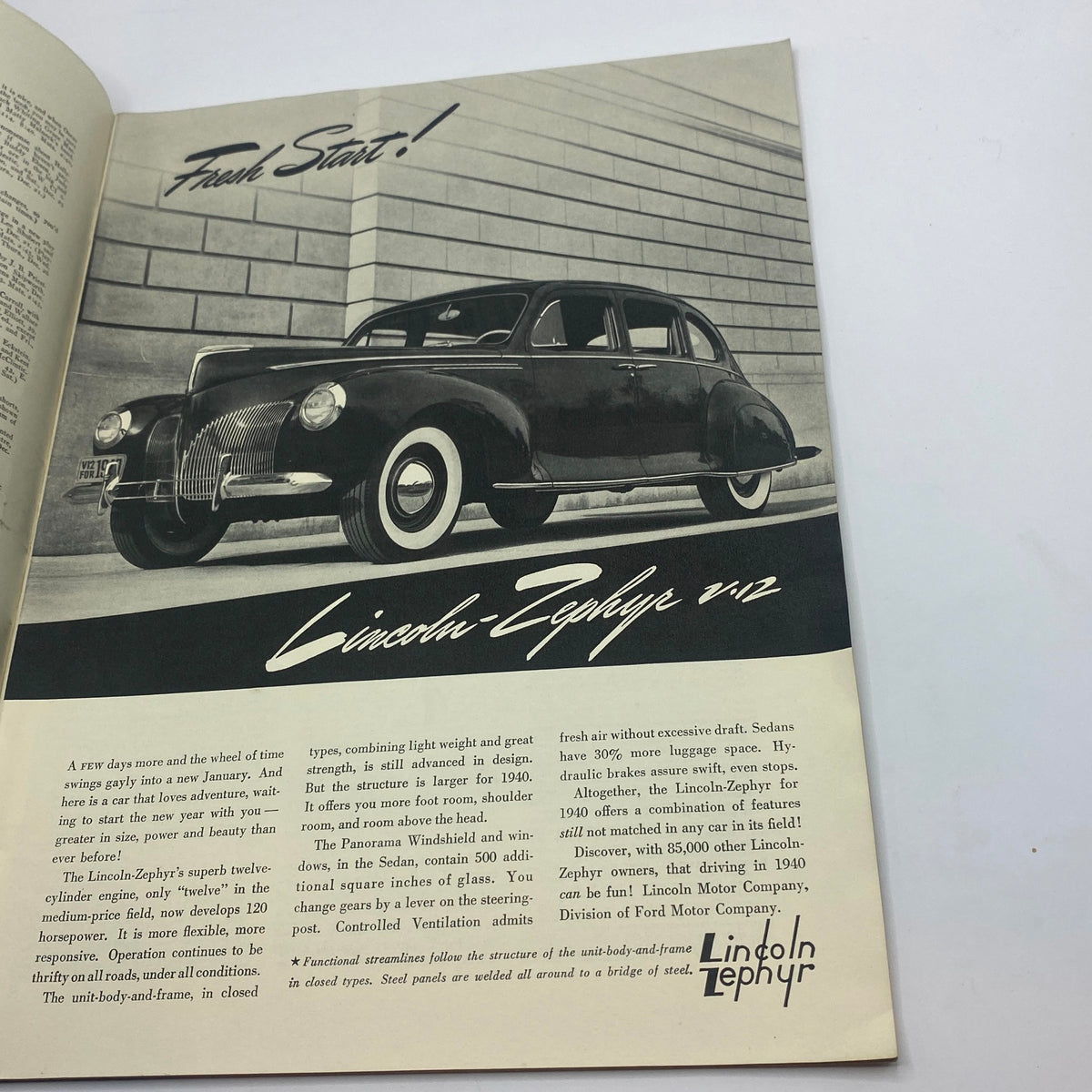
- Period advertising — Late-1930s New Yorker advertising is a primary document of luxury consumer culture on the cusp of wartime austerity — department stores, spirits, automobiles, and fashion brands whose holiday campaigns reflect the last full peacetime Christmas of the decade.
- Interior cartoons and humor pieces — Specific titles and contributors for this issue are unconfirmed in available records, but the magazine's standard format guaranteed a substantial complement of single-panel cartoons and comic prose, hallmarks of the Barlow era.
Condition & Rarity
Surviving copies of this issue should be assessed with realistic expectations for an eighty-five-year-old weekly periodical. The New Yorker was printed on relatively lightweight coated stock — better than newspaper but not archival — and most copies lived in households or office waiting rooms rather than climate-controlled storage. A copy grading as good for its age typically presents with cover integrity intact, readable interior pages, and the kind of minor toning, edge wear, and spine stress that accumulate naturally over decades of existence rather than indicating neglect. The completeness of the issue is the most critical variable: because New Yorker issues were frequently read cover to cover and passed between readers, surviving complete copies — all pages present, no clipped cartoons or excised ads — are meaningfully less common than partial copies. A complete example with the Barlow cover undamaged represents the standard collectors should prioritize when sourcing this issue.
Looking for More Issues Like This?
Perry Barlow covers from the late 1930s are among the more sought-after items for serious New Yorker collectors, and a specific December issue in good condition rarely stays available for long. If this one has moved on, the New Yorker collection at OriginalMagazines.com is one of the deepest available anywhere, spanning decades of the magazine's run with issues that are genuinely difficult to source elsewhere. Collectors building a focused 1930s shelf will also find it worth browsing the 1939 magazine collection, which brings together major titles from across that singular year in American cultural history.