
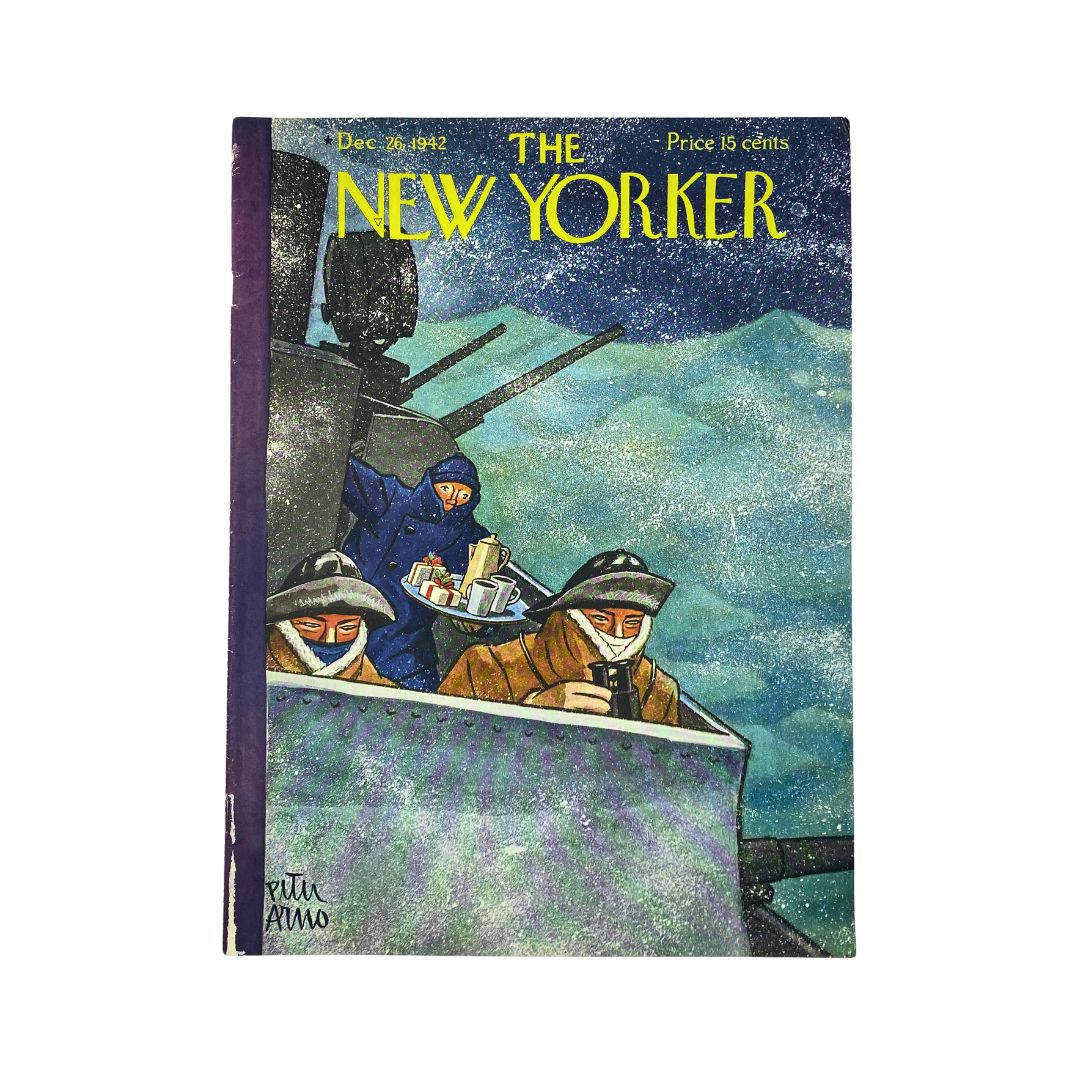


Description
Collector's Note – Why This Issue Matters
The December 26, 1942 issue of The New Yorker, featuring a cover by Peter Arno, is a primary document of two intersecting histories that give it unusual depth and significance as a collector artifact. The first is the history of The New Yorker during the war years — a period when the magazine was producing some of the most enduring journalism, fiction, and visual art in American publishing history while simultaneously maintaining the sophisticated wit and commitment to civilized life that defined its identity. The second is the specific history of Peter Arno as the most important and most distinctively New Yorker cartoonist of the magazine's first decades. Arno had joined the magazine nearly from its founding in 1925 and was, by 1942, its most celebrated visual contributor — his cartoons and covers had helped define the specific aesthetic of the publication in the public imagination, and his work was inseparable from what The New Yorker meant as a cultural object and a social statement. A Christmas-week cover by Arno in December 1942 is not simply a holiday illustration; it is a primary artifact of his long, defining relationship with the magazine at the precise moment when that relationship had fully matured and was operating under the specific pressure of wartime. Collectors building a focused archive of New Yorker cover art from the magazine's foundational decades will find the New Yorker magazine collection the most comprehensive resource for identifying covers of particular artistic and historical significance across the publication's most celebrated visual periods.
December 26, 1942 sits in the exact center of World War II — thirteen months after Pearl Harbor, eighteen months before D-Day — and a Christmas-week issue of The New Yorker from this specific moment carries the full weight of that historical position. The magazine's Christmas and holiday covers were among the most carefully considered in its annual publishing calendar, and a Peter Arno Christmas cover in 1942 would have balanced the seasonal visual tradition of warmth and celebration against the specific realities of a wartime Christmas: the men overseas, the rationing and sacrifice at home, the particular human tension between maintaining holiday cheer and acknowledging what the world was actually going through. Arno's signature style — the bold line work, the sophisticated situations, the knowing wit that never fully surrendered to sentimentality — was precisely suited to this challenge, and the resulting cover would have been the product of a major artist engaging seriously with one of the most emotionally complex Christmas moments in recent American memory. The complete magazine format noted in the listing means the full editorial program of this December 26 issue is preserved, including whatever journalism, fiction, poetry, and criticism The New Yorker assembled for the final full week of a year defined entirely by the war. Collectors focused on the wartime period will find that 1942 magazine issues represent some of the most historically charged primary documents in the American periodical archive.
Peter Arno's importance to The New Yorker's visual identity cannot be overstated as context for understanding why this cover has specific collector value beyond the general significance of a wartime New Yorker issue. His covers from the late 1920s through the 1950s are among the most studied and most collected in the publication's entire visual history — they are the covers most associated with the magazine's founding aesthetic of urban sophistication, social comedy, and the particular visual wit that made the New Yorker cover instantly recognizable to anyone who had ever seen one. A December 1942 Arno cover is therefore a primary document of the most important visual relationship in the magazine's history, produced at the most emotionally demanding moment the country had faced in a generation, and preserved in the complete magazine format that makes it accessible as both art object and historical document.
About the Publication
The New Yorker was founded in 1925 by Harold Ross and had established itself by 1942 as the most culturally significant weekly magazine in the United States, combining long-form journalism, fiction, poetry, criticism, and the distinctive visual identity that had made it one of the most recognizable publications in the world. During the World War II years under Harold Ross's editorship, the magazine produced some of the most enduring American journalism of the century while maintaining the wit, sophistication, and commitment to quality that had defined it from its founding. The cover art program was central to its identity: individual covers were serious artistic commissions, and Peter Arno — who had been contributing since nearly the magazine's founding — was understood as the publication's most defining visual contributor, whose covers embodied the New Yorker aesthetic more completely than almost any other single artist. Complete issues from the wartime years are primary documents of both the publication's editorial program and the broader American cultural life of the early 1940s, and issues from this specific period are among the most historically significant surviving examples of the weekly magazine format from the war years.
Key Highlights Inside
- Christmas-week cover painting by Peter Arno — a primary artifact of the most defining visual relationship in The New Yorker's history, produced during the second full Christmas of World War II by the artist most closely associated with the magazine's founding aesthetic of sophisticated urban wit, at the precise moment when that aesthetic was being tested against the emotional demands of wartime.
- December 26, 1942 complete issue — a full surviving example of The New Yorker's wartime editorial program in its holiday-week format, preserving whatever journalism, fiction, poetry, criticism, and cartoons appeared in the final full issue of 1942, a year defined entirely by the global war and its impact on American life.
- Complete magazine format — distinguishing this artifact from cover-only examples of the same issue, meaning the full editorial content of this December 26 date is preserved and accessible, including the surrounding journalism and fiction that provides the complete context for Arno's cover art and for the magazine's specific engagement with the wartime Christmas moment.
- World War II Christmas documentation — placing this issue at the intersection of the holiday publishing tradition and the wartime reality of December 1942, a moment when the tension between seasonal celebration and global conflict gave every New Yorker editorial decision a particular human weight and historical significance.
- Note: Specific interior article titles, fiction contributors, poetry, criticism, and additional editorial content from this issue are unconfirmed beyond what is indicated by the cover artist, date, and complete magazine format. The above reflects what is verifiable from these attributes and the thoroughly documented history of Peter Arno's work and The New Yorker's wartime editorial program.
Condition & Rarity
Good condition with minor wear typical for age is an honest and appropriate assessment for a complete New Yorker issue from December 1942 now more than eighty years old. Wartime New Yorker issues were produced under paper rationing constraints that affected the stock quality of American magazines during the war years — wartime paper allocations required publishers to use lower-grade materials, which means 1942 issues are somewhat more physically fragile than their prewar predecessors and have aged accordingly over eight decades of storage. Good condition accurately describes a complete issue that retains its full structural integrity, legible cover art, and complete interior editorial content despite the expected yellowing, edge wear, and minor physical deterioration that paper of this age and wartime quality inevitably shows. For collectors of complete wartime New Yorker issues specifically, good condition for an eighty-plus-year-old complete magazine with a Peter Arno cover is a genuinely preservable primary document whose historical and artistic significance is not diminished by the honest acknowledgment of age-appropriate wear. Collectors should consult the provided photographs for specific condition details relevant to their display and research requirements.
Looking for More Issues Like This?
Complete New Yorker issues from the World War II Christmas weeks — particularly those featuring cover work by Peter Arno, whose covers are among the most historically significant and most collected in the publication's entire visual archive — are among the more specifically valuable items in the wartime New Yorker collector market. The broader New Yorker magazine collection is the most reliable starting point for finding other significant complete issues and covers from across the publication's history, including other wartime issues from the early 1940s that document the magazine at one of its most editorially ambitious and historically consequential periods. Collectors building a focused archive of 1942 as a pivotal wartime year across American cultural and journalistic publications will find the complete 1942 magazine collection an invaluable resource for locating other titles and issues that document this extraordinary year from the multiple perspectives that serious archival research requires.