



Description
Collector's Note – Why This Issue Matters
The December 31, 1938 issue of The New Yorker with a cover by Rea Irvin is a document of unusual historical and cultural weight. It is the last issue of 1938 — the final edition of a year that had included the Anschluss of Austria in March, the Munich Agreement in September, and Kristallnacht in November. For American readers in New York closing out the year on December 31, 1938, these events formed the backdrop to whatever wit and elegance their weekly magazine offered. The New Yorker under Harold Ross had not yet fully committed to direct engagement with the European crisis — that would come more explicitly in the years ahead — but its readership was among the most internationally aware in America, and the New Year's Eve issue of 1938 would have been read with the full weight of that year's history pressing on it. A year-end issue from a weekly magazine functions as an inadvertent summary of the year, and the December 31, 1938 New Yorker sits at the close of one of the most alarming years in modern history. Collectors who follow the magazine's sustained visual and editorial program across this period will find that history documented throughout the New Yorker collection at OriginalMagazines.com.
A New Year's Eve cover by Rea Irvin carries specific significance within the magazine's own visual history. Irvin was not merely a regular contributor — he was the founding art editor of The New Yorker, appointed by Harold Ross when the magazine launched in 1925, and the person most responsible for establishing every dimension of its visual identity. He designed the magazine's original typeface, still known as Irvin type. He created Eustace Tilley — the iconic top-hatted dandy who has appeared on the magazine's anniversary covers since the first issue. He set the visual standards and editorial art philosophy that governed the magazine's appearance for decades. When Irvin contributed a cover to the final issue of any year, it was the work of the person who had invented what The New Yorker looked like, closing out a year in the visual language he had created. For collectors of American illustration history and magazine design, a late-1930s Irvin cover is a primary document of one of the most significant editorial art programs in American publishing. The broader cultural and historical context of this extraordinary year is captured in the 1938 magazines collection, which spans a year whose final months — Munich, Kristallnacht, and the accelerating European crisis — left no thoughtful American observer unchanged.
About the Publication
The New Yorker was founded in New York in 1925 by Harold Ross with the explicit intention of creating a magazine of sophisticated urban wit and literary quality aimed at a cosmopolitan readership rather than the rural mainstream. Rea Irvin served as its first art editor from the magazine's founding, designing its typeface, establishing its visual standards, and creating the Eustace Tilley character that became the magazine's enduring mascot. By December 1938, under Ross's continued editorship, the magazine had been publishing for thirteen years and had established itself as the most prestigious literary and cultural weekly in the United States. Its editorial format combined long-form journalism, short fiction, poetry, and cultural criticism with the "Talk of the Town" section, cartoons, and the weekly cover — which functioned as a standalone artwork conceived independently of the issue's editorial content. Its readership was educated, urban, and internationally minded, making it a particularly significant document of how America's intellectual class was processing the events of late 1938.
Key Highlights Inside
- Rea Irvin New Year's Eve cover — A cover by the founding art editor of The New Yorker and creator of Eustace Tilley, closing out 1938 — one of the most historically alarming years of the twentieth century — in the visual language he had created for the magazine thirteen years earlier.
- December 31, 1938 — the close of a pivotal year — The final issue of a year that included the Anschluss, the Munich Agreement, and Kristallnacht, published as American readers confronted the implications of European events that were rapidly becoming impossible to ignore or dismiss.
- Year-end literary and cultural content — Consistent with the magazine's well-documented format, a final-week December issue would have included short fiction, poetry, cultural criticism, year-end observations, cartoons, and Talk of the Town material reflecting Harold Ross's editorial standards.
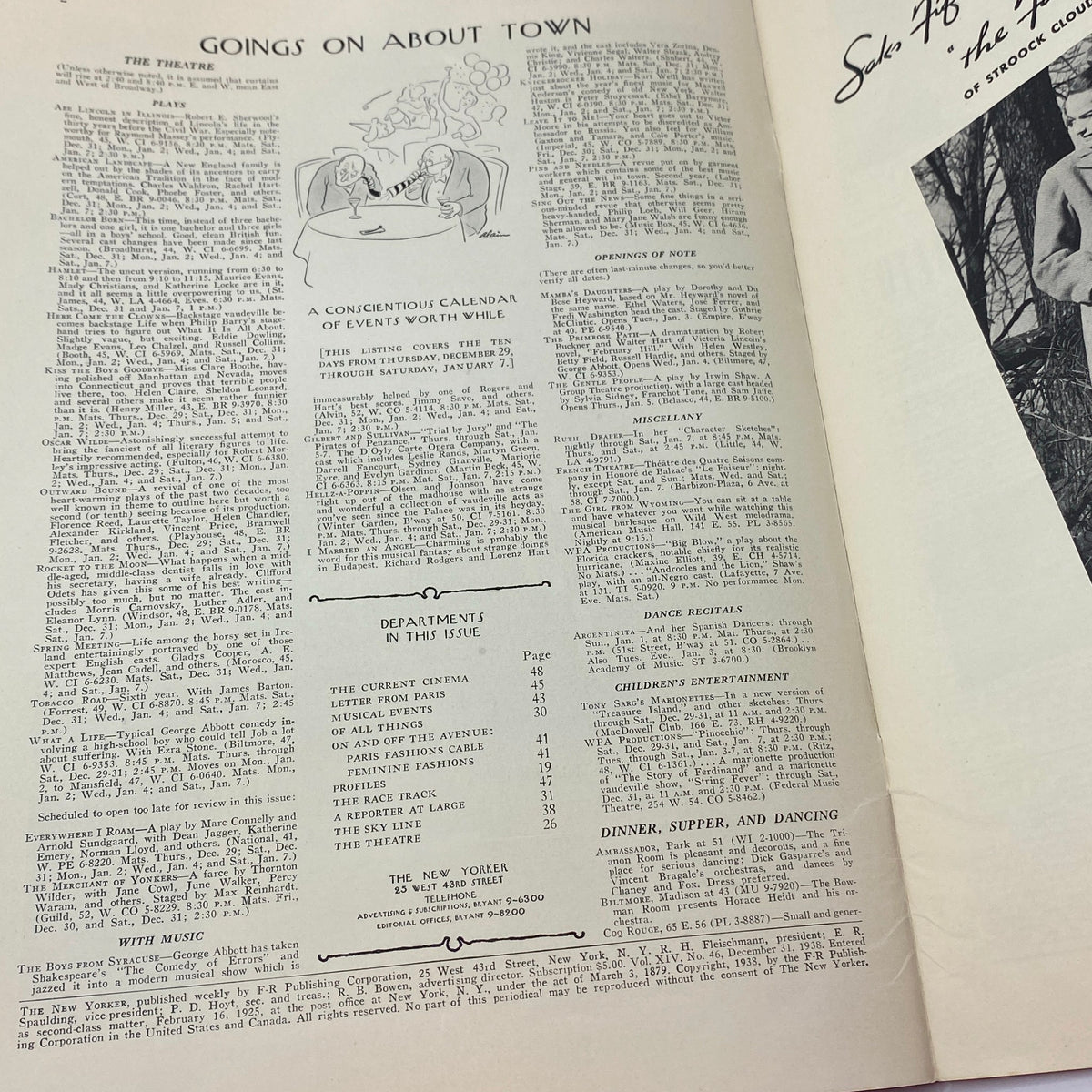
- Note: Specific interior article titles, fiction contributors, and additional content have not been independently confirmed for this issue. The highlights above reflect the well-documented editorial format of The New Yorker during this period and the verifiable identity of the cover artist and historical context.
Condition & Rarity
Issues of The New Yorker from December 1938 are eighty-seven years old, and the paper stock used in the magazine's weekly production during this era was not manufactured with archival longevity in mind. When evaluating any surviving copy of this issue, the attributes that matter most to serious collectors are the condition of the Irvin cover art — its color integrity, surface cleanliness, and freedom from significant staining, tearing, or fading — the structural integrity of the spine and staple binding, and the completeness of interior pages. The good condition noted for a publication of this age indicates a survivor in the better range of what typically circulates for late-1930s New Yorker issues. Minor edge wear consistent with authentic age is an expected and honest characteristic of a publication nearly nine decades old and does not meaningfully diminish the issue's collectible or historical value. Given Irvin's foundational importance to the magazine's visual identity, the quality and integrity of the cover image is the primary variable collectors should assess through available photographs.
Looking for More Issues Like This?
A New Yorker New Year's Eve cover by Rea Irvin — the magazine's founding art director, creator of Eustace Tilley, and architect of its visual identity — from the close of 1938 is one of the most historically situated and artistically significant issues in the publication's pre-war run. If this issue is currently unavailable, the New Yorker collection at OriginalMagazines.com is the best place to browse what has recently surfaced from across the magazine's long publishing history. Collectors with a broader interest in the print culture of this pivotal year should also explore the 1938 magazines collection for a wider view of American media during one of the twentieth century's most consequential twelve months.