



Description
Collector's Note – Why This Issue Matters
The December 5, 1970 issue of The New Yorker featuring a cover by Jean-Michel Folon is one of the more artistically distinguished issues in the magazine's early-1970s run — and the Folon cover alone places it in a specific and valued category for collectors of the publication's visual history. Folon, the Belgian illustrator and graphic artist, was one of the most recognizable and widely reproduced illustrators working in the late 1960s and 1970s, known for his melancholy, humanist imagery of small solitary figures in vast institutional or bureaucratic environments — a visual vocabulary that resonated deeply with a culture processing the alienations of modern life. His work appeared on Time, Fortune, and The Atlantic as well as The New Yorker, and his covers for the magazine are among the most collectible in the publication's extensive visual archive. A December 1970 Folon cover was produced at the height of his international reputation and at a moment when his particular aesthetic — elegiac, slightly surreal, deeply humanistic — was in perfect alignment with the cultural mood of the post-1960s disillusionment. Collectors building archives of The New Yorker's cover art history specifically seek out Folon covers as distinctive entries in the publication's visual legacy.
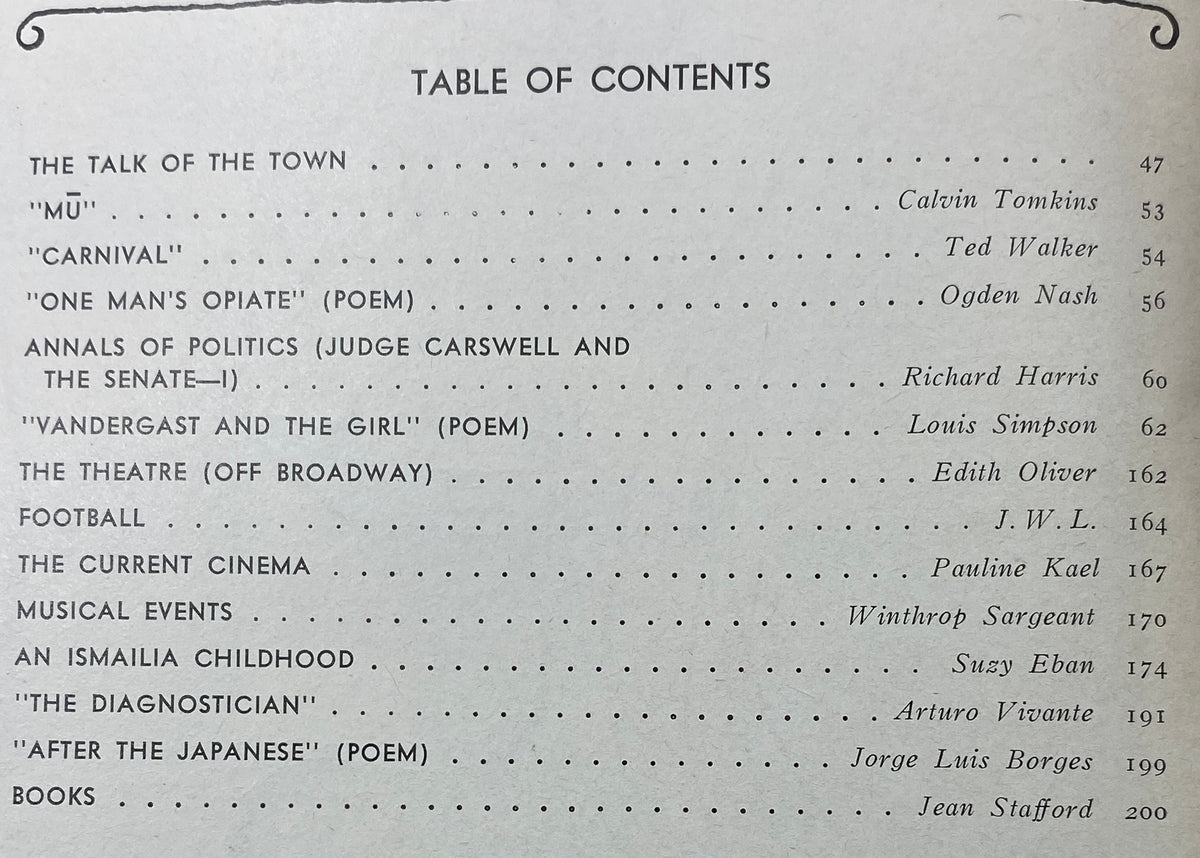
The editorial content of this issue is unusually well-documented for a listing of this type, and the table of contents rewards careful attention. The presence of Jorge Luis Borges — "After the Japanese," a poem — is the single most striking literary attribution. Borges was sixty-one years old in 1970 and at the peak of his international reputation following the English-language publication of Labyrinths in 1962, which had made him a canonical figure in world literature. His appearance in a December 1970 New Yorker alongside Ogden Nash, Louis Simpson, film criticism by Pauline Kael, and Richard Harris's political reporting on Judge Carswell and the Senate reflects the magazine at its most editorially ambitious — holding together poetry, politics, cinema, theatre, and music within the same weekly format. Pauline Kael's film column in particular was at its most influential during this period; her New Yorker criticism of the early 1970s is studied in film programs as defining work in American movie writing. For collectors documenting 1970 through its print culture, this issue is one of the most content-rich examples from that year's magazine landscape.
About the Publication
The New Yorker was founded by Harold Ross in 1925 and had, by December 1970, been operating under the editorship of William Shawn for nearly two decades. Shawn's tenure — which would continue until 1987 — is widely regarded as the magazine's second and perhaps greatest creative peak, distinguished by its commitment to long-form journalism, its expansion into serious political and cultural reporting, and its continued support of the finest fiction writers, poets, and critics working in America. The early 1970s issues reflect the magazine processing the upheavals of the late 1960s — Vietnam, civil rights, the counterculture — through its characteristic lens of intelligent, precise, slightly ironic observation. The visual program under Shawn maintained its tradition of commissioning significant artists for covers, and Jean-Michel Folon's appearances among those commissions are among the most aesthetically distinctive of the era.
Key Highlights Inside
- Cover illustration by Jean-Michel Folon: Folon's December 5, 1970 cover represents the Belgian illustrator at the height of his international reputation — his characteristic imagery of solitary figures in vast, slightly absurdist environments perfectly calibrated to the cultural mood of post-1960s America.
- "After the Japanese" — poem by Jorge Luis Borges (p. 199): A poem by one of the twentieth century's most canonized literary figures, published in The New Yorker at the peak of his international prominence — one of the more significant single-author attributions in the magazine's early 1970s run.
- Pauline Kael film criticism — "The Current Cinema" (p. 164): Kael's New Yorker film column during this period is studied as defining work in American movie criticism — her early 1970s writing is among the most influential film journalism produced in the twentieth century.
- Richard Harris — "Annals of Politics: Judge Carswell and the Senate" (p. 56): Long-form political journalism on the Senate's rejection of Nixon's Supreme Court nominee G. Harrold Carswell — a significant constitutional moment documented in The New Yorker's signature Annals format.
- Ogden Nash poem (p. 54) and Louis Simpson poem (p. 60): Two named poets in a single issue — Nash, one of America's most beloved comic verse writers, and Simpson, a Pulitzer Prize winner — reflecting the magazine's continued commitment to poetry as a central rather than peripheral editorial element.
- Calvin Tomkins on "MŪ" and Suzy Eban's "An Ismailia Childhood" (pp. 47, 170): Tomkins, The New Yorker's long-serving art correspondent, contributes to the issue alongside a memoir piece by Suzy Eban — reflecting the magazine's characteristic blend of art world coverage and personal essay.
Condition & Rarity
Very good condition with only minor edge wear is a strong grading result for a fifty-plus-year-old New Yorker. The magazine's uncoated interior stock from this era ages to moderate tanning under average storage conditions, and lightly toned, structurally stable interior pages in a copy of this vintage indicate careful preservation. The listing specifies complete condition — all pages intact — which is the paramount attribute for any issue from this era, as cartoons, cover art, and notable pages were frequently removed for framing or display over the decades. The listing states that the item photographed is the exact item to be received, which allows for direct condition assessment from the provided images. When evaluating any surviving copy of this issue, the Folon cover's surface condition and color retention are the primary grading variables, followed by interior page completeness, toning degree, and spine attachment integrity. A complete, very good copy of a 1970 New Yorker with a confirmed Folon cover and documented Borges poetry is a specific and distinguished find within the vintage magazine market.
Looking for More Issues Like This?
Complete New Yorker issues from the early 1970s with Jean-Michel Folon covers and documented interior content of this literary density are among the more rewarding finds for serious collectors of the publication — the combination of visual distinction and editorial substance places this issue well above the average survivor from its era. If this one has already found a home, the full archive of The New Yorker issues is the essential destination for collectors working through the magazine's remarkable run across the decades. The 1970 magazine collection is also worth exploring for anyone building a broader documentary picture of American print culture in that pivotal year.