



Description
Collector's Note – Why This Issue Matters
February 1, 1941 places this issue of The New Yorker at one of the most consequential weeks in American pre-war history. The Lend-Lease Act — the legislation that would formally commit American industrial capacity to the Allied cause — was in the middle of its Congressional debate, having been introduced in January and generating the most intense national foreign policy argument the country had conducted since the First World War. The bill would be signed into law by Roosevelt on March 11, just thirty-eight days after this issue's publication. In Britain, the Blitz was continuing. The Atlantic naval war was intensifying. Roosevelt's Four Freedoms speech had been delivered on January 6, just twenty-six days earlier, articulating a vision of American purpose that pointed unmistakably toward eventual involvement. For collectors building a serious historical archive through original magazines from 1941, a February 1 issue documents the American home front at the precise midpoint of the Lend-Lease debate — the most consequential legislative argument of the pre-war period, still unresolved and actively contested as this magazine reached its readers.
The cover by Peter Arno makes this issue one of the most artistically significant and historically charged objects in the magazine's pre-war archive. Arno was one of the most celebrated and influential figures in The New Yorker's entire history — a cartoonist whose work spanned nearly four decades and whose bold, dramatically composed satirical illustrations defined the magazine's visual identity at its most ambitious and socially pointed. His style was immediately recognizable and without real precedent in American illustration: large, confident compositions featuring the predatory wealthy, the hypocrisies of high society, and the appetites of the comfortable class rendered with a satirical ferocity and visual authority that gave his work a force unmatched by virtually any of his contemporaries. The listing accurately describes his work as sophisticated humor combined with insightful observations of urban life — qualities that made Arno not merely a cover artist but a central creative intelligence in the magazine's project of social observation and cultural commentary. For collectors tracing the visual history of the publication through original New Yorker issues, an Arno cover from February 1941 — at the height of the Lend-Lease debate and in the magazine's founding anniversary month — is among the most significant and personally compelling objects available in the pre-war archive.
February 1 also falls within the magazine's founding anniversary season — The New Yorker first appeared on February 21, 1925, and a February 1 issue arrives three weeks before the magazine's sixteenth anniversary. An Arno cover in anniversary month, produced at the midpoint of the most consequential foreign policy debate in a generation, gives this issue a calendar resonance that the historically attentive collector will find genuinely distinctive.
About the Publication
Founded in February 1925 by Harold Ross, The New Yorker was by February 1941 one of the most editorially distinguished and internationally attentive weekly publications in the English-speaking world. Its readership was urban, educated, and expected the combination of wit, literary quality, and serious engagement with world affairs that Ross enforced with legendary editorial discipline. The magazine's format was fully mature: "Talk of the Town" commentary opened each issue, followed by reported features, fiction, poetry, and critical reviews spanning theater, books, art, and film, all interwoven with cartoons and spot illustrations representing one of the most celebrated traditions in American periodical publishing. Arno's contributions were a central pillar of the publication's visual identity, and his covers were among the most anticipated and artistically ambitious features in any issue he appeared in.
Key Highlights Inside
- Peter Arno cover illustration: The cover is the defining collectible and artistically significant feature of this issue — original artwork by one of the most celebrated and influential figures in The New Yorker's entire history, whose bold satirical vision and visual authority defined the magazine's cartoon tradition at its most ambitious across nearly four decades.
- Midpoint of the Lend-Lease Congressional debate: Published on February 1, 1941 — at the midpoint of the Lend-Lease Act's Congressional debate, thirty-eight days before its signing — this issue documents the American home front at the most contested moment of the most consequential foreign policy argument of the pre-war period.
- Twenty-six days after the Four Freedoms speech: Roosevelt's January 6, 1941 address articulating the Four Freedoms — one of the defining rhetorical statements of the entire war era — had been delivered less than four weeks before this issue's publication, shaping the political and moral atmosphere in which it appeared.
- Magazine founding anniversary month: Published three weeks before The New Yorker's sixteenth founding anniversary on February 21 — an Arno cover in the anniversary month of the publication whose visual identity his work had helped define since its earliest years.
- Atlantic Blitz and naval war context: February 1941 coincided with the ongoing London Blitz and the intensifying undeclared Atlantic naval war — dimensions of the European conflict that were being followed with intense anxiety by the magazine's internationally minded readership and shaping its editorial voice throughout this period.
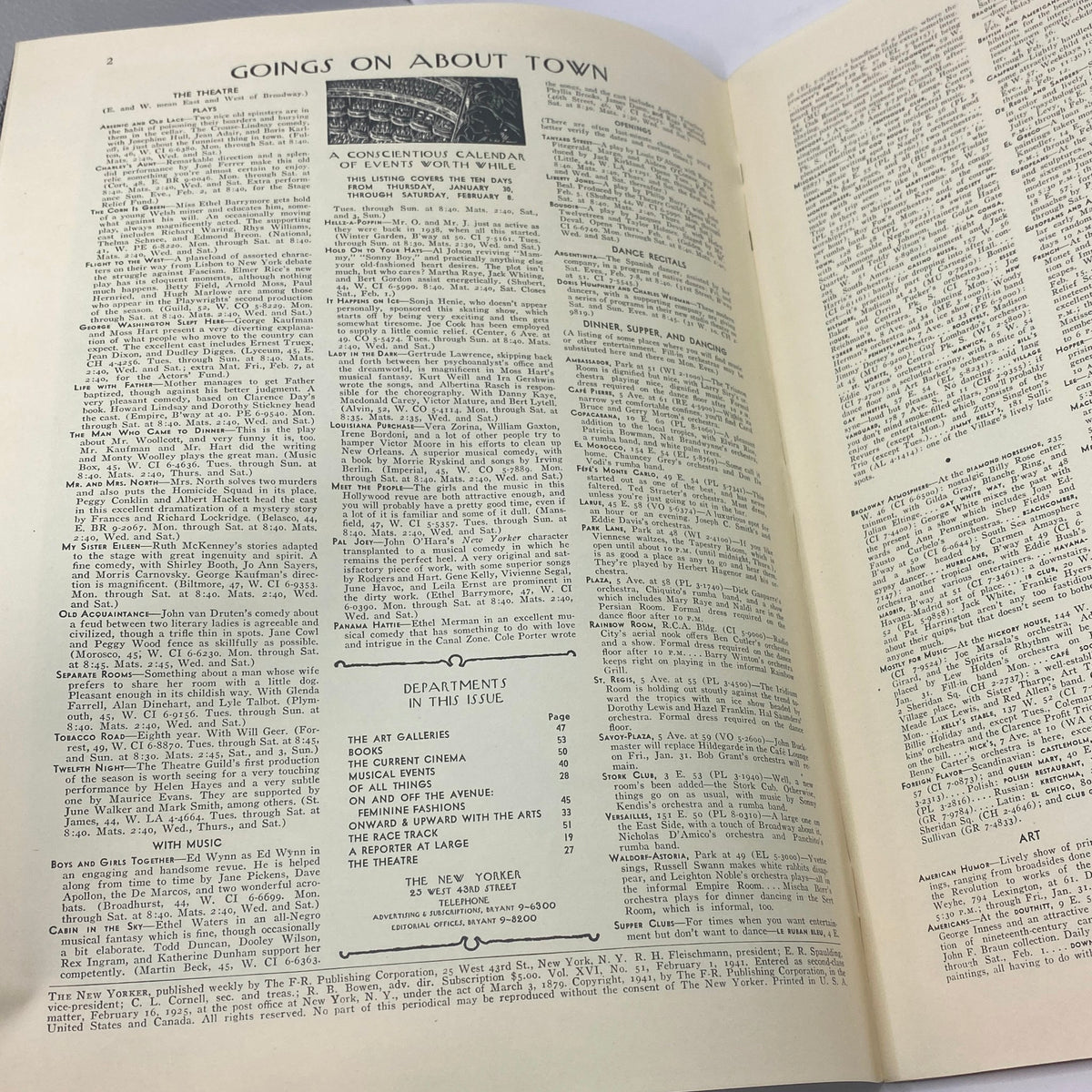
Note: Specific article titles, bylines, and interior content for this exact issue have not been independently confirmed beyond what appears in the listing. The highlights above reflect only what is verifiable from the cover credit, publication date, and the magazine's well-documented editorial format during this period.
Condition & Rarity
A surviving copy of a weekly newsstand magazine from February 1941 presenting in very good condition — with minor edge wear as the only noted imperfection — is a sound and genuinely desirable preservation result for a publication now more than eighty years old. The New Yorker was printed on acidic wood-pulp paper stock standard for weekly periodicals of this era, a material inherently prone to toning, brittleness, and structural fatigue over time. Edge wear of the kind described is entirely consistent with honest age and careful storage rather than mishandling or neglect. When evaluating any surviving copy of this issue, the meaningful criteria are the integrity and compositional boldness of Arno's cover art — his characteristically dramatic visual compositions are particularly affected by any toning or fading that diminishes contrast and line clarity — the completeness of all interior pages, the absence of subscription label adhesive residue or moisture damage, and the structural soundness of the spine. A copy meeting the standard described represents the preservation grade that serious collectors of pre-war and wartime periodicals, and particularly of Arno-associated material, actively seek.
Looking for More Issues Like This?
A Peter Arno cover from the midpoint of the Lend-Lease debate — in the magazine's founding anniversary month, three weeks before the sixteenth anniversary — is one of the most artistically significant and historically layered objects in the pre-Pearl Harbor New Yorker collector market, and February 1, 1941 is a date whose multiple dimensions of significance reward the collector who takes the time to understand them. If this issue is no longer available, the extensive original New Yorker collection at OriginalMagazines.com is one of the deepest archives of the magazine accessible to serious collectors, spanning many decades of its publishing history. For those drawn to the charged and irreversible atmosphere of the final months before American entry into the Second World War, the full 1941 magazine collection rewards the most careful and patient exploration — every issue from this year sits at a different point on an arc toward a transformation that, by December, would change everything.