
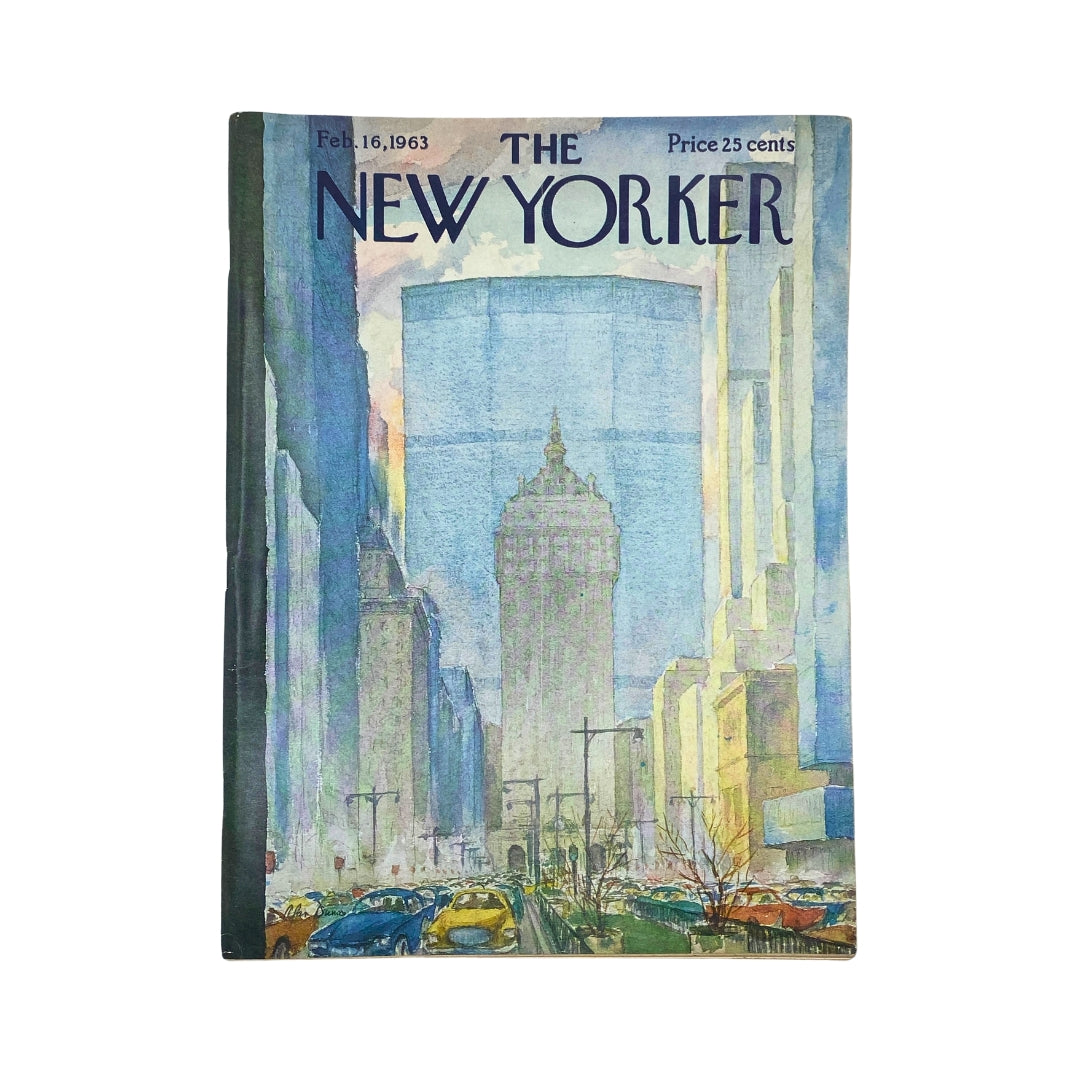


Description
Collector's Note – Why This Issue Matters
The February 16, 1963 issue of The New Yorker arrives at a peculiar hinge point in American cultural life. The early weeks of 1963 carried an atmosphere of cautious optimism — Kennedy was in the White House, the civil rights movement was gathering irreversible momentum, and New York City remained the undisputed center of the American intellectual and artistic universe. A weekly magazine that took all of that seriously, and reported on it with genuine literary ambition, was something readers depended on in a way that's difficult to fully reconstruct today. This issue is a precise cross-section of that world, frozen on a specific Saturday in mid-February.
The cover is the work of Alan Dunn, one of the most quietly celebrated cartoonists in the magazine's history. Dunn contributed to The New Yorker for decades, and his covers and cartoons are now recognized as defining artifacts of mid-century American illustration. His draftsmanship was economical and wry, always more interested in observation than punchline — a sensibility that fit the magazine's editorial character almost perfectly. A cover bearing his name is a meaningful detail for collectors who track the magazine's visual history, and for anyone building a serious New Yorker magazine collection, issues with identified cover artists carry particular reference value.
February 1963 also places this issue in one of the most consequential years for American letters and criticism. The departments listed inside — cinema, theatre, musical events, art galleries, books — represent the full breadth of The New Yorker's cultural coverage at what many historians consider the apex of its mid-century authority. For collectors focused on 1963 magazines as a documentary year, this issue captures the critical establishment doing exactly what it did best: attending everything, judging carefully, and writing about it with unusual precision.
About the Publication
The New Yorker, founded by Harold Ross in 1925 and edited by William Shawn from 1952 onward, was by 1963 the most prestigious general-interest weekly in the United States. Its readership was educated, urban, and culturally engaged — the kind of audience that expected its film criticism, theatre notices, and book reviews to be written by genuine authorities rather than generalists. The magazine's format combined long-form journalism and fiction with short humor pieces, cartoons, and tightly written department columns covering the arts and city life. It had no direct competitor in tone or ambition, and its back issues are among the most consistently sought-after periodicals in the collector market.
Key Highlights Inside
- The Theatre – Page 114: The New Yorker's theatre criticism in 1963 was among the sharpest in print, covering Broadway during one of its most active and transitional decades.
- The Race Track – Page 117: A recurring column that blended sports observation with the kind of character-driven reportage the magazine applied to nearly every subject it touched.
- The Art Galleries – Page 126: New York's gallery scene in early 1963 was in active ferment, with Abstract Expressionism still dominant but Pop Art beginning its ascent — this column was a primary record of that moment.
- On and Off the Avenue: This and That – Page 138: The magazine's celebrated consumer and style column, offering a window into the material culture and retail landscape of early-1960s Manhattan.
- Tables for Two – Page 142: Restaurant criticism written with the same seriousness the magazine applied to opera and fiction — a useful document of the city's dining culture at the time.
- The Current Cinema – Page 147: Film criticism in early 1963 covered a period of significant transition in world cinema, with European art films increasingly crossing into American consciousness.
- Books – Page 153 / Musical Events – Page 150: Rounding out the cultural coverage, these departments represent The New Yorker's commitment to treating every art form with equal editorial rigor.
Condition & Rarity
Surviving copies of this issue in collectible condition are notably harder to locate than one might expect for a major American weekly. The New Yorker was read — actively, thoroughly — which means most copies from this era show the wear of genuine use. What distinguishes a collector-grade copy is the absence of a mailing label on the cover, a feature that indicates newsstand origin rather than subscription delivery. Label-free copies preserve the full integrity of the cover art, which matters considerably when the cover carries an identified artist credit like Alan Dunn's. Page integrity across all sections is the other key variable: issues that retain their complete interior — including all department columns through the back pages — are meaningfully more useful as research and reference objects than incomplete survivors. A plastic protective covering, when present on a stored copy, is a reliable indicator that a previous owner recognized the issue's preservation value and treated it accordingly.
Looking for More Issues Like This?
A mid-February 1963 issue in this condition is genuinely difficult to track down, and if this one has already found a home, the search doesn't have to end here. The full New Yorker collection at OriginalMagazines.com spans many decades and includes issues across the magazine's entire mid-century run — well worth browsing for anyone building a serious archive. For collectors focused on the year itself, the 1963 magazine collection brings together surviving issues from across publications, offering a broader view of what that particular year looked and read like on the newsstands.