



Description
Collector's Note – Why This Issue Matters
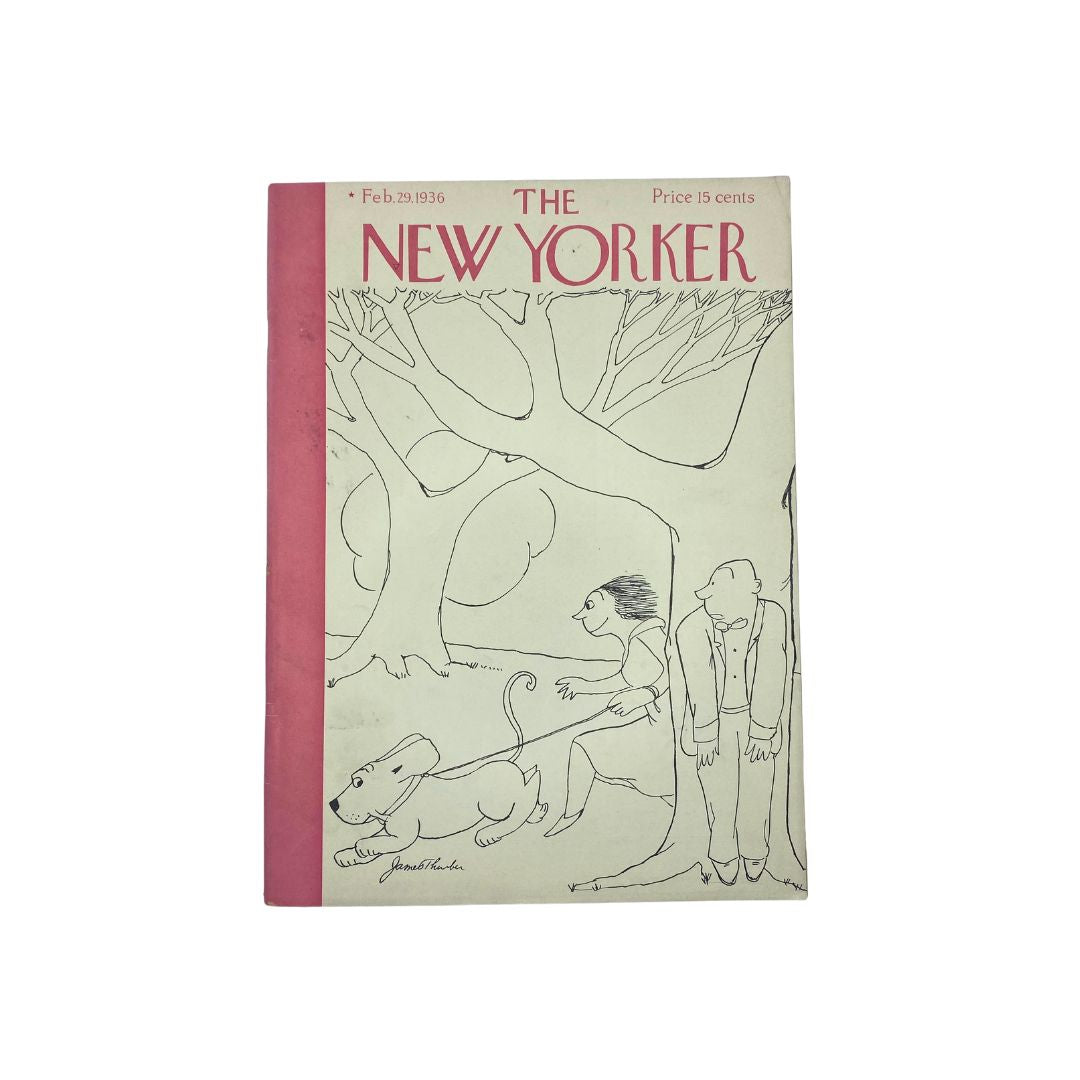
February 29, 1936 is a date that occurs only once every four years, and this particular leap day carries a specific and remarkable significance within The New Yorker's publishing history. The cover by James Thurber makes it immediately exceptional — but the date itself is worth pausing on. A February 29 issue of any annual publication is by definition a once-in-four-years artifact, and for collectors who think carefully about the calendar, this specific combination of a Thurber cover and a leap day publication date gives this issue a documentary singularity that no adjacent date can replicate. The broader historical context amplifies that singularity: February 1936 was the month of the Winter Olympics in Garmisch-Partenkirchen, Germany — the first major international event held on Nazi soil, attended by delegations from around the world and observed with considerable unease by those tracking the direction of the Hitler regime. In the United States, Roosevelt's first term was in its final year, and the presidential election of November 1936 was already beginning to take shape as the dominant political story of the coming months. For collectors building a documentary archive through original magazines from 1936, a leap day issue carries a date specificity that makes it immediately identifiable and permanently unrepeatable within the magazine's annual run.
The cover by James Thurber elevates this issue from historically interesting to genuinely essential for serious collectors. Thurber was not simply a contributor to The New Yorker — he was one of the central figures in the magazine's literary and artistic identity, a writer and cartoonist whose association with the publication spanned decades and whose work was inseparable from what the magazine was and aspired to be. His cartoons — the anxious men, the formidable women, the dogs, the surreal domestic scenarios rendered in his loose, distinctive line — defined a sensibility that was recognizably New Yorker in a way that transcended individual issues. Thurber covers are among the most sought-after in the magazine's collector market precisely because his visual and literary presence was so central to the publication's identity, and a cover bearing his name and artwork from 1936 — at the height of his most productive period — is a primary artifact of that creative partnership. For collectors tracing the full visual and literary history of the publication through original New Yorker issues, a Thurber cover from the mid-1930s occupies a position of unusual importance in the archive.
It is also worth noting what February 1936 represents within the magazine's own institutional calendar. The end of February falls close to the magazine's founding anniversary — The New Yorker published its inaugural issue on February 21, 1925 — and by the eleventh anniversary of that founding in 1936, Thurber had been a central part of the magazine's identity for nearly a decade. A February 29 issue with a Thurber cover is therefore not only a leap day artifact and a historically significant document; it is a piece of the magazine's founding-anniversary season, produced at the height of its mid-Depression creative maturity.
About the Publication
Founded in February 1925 by Harold Ross, The New Yorker was by early 1936 a fully established institution of American cultural life, entering its eleventh year with the editorial confidence and literary ambition that would define its reputation for generations. Its readership was urban, educated, and expected the combination of wit, critical intelligence, and serious engagement with the world that Ross enforced with legendary editorial discipline. The magazine's format was mature and consistent: "Talk of the Town" commentary opened each issue, followed by reported features, fiction, poetry, and critical reviews spanning theater, books, art, and film, all interwoven with cartoons and spot illustrations — including Thurber's own celebrated work — that had developed by mid-decade into one of the most distinguished creative traditions in American periodical publishing. Covers were individually commissioned works of illustration, each a complete artistic statement, produced by a rotating roster of contributing artists whose collective mid-1930s output constitutes one of the most visually accomplished periods in the publication's history.
Key Highlights Inside
- James Thurber cover illustration: The cover is the defining collectible and historically significant feature of this issue — original artwork by one of the most important creative figures in The New Yorker's entire history, a cartoonist and writer whose work was central to the magazine's identity across multiple decades and whose covers are among the most sought-after in the collector market.
- Leap day publication date: February 29, 1936 is a once-in-four-years date that makes this issue permanently and specifically identifiable within the magazine's publishing history — a documentary singularity that no adjacent date can replicate.
- Eleventh anniversary season: Published in the same month as the magazine's founding anniversary — The New Yorker first appeared February 21, 1925 — this issue arrives in the anniversary season of the publication's eleventh year, at the height of its mid-Depression creative maturity.
- 1936 Garmisch Winter Olympics and European context: February 1936 coincided with the Winter Olympics held on Nazi soil in Germany — an event observed with considerable international unease and widely covered by the American press, providing the international backdrop against which this issue's editorial content was produced.
- Pre-election year political atmosphere: With Roosevelt's re-election campaign taking shape in early 1936, the political atmosphere of this late February issue carried the energized uncertainty of a presidential election year just beginning to come into focus.
Note: Specific article titles, bylines, and interior content for this exact issue have not been independently confirmed beyond what appears in the listing. The highlights above reflect only what is verifiable from the cover credit, publication date, and the magazine's well-documented editorial format during this period.
Condition & Rarity
A surviving copy of a weekly newsstand magazine from February 29, 1936 presenting in very good condition — with minor edge wear as the only noted imperfection — is a strong preservation result for a publication now approaching ninety years old. The New Yorker was printed on acidic wood-pulp paper stock standard for weekly periodicals of the era, a material inherently prone to toning, brittleness, and structural degradation over time. Edge wear of the kind described is entirely consistent with honest age and careful storage rather than mishandling or neglect. When evaluating any surviving copy of this issue, the meaningful criteria are the integrity and line fidelity of Thurber's cover art — his characteristic loose draftsmanship is particularly sensitive to any toning or foxing that obscures line detail — the completeness of all interior pages, the absence of subscription label adhesive residue or moisture damage, and the structural soundness of the spine. A copy meeting the standard described represents the preservation grade that serious collectors of Depression-era and Thurber-associated material actively seek.
Looking for More Issues Like This?
A James Thurber cover on a leap day issue from 1936 is one of the most specifically identifiable and collectible combinations in the entire New Yorker archive — the kind of date that, once you know it exists, you don't forget. If this issue is no longer available, the extensive original New Yorker collection at OriginalMagazines.com is one of the deepest archives of the magazine accessible to collectors anywhere, spanning many decades of its publishing history. For those drawn to the mid-Depression era and the magazine's most creatively abundant interwar years, the full 1936 magazine collection rewards careful and patient exploration — it is a year whose historical complexity and cultural richness are present in every issue that has survived to the present day.