


Description
Collector's Note – Why This Issue Matters
January 14, 1939 places this issue of The New Yorker at the opening of one of the most consequential and darkly anticipated years of the twentieth century. The world had emerged from the Munich Agreement of September 1938 with a peace that virtually everyone who understood the situation recognized as temporary. Hitler had absorbed the Sudetenland, Czechoslovakia was fatally weakened, and the pretense that Nazi territorial ambitions could be satisfied through negotiation had been exposed as a dangerous fiction. In the United States, the new year brought with it a heightened sense of foreboding about European events, and Roosevelt's State of the Union address — delivered on January 4, ten days before this issue — had warned Congress and the country with unusual directness about the threat posed by aggressor nations. The New Yorker's editorial staff, with its deep cultural and intellectual ties to Europe, was operating in full awareness of what the year ahead might bring. For collectors building a serious historical archive through original magazines from 1939, a mid-January issue from this year captures the country at the precise threshold of the last full year of European peace — a threshold that, with the benefit of hindsight, carries an almost unbearable weight.
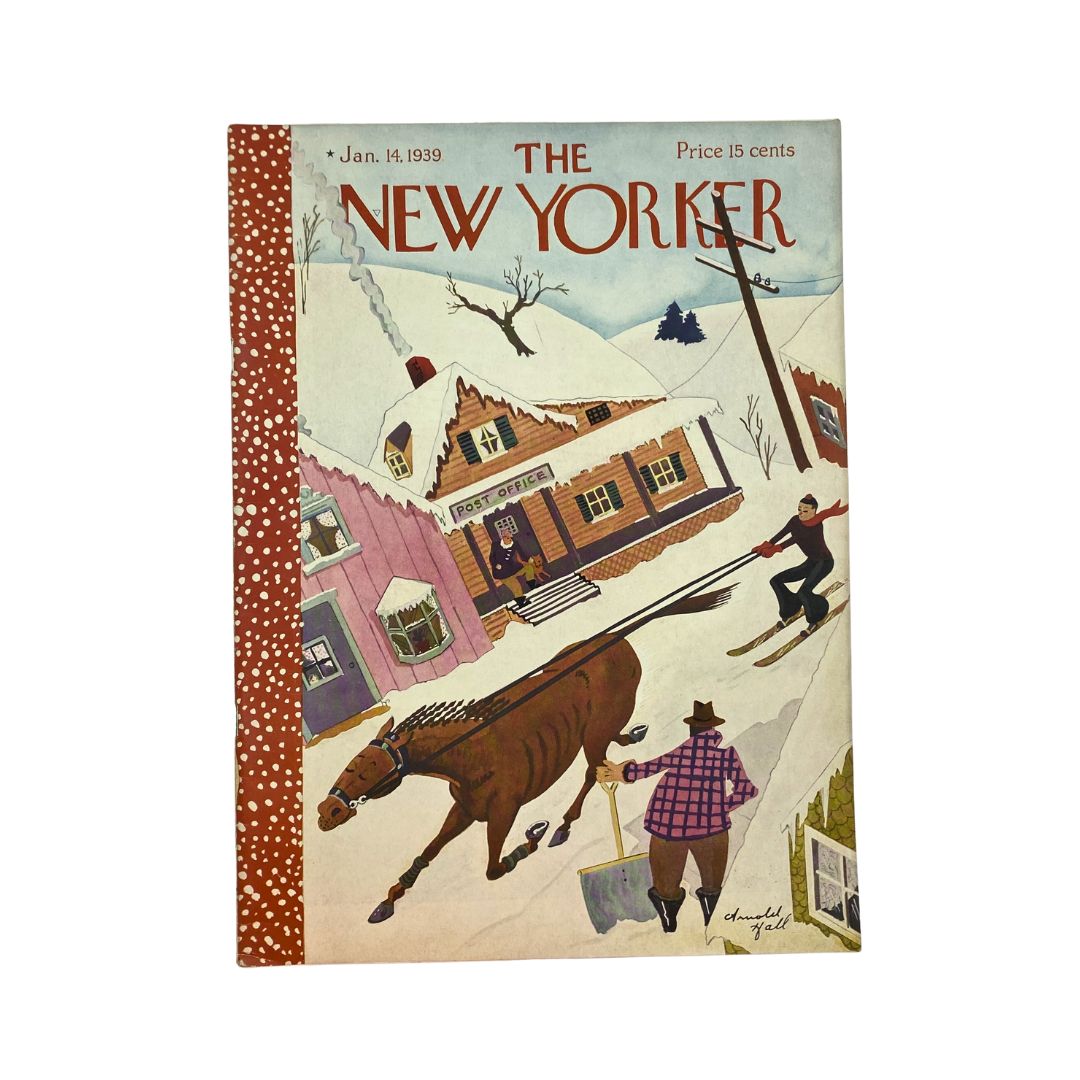
The cover by Arnold Hall gives this issue a specific place within the magazine's late 1930s visual history. Hall contributed cover art to The New Yorker during this period, working in the tradition of vibrant, imaginative illustration that the magazine's art department had cultivated since its founding under Rea Irvin. The listing's description of Hall's work as bringing energy and vibrancy to urban life — illustrations that resonate with an imaginative quality — is consistent with the broader aesthetic sensibility that characterized the magazine's contributing artists who found the visual dynamism and social texture of New York worth capturing with enthusiasm and formal invention. A Hall cover from January 1939 is a relatively uncommon artifact within the magazine's pre-war visual archive, representing the work of a contributing artist whose output during this period is less widely documented than that of the publication's most frequently appearing names. For collectors tracing the complete visual history of the publication through original New Yorker issues, covers by artists of this kind — energetic, characteristic of their moment, and encountered less frequently in the collector market — represent some of the most historically honest and least competed-for material available.
A mid-January issue also carries a specific quality within the magazine's annual publishing rhythm. Second-week-of-January numbers from this period reflect the publication fully resuming its editorial season after the holiday break, with the new year's cultural and political landscape coming into focus. In January 1939, that resumption was taking place in a world whose political landscape was darker and more fragile than it had been at the start of any previous year in the magazine's fourteen-year history, and the editorial intelligence that The New Yorker brought to its coverage of that moment was operating with unusual urgency and precision.
About the Publication
Founded in February 1925 by Harold Ross, The New Yorker was by January 1939 one of the most editorially distinguished and internationally attentive weekly publications in the English-speaking world, fourteen years into its run and operating with the full confidence of a publication that had established itself as the standard of American literary and journalistic excellence. Its readership was urban, educated, and expected the combination of wit, literary quality, and serious engagement with the world that Ross enforced with legendary editorial discipline. The magazine's format was mature and consistent: "Talk of the Town" commentary opened each issue, followed by reported features, fiction, poetry, and critical reviews spanning theater, books, art, and film, all interwoven with cartoons and spot illustrations representing the full flowering of the magazine's interwar visual tradition. Covers were individually commissioned works of illustration, produced by a rotating roster of contributing artists whose collective late-1930s output constitutes one of the most visually accomplished and historically resonant periods in the publication's history.
Key Highlights Inside
- Arnold Hall cover illustration: The cover is the most historically documentable feature of this issue — original artwork by a contributing illustrator known for energetic and vibrant depictions of urban life, working in the visual tradition that defined The New Yorker's late 1930s cover aesthetic.
- Ten days after Roosevelt's 1939 State of the Union: Published ten days after Roosevelt's January 4 State of the Union address — in which he warned Congress with unusual directness about the threat posed by aggressor nations — this issue appeared in the immediate aftermath of one of the most sobering presidential addresses of the interwar period.
- Post-Munich opening of 1939: Published in the first full month of the year following the Munich Agreement, this issue captures the magazine's editorial voice in the opening weeks of the last year of European peace — a moment whose historical significance only deepens with the knowledge of what September 1939 would bring.
- New year cultural and political landscape: Mid-January issues from this period reflect The New Yorker fully resuming its editorial season with the attentiveness and critical engagement that characterized its winter numbers — in January 1939, operating against a political backdrop of unusual gravity.
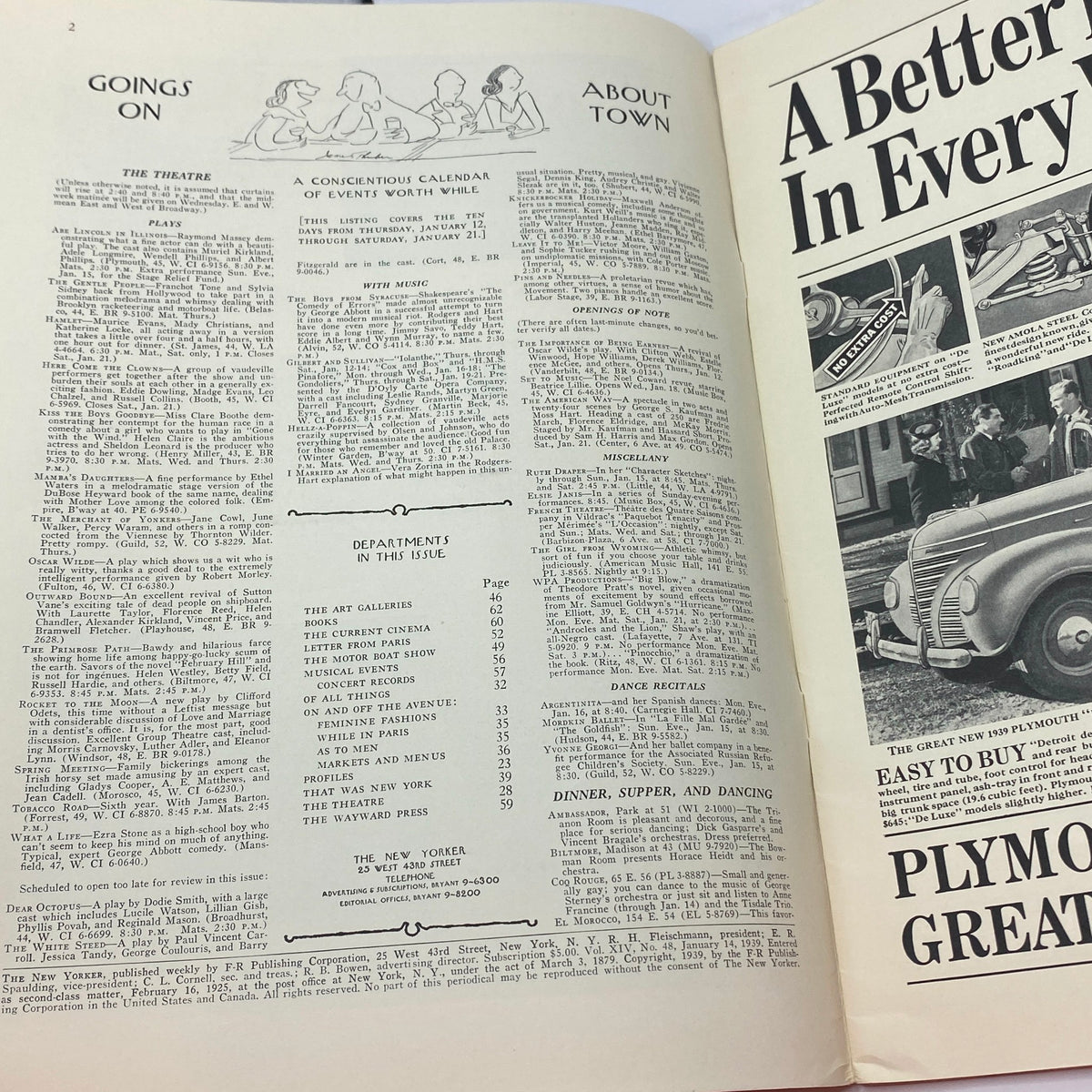
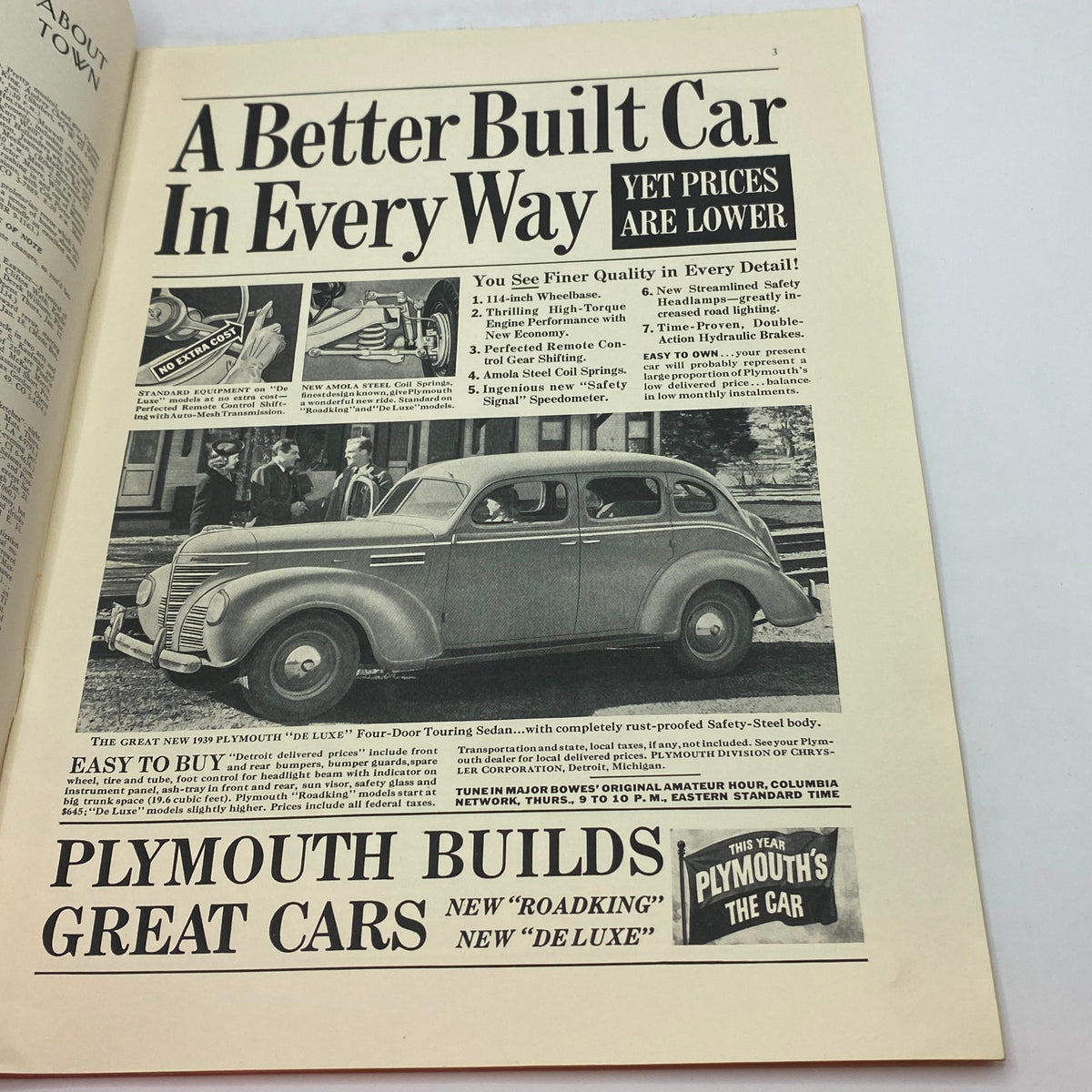
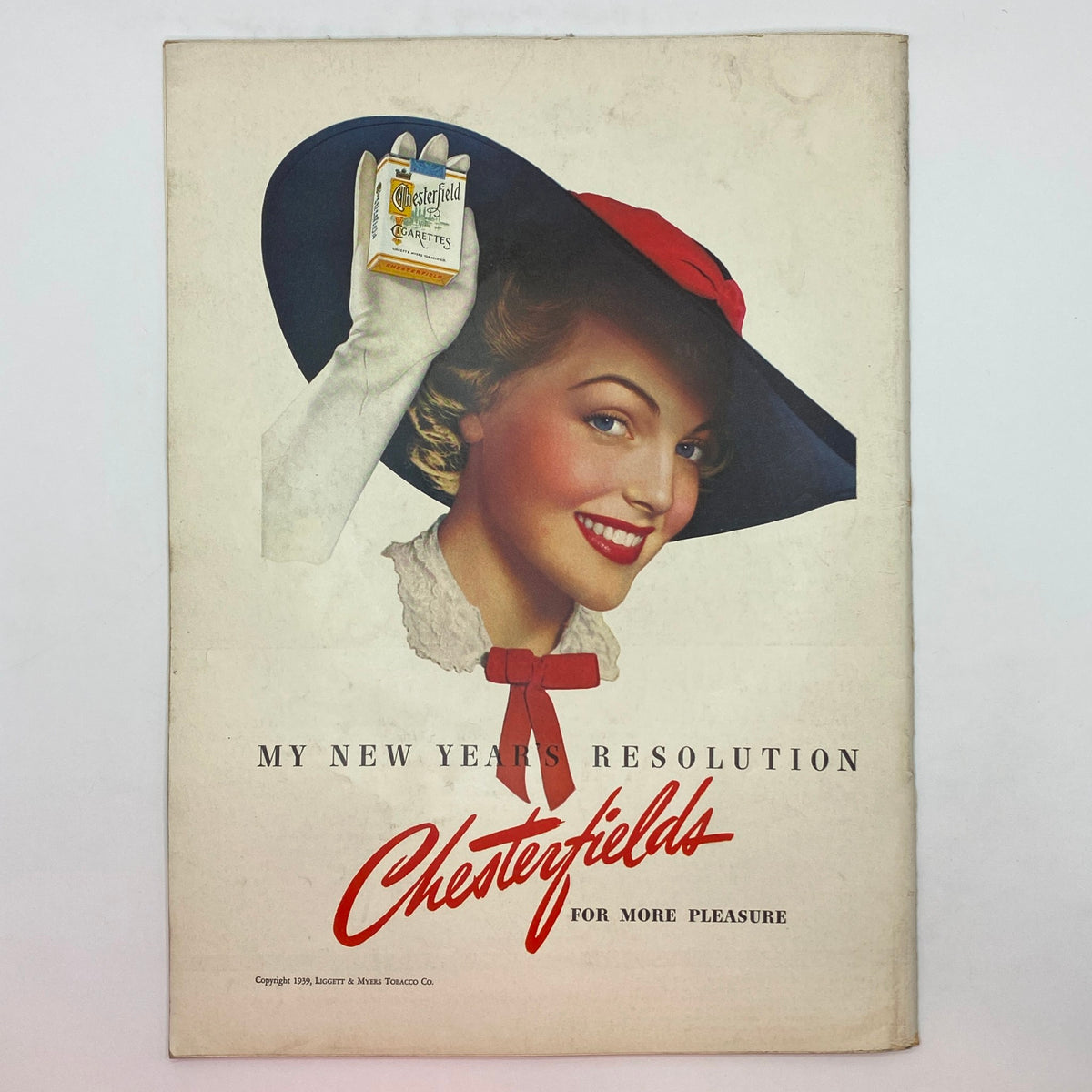
- Period cartoons and advertising: Issues from early 1939 are valued by collectors and cultural historians for the cartoons, illustrations, and advertising that together document American civilian life and cultural confidence in the final months before the outbreak of the Second World War.
Note: Specific article titles, bylines, and interior content for this exact issue have not been independently confirmed beyond what appears in the listing. The highlights above reflect only what is verifiable from the cover credit, publication date, and the magazine's well-documented editorial format during this period.
Condition & Rarity
A surviving copy of a weekly newsstand magazine from January 1939 presenting in very good condition — with minor edge wear as the only noted imperfection and the quality of ink and craftsmanship described as appreciable — is a sound and desirable preservation result for a publication now eighty-six years old. The New Yorker was printed on acidic wood-pulp paper stock standard for weekly periodicals of this era, a material inherently prone to toning, brittleness, and structural fatigue over time. Edge wear of the kind described is entirely consistent with honest age and careful storage. The specific mention of appreciable ink quality and craftsmanship throughout the interior pages is a meaningful positive condition note for an issue of this age, where paper degradation can affect print clarity. When evaluating any surviving copy of this issue, the meaningful criteria are the integrity and color fidelity of Hall's cover art, the completeness of all interior pages, the absence of subscription label adhesive residue or moisture damage, and the structural soundness of the spine. A copy meeting the standard described represents the preservation grade that serious collectors of pre-war periodicals actively seek.
Looking for More Issues Like This?
Arnold Hall covers from early 1939 are among the less commonly encountered in the pre-war New Yorker collector market, and this specific January 14 date — in the opening weeks of the last full year before the Second World War — makes it a find whose historical significance rewards the patient search. If it is no longer available, the extensive original New Yorker collection at OriginalMagazines.com is one of the deepest archives of the magazine accessible to collectors anywhere, spanning many decades of its publishing history. For those drawn to the charged and irreplaceable atmosphere of the final pre-war months, the full 1939 magazine collection rewards the most careful and unhurried exploration — it is a year whose historical gravity is unlike any other in the magazine's long and distinguished run.