

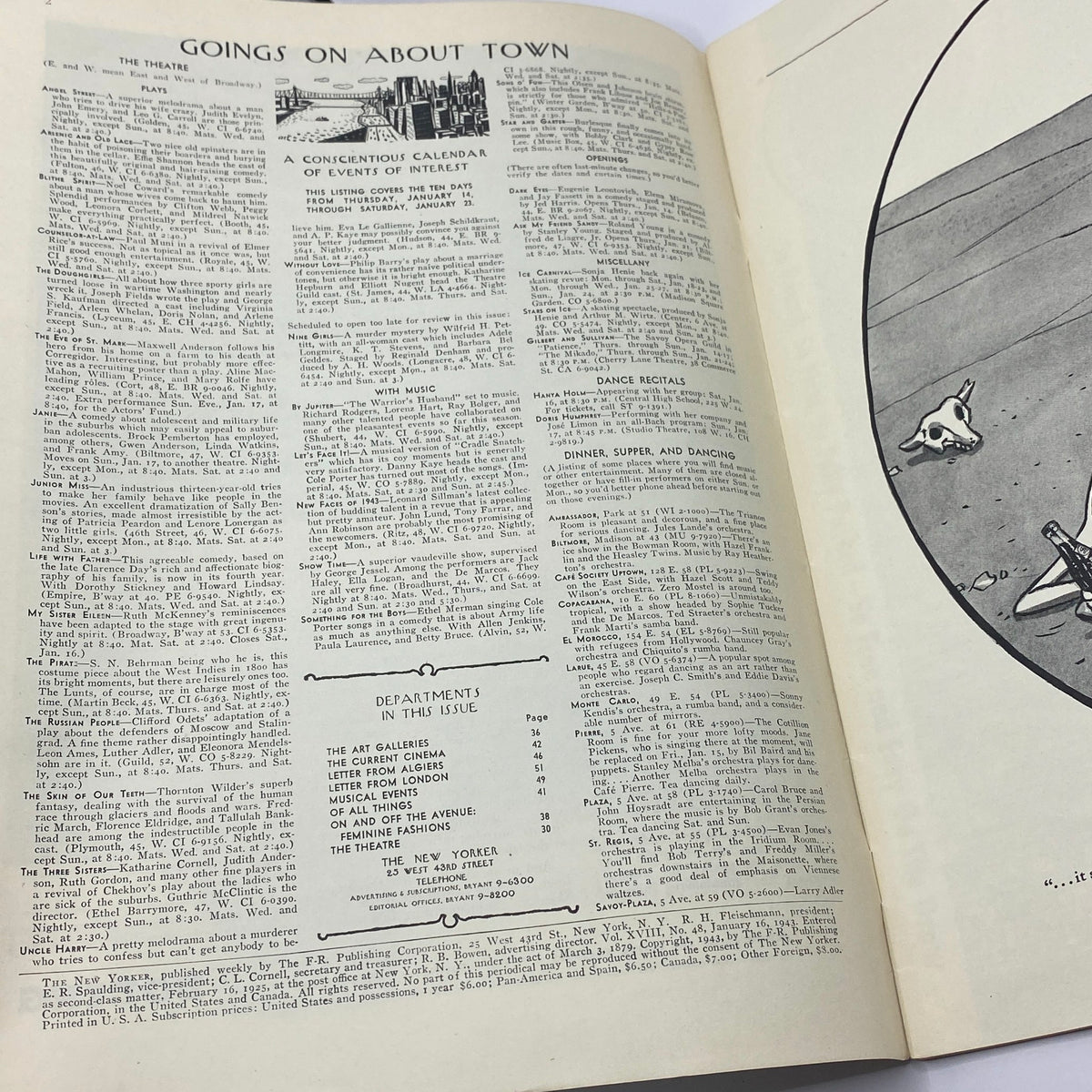
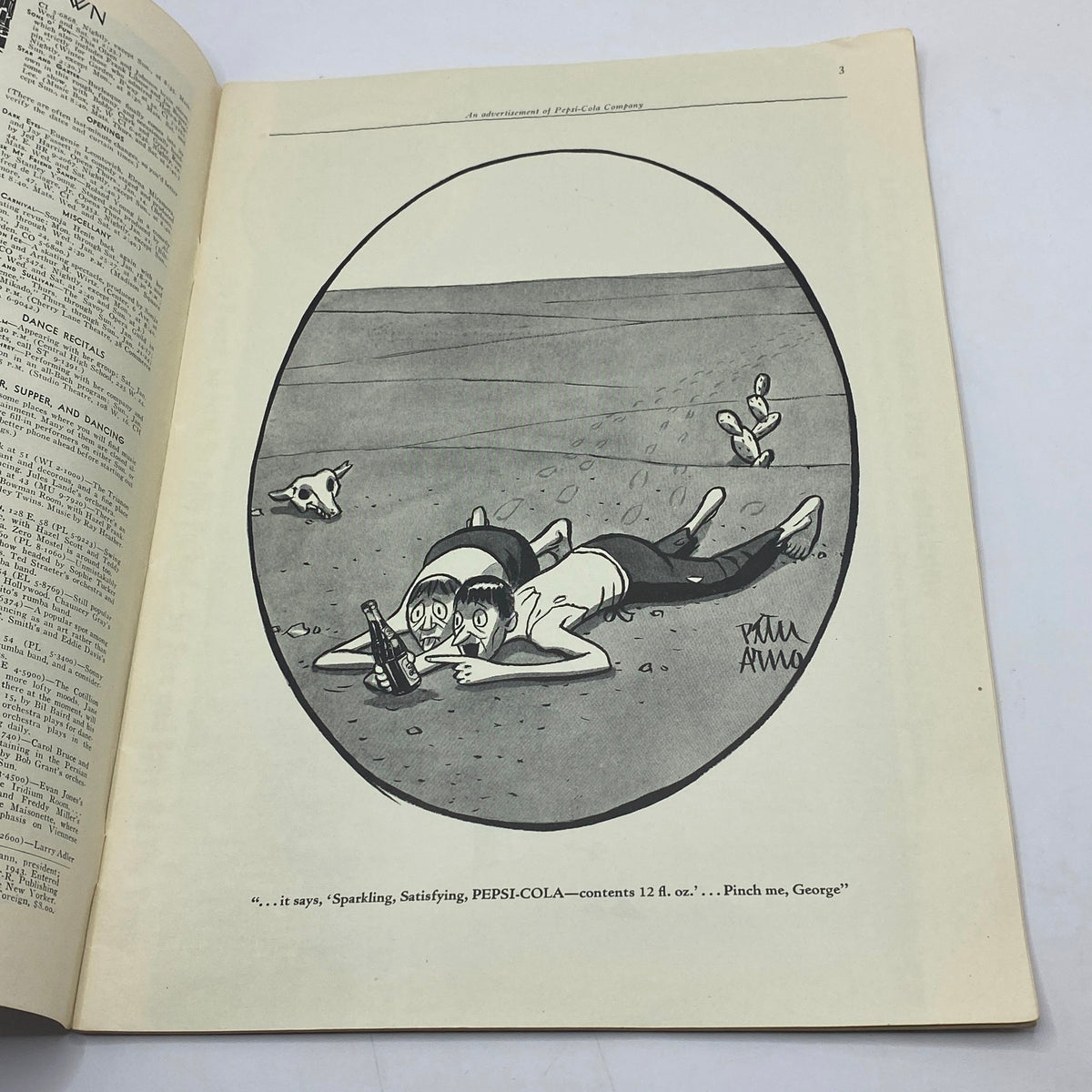


Description
Collector's Note – Why This Issue Matters
The January 16, 1943 issue of The New Yorker is a document of the magazine at one of the most consequential periods in its history. By the third week of January 1943, the United States had been at war for just over a year, and The New Yorker — under the editorship of Harold Ross — had transformed itself into one of the most serious and morally engaged publications in American journalism without abandoning the wit and literary sophistication that defined its identity. The magazine's wartime issues are among the most studied in its entire run: its correspondents were filing from every theater of the war, its fiction writers were grappling with what the conflict meant for American life, and its cartoonists were finding ways to sustain the comedy of civilian existence against a backdrop of global catastrophe. A January 1943 issue captures that editorial equilibrium at a moment when the war's outcome was still genuinely uncertain — the Allied landings in North Africa had occurred in November 1942, Stalingrad was still being fought, and the Pacific campaign was grinding forward with no clear end in sight. For collectors building archives of vintage New Yorker magazines, wartime issues from the Ross era represent some of the most historically charged and editorially distinctive material in the publication's long run.
The January 16, 1943 issue arrives at a specific moment within the magazine's wartime editorial calendar. Ross had been struggling throughout 1942 with the challenges of producing a sophisticated literary and cultural weekly during a total war — paper rationing, staff departures for military service, and the editorial question of how much the magazine should change its voice and priorities in response to the conflict. By early 1943 an editorial equilibrium had been found: The New Yorker would cover the war with seriousness and depth through its reporting and fiction while maintaining its commitment to the cultural and domestic life that its readership continued to live. That balance is visible in surviving wartime issues, which combine war correspondence and fiction engaging directly with the conflict alongside the cartoons, criticism, and lighter pieces that had always been central to the magazine's identity. Collectors of 1943 magazines will find this issue representative of American literary journalism operating under the specific pressures and creative constraints of a nation at war.
The cover art of any given New Yorker issue from this period was produced by the magazine's roster of contributing illustrators — artists whose weekly commissions had created a visual archive of American life across more than fifteen years by January 1943. Wartime covers from this era engaged with the season, with civilian life, and occasionally with the war itself in ways that reflected the magazine's careful editorial calibration of how directly to address the conflict in its most visible and immediate editorial space. The specific cover artist and image for the January 16, 1943 issue would be confirmed by the magazine's own masthead or by reference sources documenting New Yorker cover art — collectors seeking that specific attribution should consult those primary sources directly.
About the Publication
The New Yorker, founded by Harold Ross in 1925 and published weekly by Condé Nast, was by January 1943 in the eighteenth year of its publication and fully established as the most literarily distinguished general-interest weekly in the United States. Its editorial identity rested on short fiction, poetry, long-form reportage, cultural criticism, and single-panel cartoons, directed at a sophisticated readership that expected the magazine to be both entertaining and genuinely serious. The wartime years under Ross produced some of the magazine's most celebrated journalism — including work by A. J. Liebling, E. B. White, Mollie Panter-Downes, and John Hersey, among many others — and the issues from 1942 through 1945 are regarded by students of the magazine's history as among its most historically significant.
Key Highlights Inside
Specific interior article titles, fiction, poetry, criticism, and named contributors have not been confirmed from available sources for this issue. The highlights below reflect only what is verifiable from the listing and well-documented facts about the publication and its editorial era.
- January 1943 wartime editorial content — Published in the third week of the first full calendar year of American participation in the Second World War, this issue's content reflects The New Yorker's carefully maintained balance between war coverage and the literary, cultural, and comic material that defined its peacetime identity.
- Harold Ross wartime editorship — Produced during the period when Ross was navigating the editorial and logistical challenges of publishing a sophisticated literary weekly in wartime America, this issue documents the magazine's voice at one of its most historically tested moments.
- Very good condition with minor edge wear — A strong condition grade for an eighty-plus-year-old weekly magazine, indicating careful preservation and an above-average survival state for a publication of this age.
- Complete issue confirmed — The listing confirms this as a complete issue, meaning all editorial content — fiction, poetry, criticism, cartoons, advertising — is present, which is the primary completeness factor for research and collector evaluation of New Yorker issues from this era.
Condition & Rarity
Very good condition with only minor edge wear represents a genuinely strong survival grade for a January 1943 New Yorker. Issues from the wartime years are less commonly encountered in collector-grade condition than pre-war or postwar numbers — paper rationing affected the magazine's production stock, and the issues from this period were read actively by a wartime readership that had other things on their minds than archival preservation. A very good copy with complete interior content and only minor edge wear indicates either careful original ownership or early deliberate preservation. For New Yorker issues from this era, the standard structural evaluation points are the condition of the saddle-stitch staple binding — which can loosen or rust over eight decades — and the absence of significant toning on interior pages. The listing's confirmation of complete content is a meaningful positive for research and collector purposes, as wartime issues with missing pages or detached covers are more commonly encountered than intact examples at this age.
Looking for More Issues Like This?
Wartime New Yorker issues in very good condition are among the more rewarding finds in the magazine's back-catalogue — they document the publication at a moment of genuine historical pressure and creative distinction, and complete examples with clean interiors are less common than their importance deserves. The broader New Yorker archive at OriginalMagazines.com spans many decades of the magazine's run and is worth exploring carefully for other wartime and Ross-era issues. For collectors focused on the specific editorial and cultural moment of 1943, the complete 1943 magazine collection documents one of the most consequential years in American publishing and cultural history across a wide range of titles.