



Description
Collector's Note – Why This Issue Matters
The January 27, 1940 issue of The New Yorker with a cover by Constantin Alajalov arrives at one of the most consequential moments in the magazine's history and in the broader history of American cultural life. January 1940 sits in the uneasy interval between the outbreak of war in Europe — Germany had invaded Poland in September 1939, and Britain and France had declared war — and America's own entry into the conflict, which was still nearly two years away. New York in early 1940 was a city processing the implications of a European war that many Americans desperately hoped to avoid. The New Yorker under Harold Ross was navigating that tension with the particular combination of urbanity, wit, and seriousness that had defined the magazine since its 1925 founding, and its covers during this period were doing something more than decoration — they were offering a visual commentary on city life at a moment of genuine historical anxiety. Constantin Alajalov was one of the publication's most consistently employed cover artists across several decades, known for his warmly humorous depictions of New York social life that managed to be simultaneously affectionate and gently satirical. His covers gave the magazine a recognizable visual personality during an era when The New Yorker's covers were among the most studied single images in American periodical publishing. Collectors who follow the magazine's visual history will find the full breadth of its cover art across the decades documented throughout the New Yorker collection at OriginalMagazines.com.
Alajalov was born in Russia in 1900 and came to the United States in the early 1920s, becoming one of The New Yorker's signature cover artists from the late 1920s through the 1950s. His style was warm, slightly theatrical, and consistently focused on the comedy and pathos of urban social situations — dinner parties, theater crowds, the rituals of New York professional life — rendered with a draftsmanship that was genuinely accomplished and an eye for human absurdity that was perfectly calibrated to the magazine's editorial sensibility. A January 1940 Alajalov cover would have reflected the specific visual and social vocabulary of that winter moment: the fashions, social rituals, and urban textures of a New York that was outwardly functioning normally while the world outside its borders was being remade by force. The 1940 magazines collection provides essential context for this extraordinary year — one in which the pace of European military events accelerated dramatically through the spring and summer, transforming American public opinion and beginning the slow process that would bring the country into the war.
About the Publication
The New Yorker was founded in New York in 1925 by Harold Ross with the explicit intention of creating a magazine of sophisticated urban wit and literary quality aimed at a cosmopolitan readership rather than the rural mainstream. By January 1940, under Ross's continued editorship, it had established itself as the most prestigious literary and cultural weekly in the United States, renowned for its fiction, poetry, criticism, and reporting, as well as its cartoons and cover art. Its editorial format combined long-form journalism and criticism with short fiction, poetry, and the "Talk of the Town" section of brief urban observations, all anchored by the weekly cover — which functioned as a standalone work of art rather than a headline illustration. Its readership was educated, urban, and self-consciously sophisticated, and the magazine's tone of dry, knowing intelligence was one of the most imitated in American journalism.
Key Highlights Inside
- Constantin Alajalov cover art — A cover by one of The New Yorker's most celebrated and consistently employed cover artists, representing his warm, socially observant visual style at a significant moment in the magazine's history and in American cultural life.
- January 1940 editorial content — Consistent with the magazine's well-documented format of the period, the issue would have included fiction, poetry, criticism, cartoons, Talk of the Town observations, and reporting reflecting the cultural and social moment of early 1940 New York.
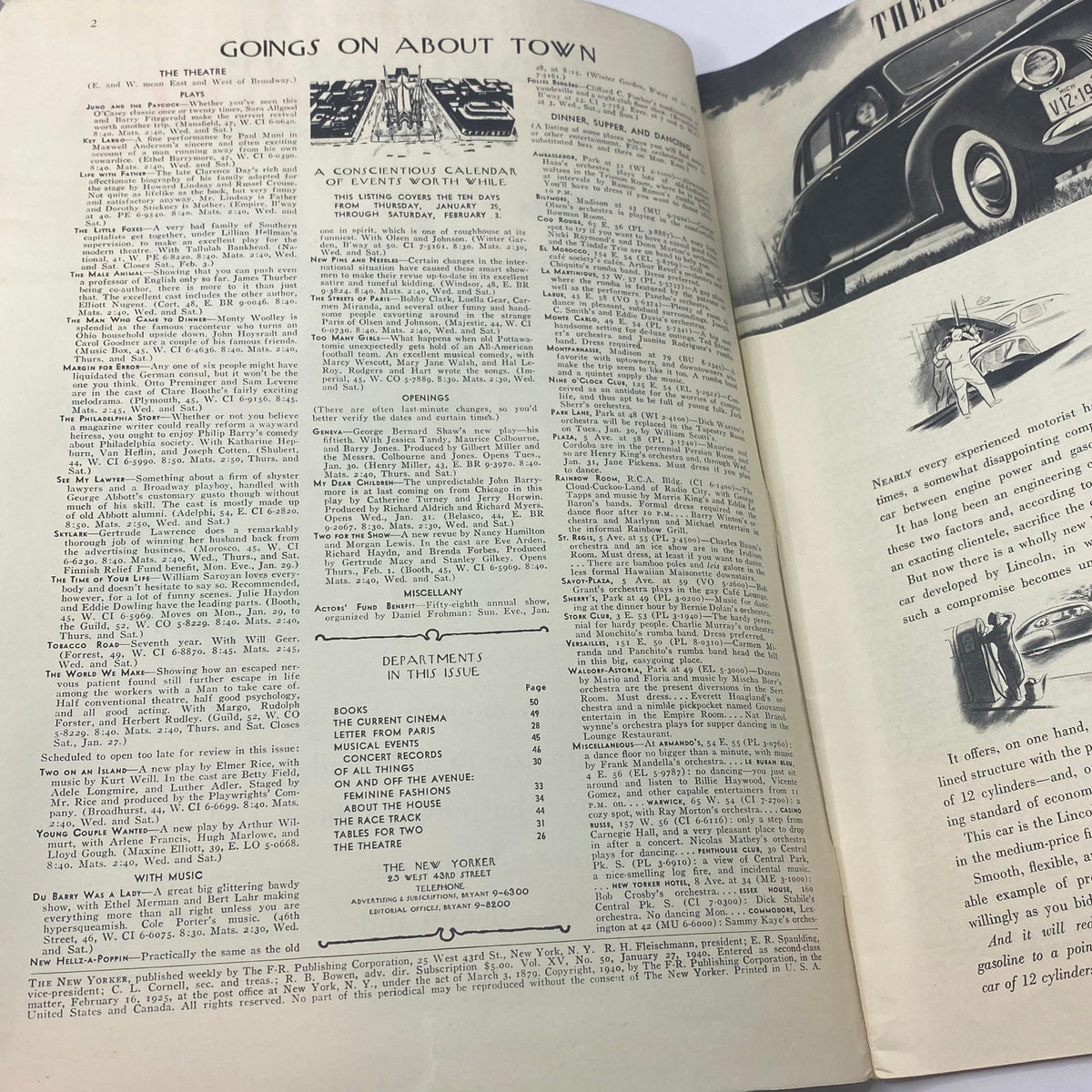
- Minor water damage noted — The issue exhibits minor water damage consistent with its age, a condition attribute relevant to collectors evaluating the legibility and integrity of the cover art and interior pages.
- Note: Specific interior article titles, fiction contributors, and additional content have not been independently confirmed for this issue. The highlights above reflect the well-documented editorial format of The New Yorker during this period and the verifiable identity of the cover artist.
Condition & Rarity
Issues of The New Yorker from January 1940 are eighty-five years old, and the paper stock used in the magazine's weekly production during this era was not manufactured for archival longevity. When evaluating any surviving copy of this issue, the attributes that matter most to serious collectors are the condition of the Alajalov cover art — its color integrity, surface condition, and freedom from significant staining or tearing — the structural integrity of the spine and staple binding, and the completeness of interior pages. The minor water damage noted in the listing is a condition attribute that collectors should evaluate through the provided photographs, as water damage on paper of this age ranges considerably in its visual impact depending on the degree and location of the damage. Any tanning, edge wear, or foxing consistent with eighty-five years of existence is expected and does not inherently disqualify a copy from serious collector consideration, particularly for an issue of this cover artist significance. The completeness and legibility of the Alajalov cover image is the primary condition variable for this specific issue.
Looking for More Issues Like This?
Early 1940s issues of The New Yorker with covers by Constantin Alajalov are genuine finds for collectors of both the magazine's visual history and American illustration from this period, and the January 27, 1940 issue is a particularly historically situated example. If it is currently unavailable, the New Yorker collection at OriginalMagazines.com is the best place to browse what has recently surfaced from across the magazine's long publishing history. Collectors with a broader interest in the print culture of this extraordinary year should also explore the 1940 magazines collection for a wider view of American media during one of the twentieth century's most consequential twelve months.