

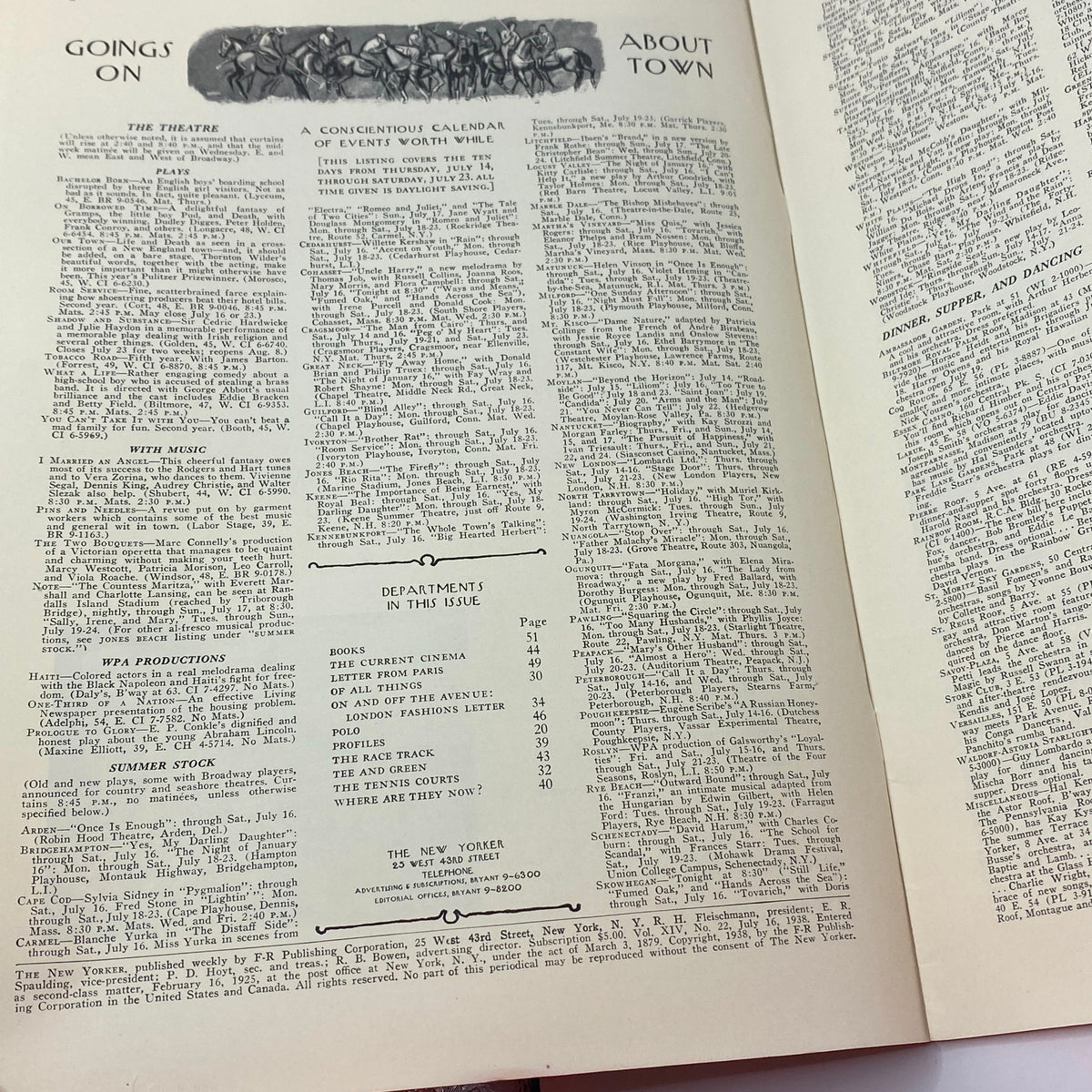


Description
Collector's Note – Why This Issue Matters
July 16, 1938 places this issue of The New Yorker at a moment when the accumulating pressures of the late 1930s were approaching their most critical phase. Hitler had annexed Austria in March — the Anschluss had been accomplished with barely a murmur of effective international resistance — and by July 1938 the next target, the Sudetenland of Czechoslovakia, was already the subject of escalating German demands and diplomatic crisis. The Munich Agreement was just ten weeks away. In the United States, the debate about the country's proper relationship to European events was intensifying, and New York's large Central European immigrant community was following the news from the continent with a dread that was becoming increasingly difficult to contain within the conventions of ordinary social life. Against this backdrop, the summer of 1938 in New York carried a quality of suspended anxiety — the cultural life of the city proceeding with its usual vitality while the world beyond its borders moved toward catastrophe. For collectors building a serious historical archive through original magazines from 1938, a mid-July issue from this year documents the American home front in the last full summer before Munich, at a moment of maximum pre-war tension.
The cover by Perry Barlow gives this issue a quality that is characteristic of The New Yorker's most interesting pre-war visual output. Barlow was a long-serving contributor to the magazine whose work was recognized for exactly the qualities the listing identifies — whimsical, humorous illustrations that captured the essence of everyday life with warmth and a light-hearted touch that found the relatable moment in ordinary domestic and social scenes. His covers tend toward the intimate and the human-scaled, treating their subjects with affectionate observation rather than sharp satire. A Barlow cover from July 1938 carries an atmospheric quality that is specific to this summer — the warm, everyday-life comedy of his visual world produced at the precise moment before the Munich crisis would force the question of European war into the center of American consciousness. For collectors tracing the visual history of the publication through original New Yorker issues, Barlow covers from the late 1930s represent a distinctive and humanly resonant strand of the magazine's pre-war visual archive.
A mid-July issue also occupies a specific position in the magazine's annual publishing rhythm. Summer numbers from this period carried a somewhat lighter editorial register than the autumn issues, but the summer of 1938 was one in which the lighter register was under increasing pressure from the weight of international events. The combination of Barlow's characteristic warmth and the gathering European crisis gives any surviving issue from this specific July a layered quality that purely peacetime summer issues cannot replicate, and that only becomes visible when you know what the following ten weeks would bring.
About the Publication
Founded in February 1925 by Harold Ross, The New Yorker was by the summer of 1938 one of the most editorially distinguished and internationally attentive weekly publications in America, thirteen years into its run and fully secure in its literary and journalistic identity. Its readership was urban, educated, and expected the combination of wit, critical intelligence, and serious engagement with the world that Ross enforced with legendary editorial discipline. The magazine's format was mature and consistent: "Talk of the Town" commentary opened each issue, followed by reported features, fiction, poetry, and critical reviews spanning theater, books, art, and film, all interwoven with cartoons and spot illustrations representing the full flowering of the magazine's interwar visual tradition. Covers were individually commissioned works of illustration, each a complete artistic statement, produced by a rotating roster of contributing artists whose collective late-1930s output constitutes one of the most visually accomplished and historically resonant periods in the publication's history.
Key Highlights Inside
- Perry Barlow cover illustration: The cover is the defining collectible feature of this issue — original artwork by a long-serving New Yorker contributor known for whimsical, warmly observed depictions of everyday life, whose light-hearted visual sensibility carried a particular resonance when set against the gathering international crisis of the summer of 1938.
- Pre-Munich summer of 1938: Published ten weeks before the Munich Agreement — the pivotal diplomatic capitulation of September 1938 that effectively ended the Versailles framework and made a general European war inevitable — this issue captures the magazine's voice in the last full summer before that threshold was crossed.
- Post-Anschluss international atmosphere: By July 1938, Hitler's annexation of Austria in March had been absorbed by international opinion with minimal effective resistance, and the next stage of German territorial demands was already being signaled — an atmosphere that the magazine's internationally attentive editorial staff was tracking with full awareness.
- Summer 1938 New York cultural life: Issues from this specific summer document New York's cultural life proceeding with characteristic vitality against a backdrop of European anxiety — a tension that gives the social observation and humor of Barlow's cover art an additional atmospheric layer.
- Period cartoons and advertising: Issues from the late 1930s are consistently valued by collectors and cultural historians for the cartoons, illustrations, and advertising that together provide an irreplaceable record of American social life in the final years before the Second World War.
Note: Specific article titles, bylines, and interior content for this exact issue have not been independently confirmed beyond what appears in the listing. The highlights above reflect only what is verifiable from the cover credit, publication date, and the magazine's well-documented editorial format during this period.
Condition & Rarity
A surviving copy of a weekly newsstand magazine from July 1938 presenting in very good condition — with minor edge wear as the only noted imperfection — is a sound and desirable preservation result for a publication now approaching ninety years old. The New Yorker was printed on acidic wood-pulp paper stock standard for weekly periodicals of this era, a material inherently prone to toning, brittleness, and structural fatigue over time. Edge wear of the kind described is entirely consistent with honest age and careful storage rather than mishandling or neglect. When evaluating any surviving copy of this issue, the meaningful criteria are the integrity and color fidelity of Barlow's cover art, the completeness of all interior pages, the absence of subscription label adhesive residue or moisture damage, and the structural soundness of the spine. A copy meeting the standard described — visually strong at nearly nine decades of age, with wear confined to the margins — represents the preservation grade that serious collectors of pre-war periodicals actively seek when pursuing issues from this historically charged final decade before the Second World War.
Looking for More Issues Like This?
Perry Barlow covers from the summer of 1938 — the last full summer before Munich — are among the more atmospherically layered and historically precise objects in the late-1930s New Yorker collector market, and this specific July 16 date is not one that comes up with any regularity. If it is no longer available, the extensive original New Yorker collection at OriginalMagazines.com is one of the deepest archives of the magazine accessible to collectors anywhere, spanning many decades of its publishing history. For those drawn to the charged pre-war atmosphere of the late 1930s, the full 1938 magazine collection rewards careful and patient exploration — it is a year whose historical momentum is present in every issue that has survived to the present day.