



Description
Collector's Note – Why This Issue Matters
July 27, 1935 places this issue of The New Yorker at a moment of particular historical and cultural intensity. The summer of 1935 was one of the most legislatively consequential in American history — the so-called Second New Deal was in full force, with the Social Security Act, the National Labor Relations Act, and the Banking Act of 1935 all signed into law within weeks of this issue's publication. Roosevelt was reshaping the relationship between the federal government and American economic and social life in ways that were generating fierce debate, and New York — as the country's financial and cultural capital — was at the center of those arguments. Internationally, Mussolini's preparations for the invasion of Ethiopia were becoming unmistakably clear through the summer of 1935, adding a darkening international dimension to what was already a charged domestic atmosphere. For collectors building a serious historical archive through original magazines from 1935, a late July issue carries the full weight of one of the most consequential legislative summers of the entire Depression era.
The cover by William Steig gives this issue a significance that extends well beyond its historical moment. Steig is one of the most remarkable figures ever associated with The New Yorker — an artist whose relationship with the magazine began in the late 1920s and continued for decades, producing hundreds of cartoons and cover illustrations that earned him a permanent place in the publication's artistic history. But Steig's legacy extends far beyond his magazine work: he went on to become one of the most celebrated children's book authors and illustrators of the twentieth century, with works including Sylvester and the Magic Pebble, Dominic, Abel's Island, and — most famously in recent decades — Shrek!, the picture book that became the basis for the DreamWorks film franchise. A New Yorker cover from July 1935 is an artifact of Steig's early career, produced before the children's book work that would define his later reputation, when his distinctive visual sensibility — the blend of whimsy, emotional depth, and insight into human nature that the listing accurately identifies — was being deployed in the magazine's cover format. For collectors tracing the visual history of the publication through original New Yorker issues, a Steig cover from the mid-1930s is a primary artifact of that early career phase, more historically rare than the work for which he is most widely known today.
The combination of Steig's early artistic voice and the specific historical moment of July 1935 gives this issue a layered quality that rewards attention from multiple angles simultaneously. The whimsy and emotional intelligence of his visual approach — the capacity to blend humor with a poignant understanding of human nature, as the listing describes — was being exercised against a backdrop of Depression-era hardship and political transformation that gives it an additional resonance. This is not simply a charming magazine cover. It is an early work by one of America's most beloved creative figures, produced at a pivotal moment in the country's history.
About the Publication
Founded in February 1925 by Harold Ross, The New Yorker was by the summer of 1935 a fully established institution of American cultural life, ten years into its run and operating with the editorial confidence and literary ambition that would define its reputation for generations. Its readership was urban, educated, and expected the combination of wit, critical intelligence, and serious engagement with the world that Ross enforced with unusual editorial discipline. The magazine's format was mature and consistent: "Talk of the Town" commentary opened each issue, followed by reported features, fiction, poetry, and critical reviews spanning theater, books, art, and film, all interwoven with cartoons and spot illustrations that had developed by mid-decade into one of the most celebrated creative traditions in American periodical publishing. Covers were individually commissioned works of illustration, produced by a rotating roster of contributing artists whose collective Depression-era output constitutes a remarkable visual record of American urban life during one of its most complex and creative periods.
Key Highlights Inside
- William Steig cover illustration: The cover is the defining collectible and historically significant feature of this issue — early career artwork by one of the most remarkable creative figures ever associated with The New Yorker, an artist who would go on to become one of the most celebrated children's book authors of the twentieth century, here represented at the beginning of his long relationship with the magazine.
- Second New Deal legislative summer: Published during the most concentrated period of New Deal legislation in American history, with the Social Security Act and the National Labor Relations Act both signed into law within weeks of this issue, this number appeared at a moment of genuine transformative domestic change.
- Pre-Ethiopia invasion international atmosphere: By late July 1935, Mussolini's preparations for the invasion of Ethiopia were clearly visible to informed observers, adding an international dimension of fascist aggression to the summer's already charged political atmosphere.
- Mid-Depression New York cultural life: By the summer of 1935, New York's cultural institutions had adapted to Depression conditions with remarkable resilience, and The New Yorker's summer editorial content reflected that adaptation with characteristic wit and precision.
- Early Steig visual sensibility: A 1935 cover represents Steig's work at an early stage of his New Yorker career — the blend of whimsy, humor, and emotional depth that would later define his children's book work already present and operating within the magazine's cover format.
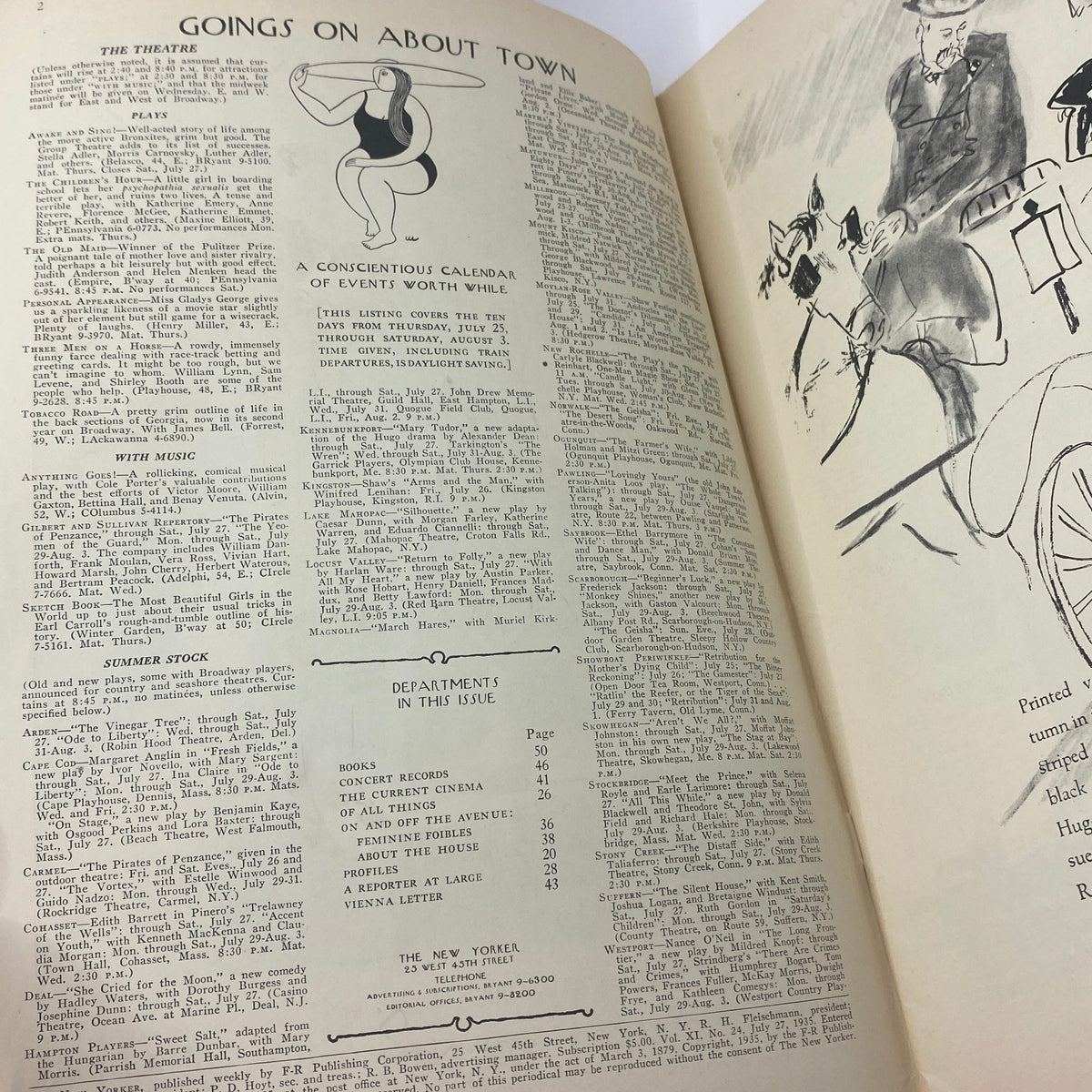
Note: Specific article titles, bylines, and interior content for this exact issue have not been independently confirmed beyond what appears in the listing. The highlights above reflect only what is verifiable from the cover credit, publication date, and the magazine's well-documented editorial format during this period.
Condition & Rarity
A surviving copy of a weekly newsstand magazine from July 1935 presenting in very good condition — with minor edge wear as the only noted imperfection — is a genuinely strong preservation result for a publication now ninety years old. The New Yorker was printed on acidic wood-pulp paper stock standard for weekly periodicals of the era, a material inherently prone to toning, brittleness, and structural degradation over time. Edge wear of the kind described is entirely consistent with honest age and careful storage rather than mishandling or neglect. When evaluating any surviving copy of this issue, the meaningful criteria are the integrity and character fidelity of Steig's cover art — his distinctive line and the expressive quality of his figures are particularly sensitive to toning or foxing that obscures detail — the completeness of all interior pages, the absence of subscription label adhesive residue or moisture damage, and the structural soundness of the spine. A copy meeting the standard described — visually strong at nine decades of age, with wear confined to the margins — represents the preservation grade that serious collectors of Depression-era periodicals, and particularly of early Steig material, actively seek.
Looking for More Issues Like This?
William Steig covers from the mid-1930s are among the most personally significant objects in the New Yorker collector market — early work by an artist whose later achievements give his magazine output a biographical resonance that few other contributors can match — and this specific July 1935 date, at such a consequential legislative and historical moment, makes it a particularly complete and meaningful find. If it is no longer available, the extensive original New Yorker collection at OriginalMagazines.com is one of the deepest archives of the magazine accessible to collectors anywhere, spanning many decades of its publishing history. For those drawn to the Depression-era magazine at its most creatively and historically abundant, the full 1935 magazine collection rewards careful and unhurried exploration — it is a year whose legislative significance and cultural vitality show up clearly in every issue that has survived to the present day.