



Description
Collector's Note – Why This Issue Matters
July 5, 1941 places this issue of The New Yorker at one of the most historically precise and extraordinary dates of the entire pre-Pearl Harbor period. Two weeks earlier, on June 22, Germany had launched Operation Barbarossa — the invasion of the Soviet Union that transformed the entire scale and character of the Second World War. The issue dated July 5 was the first full New Yorker number to appear after that transformation had been processed through a week's worth of news and public reaction. The implications of Barbarossa were enormous and immediately recognized: the war had expanded to encompass a front of unprecedented scale, the Soviet Union was now effectively an Allied partner, and the strategic calculus of the conflict had been fundamentally altered. In the United States, the debate over intervention was reconfiguring itself rapidly around these new realities. For collectors building a serious historical archive through original magazines from 1941, a July 5 issue is the first number of the post-Barbarossa era — a document produced in the immediate aftermath of the war's most transformative single event prior to Pearl Harbor, at a moment when the world's understanding of what the conflict would become was being reconstructed in real time.
The cover by James Thurber makes this issue one of the most significant and sought-after objects in the pre-war New Yorker collector market. Thurber was not merely a contributor to the magazine — he was one of the central creative figures in its entire identity, a writer and cartoonist whose association with the publication spanned decades and whose work was inseparable from what the magazine was and aspired to be. His cartoons — the anxious men, the formidable women, the surreal domestic scenarios, the dogs — defined a sensibility that was recognizably New Yorker in ways that transcended individual issues. A Thurber cover from July 5, 1941 carries therefore a double historical charge: the artistic authority of one of the magazine's most central creative figures, combined with the extraordinary historical moment of the first post-Barbarossa issue. For collectors tracing the full visual and literary history of the publication through original New Yorker issues, this combination of artist and date is among the most historically resonant available in the magazine's pre-war archive.
July 5 also carries a specific dimension within the American annual calendar. As the day after Independence Day, it occupies a moment charged with national reflection — and in July 1941, with the country navigating the most consequential foreign policy questions it had faced in a generation, that national reflection had an unusual depth and urgency. The juxtaposition of the Fourth of July holiday and the post-Barbarossa world that greeted Americans when they returned to their newspapers on July 5 gives this specific date a quality that collectors attentive to historical calendar will recognize as genuinely distinctive.
About the Publication
Founded in February 1925 by Harold Ross, The New Yorker was by the summer of 1941 one of the most editorially distinguished and internationally attentive weekly publications in the English-speaking world. Its readership was urban, educated, and expected the combination of wit, literary quality, and serious engagement with world affairs that Ross enforced with legendary editorial discipline. The magazine's format was fully mature: "Talk of the Town" commentary opened each issue, followed by reported features, fiction, poetry, and critical reviews spanning theater, books, art, and film, all interwoven with cartoons and spot illustrations representing one of the most celebrated creative traditions in American periodical publishing. Covers were individually commissioned works of illustration, produced by a rotating roster of contributing artists whose collective pre-war and wartime output constitutes one of the most visually and historically significant periods in the magazine's long publishing history.
Key Highlights Inside
- James Thurber cover illustration: The cover is the defining collectible and historically significant feature of this issue — original artwork by one of the most important creative figures in The New Yorker's entire history, a cartoonist and writer whose work was central to the magazine's identity across multiple decades and whose covers are among the most sought-after in the collector market.
- First issue after Operation Barbarossa: Published as the first full New Yorker number of the post-Barbarossa era — the first to appear after the June 22 German invasion of the Soviet Union had been absorbed through a full week of news and reaction — this issue documents the magazine's editorial voice at the exact moment the war's character was being fundamentally reconsidered.
- Day after Independence Day: July 5 — the day after the Fourth of July — places this issue at a moment of national reflection that in 1941 carried unusual urgency, with the country navigating its most consequential foreign policy debate while simultaneously processing the implications of the most transformative military development since the war began.
- Post-Barbarossa American intervention debate: The invasion of the Soviet Union had reconfigured the American debate over intervention — with new alignments, new arguments, and new urgencies — and The New Yorker's editorial voice was engaging with those reconfigurations in real time.
- Early summer 1941 wartime editorial atmosphere: Issues from early July 1941 capture the magazine operating at a specific and historically unrepeatable threshold — the American summer of a year that would end with the country at war, with the post-Barbarossa world less than two weeks old.
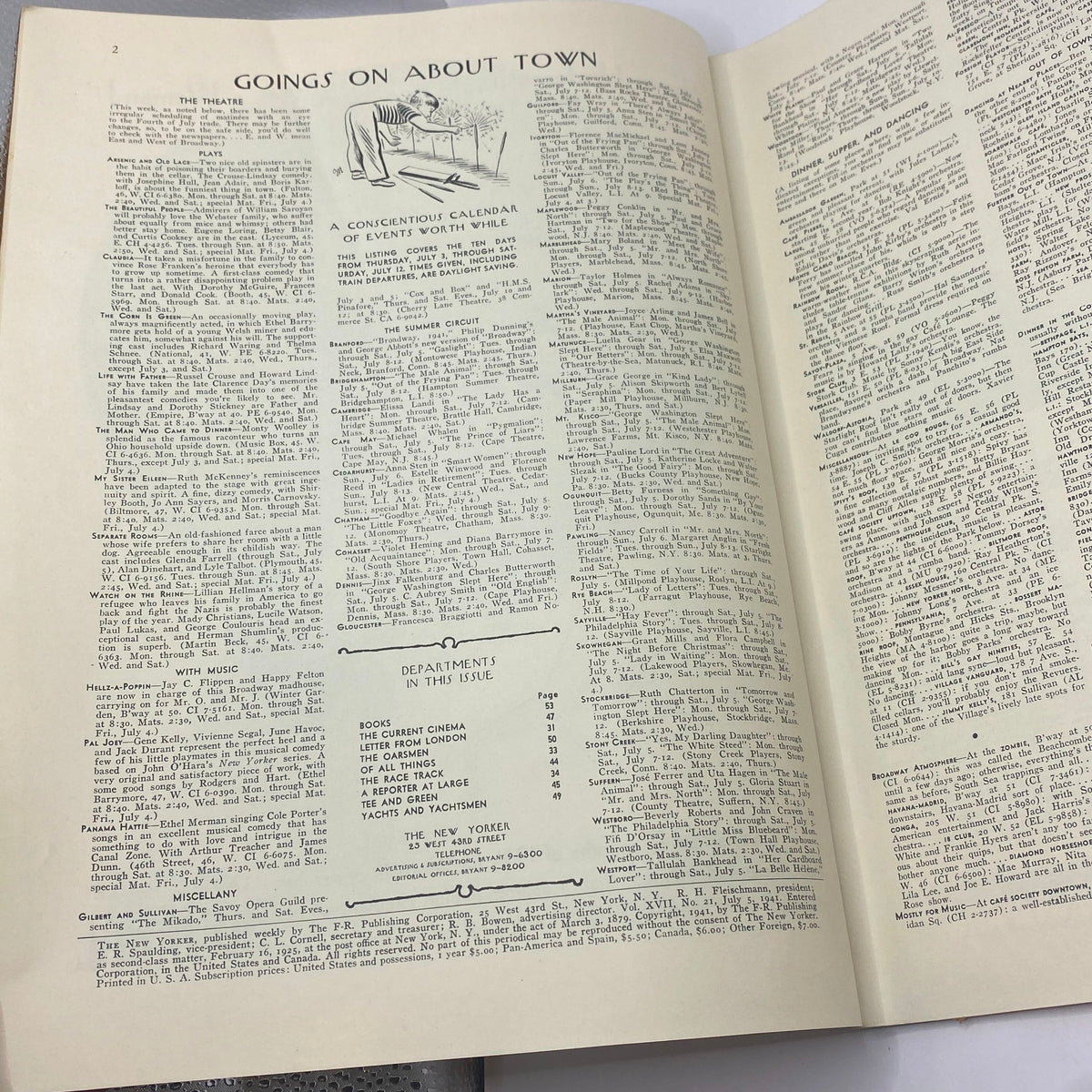
Note: Specific article titles, bylines, and interior content for this exact issue have not been independently confirmed beyond what appears in the listing. The highlights above reflect only what is verifiable from the cover credit, publication date, and the magazine's well-documented editorial format during this period.
Condition & Rarity
A surviving copy of a weekly newsstand magazine from July 5, 1941 presenting in very good condition — with minor edge wear as the only noted imperfection — is a sound and genuinely desirable preservation result for a publication now more than eighty years old. The New Yorker was printed on acidic wood-pulp paper stock standard for weekly periodicals of this era, a material inherently prone to toning, brittleness, and structural fatigue over time. Edge wear of the kind described is entirely consistent with honest age and careful storage rather than mishandling or neglect. When evaluating any surviving copy of this issue, the meaningful criteria are the integrity and line fidelity of Thurber's cover art — his characteristic loose draftsmanship is particularly sensitive to any toning or foxing that obscures line detail — the completeness of all interior pages, the absence of subscription label adhesive residue or moisture damage, and the structural soundness of the spine. A copy meeting the standard described — visually strong at over eighty years of age, with wear confined to the margins — represents the preservation grade that serious collectors of pre-war and wartime periodicals actively seek, and particularly so for Thurber-associated material from this historically charged year.
Looking for More Issues Like This?
A James Thurber cover on the first post-Barbarossa issue of The New Yorker is one of the most historically precise and artistically significant objects in the magazine's pre-war collector market, and July 5, 1941 is a date whose multiple layers of significance reward the collector who takes the time to understand them. If this issue is no longer available, the extensive original New Yorker collection at OriginalMagazines.com is one of the deepest archives of the magazine accessible to serious collectors, spanning many decades of its publishing history. For those drawn to the extraordinary historical atmosphere of the final months before American entry into the Second World War, the full 1941 magazine collection rewards the most careful and patient exploration — every issue from this year sits at a different point on an arc toward a transformation that, by December, would change everything.