



Description
Collector's Note – Why This Issue Matters
The July 6, 1963 issue of The New Yorker, featuring a cover by Anatol Kovarsky, is a primary document of American literary and cultural journalism at one of its most distinguished periods. The summer of 1963 was a moment of unusual intensity in American public life: the Civil Rights Movement was approaching its legislative crisis point — the March on Washington would occur on August 28, just seven weeks after this issue's publication date — and the Kennedy administration was navigating a foreign policy landscape that included the Cuban Missile Crisis's aftermath and the deepening American involvement in Vietnam. The New Yorker in this period was the most important literary and cultural magazine in America, and its summer issues, while typically lighter in political content than its autumn numbers, reflected a readership that expected serious engagement with arts, letters, and ideas regardless of season.
Anatol Kovarsky was one of The New Yorker's most distinctive and beloved cover artists, known for his gentle, observational humor and his ability to capture the specific textures of American middle-class and urban life with warmth and precision. His covers for the magazine across the 1950s and 1960s represent a significant body of American illustration work that is now collected and studied as an important chapter in the history of commercial art. A summer 1963 Kovarsky cover — almost certainly depicting some aspect of leisure, vacation, or outdoor life given the July date — would be characteristic of his approach to seasonal subject matter: finding the quietly comic in the ordinary American summer experience. For collectors building a documentary record of American magazine culture from 1963, a Kovarsky-cover New Yorker from this specific summer represents the publication at the intersection of its greatest editorial authority and one of its most gifted visual collaborators.
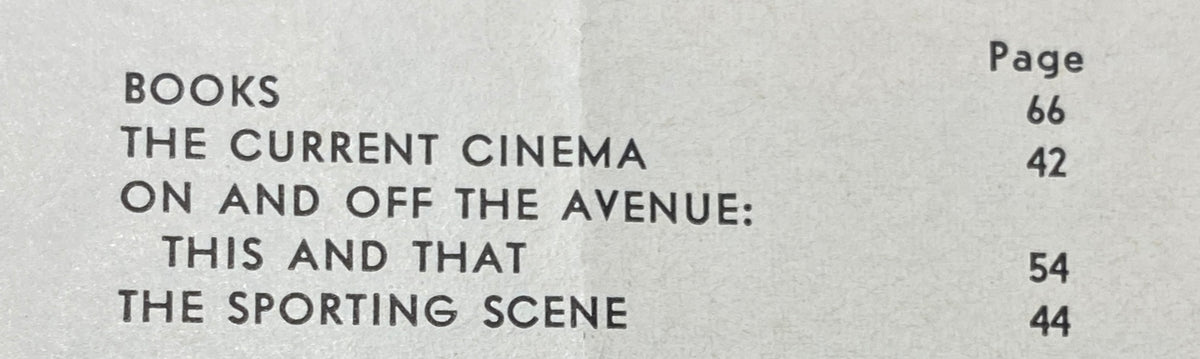
The confirmed section headers — Books, Current Cinema, On and Off the Avenue, and The Sporting Scene — reflect The New Yorker's characteristic editorial architecture in this period. The film criticism column in summer 1963 would have been engaging with the American release calendar of a year that produced some of the decade's most discussed films. The Books section in a July 1963 New Yorker was edited within the tradition that the magazine had established through figures like Edmund Wilson and would continue with subsequent generations of literary critics — serious, long-form book reviewing that treated its readers as genuine intellectual peers. Collectors who follow the complete New Yorker archive will recognize that issues from the early 1960s with confirmed Kovarsky covers represent a distinct and historically significant collecting category — the magazine at its mid-century cultural peak, with its visual identity still defined by the hand-drawn illustration tradition rather than photography.
About the Publication
The New Yorker was founded in 1925 by Harold Ross and had by July 1963 spent nearly four decades as the most intellectually prestigious general-interest magazine in America. Under editor William Shawn, who had led the publication since 1952, it had developed an editorial identity that combined long-form literary journalism, short fiction, poetry, cultural criticism, and humor with the distinctive visual culture of its covers and cartoons — a combination that made it essential reading for educated Americans and a global benchmark for magazine quality. Its summer issues in this period typically balanced lighter feature content with the same quality of film criticism, book reviewing, and cultural commentary that characterized its year-round output, and its illustrated covers remained among the most carefully produced and widely discussed in American publishing.
Key Highlights Inside
- Anatol Kovarsky cover illustration: A confirmed cover by one of The New Yorker's most distinctive mid-century illustrators, whose body of work for the magazine represents a significant chapter in American commercial art history — a July cover almost certainly depicting summer leisure in his characteristic warmly observational style.
- The Current Cinema (p. 42): Film criticism from the July 1963 American release calendar, written within The New Yorker's tradition of serious, long-form movie reviewing that treated cinema as a subject worthy of genuine intellectual engagement.
- Books (p. 66): Literary criticism consistent with The New Yorker's tradition of sustained, authoritative book reviewing — a section edited during the Shawn era with a seriousness that made it one of the most influential literary voices in American publishing.
- The Sporting Scene (p. 44) and On and Off the Avenue (p. 54): Confirmed sections reflecting the magazine's characteristic breadth — sports journalism and consumer/lifestyle coverage in the specific editorial voice that distinguished The New Yorker from all competitors.
- Note: Specific article titles, named contributors, fiction content, and complete interior details beyond the confirmed section headers have not been independently verified for this issue. Collectors seeking a full content inventory may wish to consult The New Yorker digital archive or a university periodicals library.
Condition & Rarity
The listing confirms this as a label-free copy — the expected condition for a newsstand rather than subscriber edition — which is the most significant positive condition attribute for any surviving New Yorker from this period. The absence of a subscriber mailing label preserves the complete visual integrity of the Kovarsky cover illustration without obstruction, which is particularly meaningful for a publication whose covers are primary collectible elements in their own right. The listing directs collectors to the accompanying photographs for a precise condition assessment, which is the appropriate standard for a vintage item now over sixty years old. The New Yorker in 1963 was printed on paper stock of reasonable quality for its era, and any surviving copy retaining its cover integrity, complete pages, and legible text represents a legitimate collector-grade specimen. The plastic protective covering confirms deliberate preservation. When evaluating any surviving copy of this issue, the condition of the Kovarsky cover illustration and the completeness of the Books and Cinema sections are the primary assessment criteria.
Looking for More Issues Like This?
A label-free copy of a July 1963 New Yorker with a confirmed Kovarsky cover is a find that collectors of mid-century American illustration, literary magazine ephemera, and early-1960s Americana pursue with genuine intent — the combination of the publication's editorial authority at its peak and one of its most gifted cover artists makes this a more substantive specimen than a casual collector might initially recognize. If this issue is no longer available, the full New Yorker archive at OriginalMagazines.com is the best place to continue exploring the publication's remarkable early-1960s run. The broader 1963 magazine collection is equally worth browsing for collectors building a comprehensive primary-source record of American print culture from one of the most consequential years of the decade.