
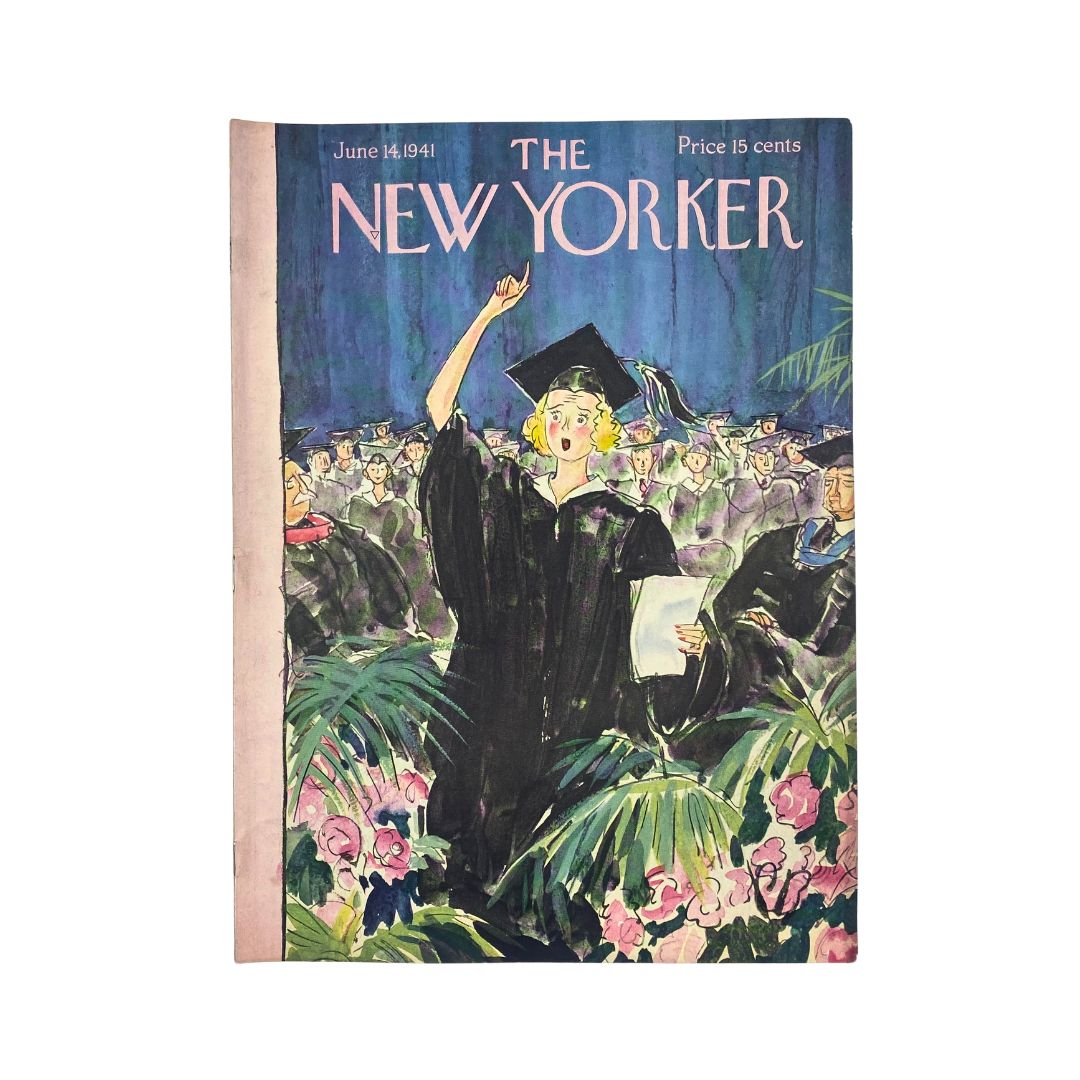


Description
Collector's Note – Why This Issue Matters
June 14, 1941 places this issue of The New Yorker at one of the most consequential and psychologically charged moments of the entire pre-Pearl Harbor period. The United States was exactly six months from entering the war. American destroyers were already engaged in an undeclared naval conflict in the Atlantic — the USS Reuben James would be sunk by a German submarine in October, the first American naval vessel lost in the conflict. The Lend-Lease Act had been signed in March, effectively committing American industrial capacity to the Allied cause. And just one week after this issue's publication date, on June 22, 1941, Germany would launch Operation Barbarossa — the invasion of the Soviet Union that would transform the entire scale and character of the war. This issue was printed in the last week before that transformation. For collectors building a serious historical archive through original magazines from 1941, a June 14 issue sits at one of the most historically precise thresholds in the magazine's entire pre-war run — the final days of the war's first phase, before Barbarossa changed everything.
The cover by Perry Barlow brings a quality to this issue that is characteristic of The New Yorker's most resonant wartime visual output. Barlow was a long-serving contributor to the magazine whose work was recognized for exactly the qualities the listing identifies — a unique ability to capture the essence of New York City through humor and vibrant illustration, treating his subjects with warmth and an affectionate observational eye. His covers tend toward the intimate and the human-scaled, finding the telling detail in ordinary domestic and social scenes rather than deploying the broader satirical register of some of the magazine's other cover artists. A Barlow cover from June 14, 1941 — the last Saturday before Operation Barbarossa — carries a specific quality of historical poignancy: the warm, city-scaled comedy of his visual world produced at the precise moment before the war entered its most catastrophic phase. For collectors tracing the visual history of the publication through original New Yorker issues, this combination of artist and date gives this issue a layered resonance that few objects in the pre-war archive can match.
June 14 also carries a specific symbolic dimension worth noting for the historically attentive collector. It is Flag Day in the United States — the anniversary of the adoption of the American flag in 1777 — and in June 1941, with the debate over American involvement in the war at its most intense, the symbolism of that date had a particular charge. Whether or not the issue's editorial content engaged with that resonance directly, the date places the magazine at the intersection of American national identity and the most consequential foreign policy debate the country had faced since the First World War.
About the Publication
Founded in February 1925 by Harold Ross, The New Yorker was by June 1941 one of the most editorially distinguished and internationally attentive weekly publications in the English-speaking world. Its readership was urban, educated, and expected the combination of wit, literary quality, and serious engagement with world affairs that Ross enforced with legendary editorial discipline. The magazine's format was fully mature: "Talk of the Town" commentary opened each issue, followed by reported features, fiction, poetry, and critical reviews spanning theater, books, art, and film, all interwoven with cartoons and spot illustrations representing one of the most celebrated traditions in American periodical publishing. Covers were individually commissioned works of illustration, produced by a rotating roster of contributing artists whose collective pre-war and wartime output constitutes one of the most visually and historically significant periods in the magazine's long publishing history.
Key Highlights Inside
- Perry Barlow cover illustration: The cover is the defining collectible feature of this issue — original artwork by a long-serving New Yorker contributor known for his warm, humor-driven depictions of New York City life, whose visual sensibility captured the human scale of urban experience with consistent wit and affection.
- One week before Operation Barbarossa: Published seven days before Germany's invasion of the Soviet Union on June 22, 1941, this issue was produced in the final week of the war's first phase — a threshold whose historical significance is impossible to overstate and impossible to recover except through surviving documents from these exact days.
- Flag Day publication date: June 14 — American Flag Day — places this issue at the intersection of national symbolism and the most consequential foreign policy debate the country had faced in a generation, with the interventionism question at its most acute.
- Undeclared Atlantic naval war: By mid-June 1941, American destroyers were engaged in convoy escort operations in the Atlantic that amounted to an undeclared naval conflict with Germany — a dimension of the pre-Pearl Harbor situation that the magazine's editorial staff was tracking with full awareness.
- Final spring of American neutrality: June 14, 1941 was among the last days of the spring season in the final year of American formal non-involvement in the war — a cultural and editorial atmosphere that makes surviving issues from this specific month uniquely charged as historical documents.
Note: Specific article titles, bylines, and interior content for this exact issue have not been independently confirmed beyond what appears in the listing. The highlights above reflect only what is verifiable from the cover credit, publication date, and the magazine's well-documented editorial format during this period.
Condition & Rarity
A surviving copy of a weekly newsstand magazine from June 1941 presenting in very good condition — with minor edge wear as the only noted imperfection — is a sound and desirable preservation result for a publication now more than eighty years old. The New Yorker was printed on acidic wood-pulp paper stock standard for weekly periodicals of this era, a material inherently prone to toning, brittleness, and structural fatigue over time. Edge wear of the kind described is entirely consistent with honest age and careful storage rather than mishandling or neglect. When evaluating any surviving copy of this issue, the meaningful criteria are the integrity and color fidelity of Barlow's cover art, the completeness of all interior pages, the absence of subscription label adhesive residue or moisture damage, and the structural soundness of the spine. A copy meeting the standard described — visually strong at over eight decades of age, with wear confined to the margins — represents the preservation grade that serious collectors of pre-war and wartime periodicals actively seek when pursuing issues from this historically singular period.
Looking for More Issues Like This?
A Perry Barlow cover from the last week before Operation Barbarossa is one of the most historically precise objects in the pre-war New Yorker collector market, and June 14, 1941 is a date whose significance deepens the more carefully you examine it. If this issue is no longer available, the extensive original New Yorker collection at OriginalMagazines.com is one of the deepest archives of the magazine accessible to serious collectors, spanning many decades of its publishing history. For those drawn to the charged and irreversible atmosphere of the final months before American entry into the Second World War, the full 1941 magazine collection rewards the most careful and patient exploration — every issue from this year sits at a different point on the arc toward a transformation that, by December, would change everything.