




Description
Collector's Note – Why This Issue Matters
June 15, 1935 places this issue of The New Yorker in the middle of one of the most legislatively active summers in American political history. The so-called Second New Deal was in full force — the Social Security Act, the National Labor Relations Act, and the Revenue Act of 1935 were all moving through Congress simultaneously, and the country was engaged in a sustained national argument about the proper role of government in economic life. New York City, as the financial and cultural capital of the country, felt these debates with particular intensity. And yet June in New York also meant the beginning of the summer season, the relaxation of certain social registers, and the particular atmosphere of a city transitioning between its more formal winter rhythms and the looser pace of summer. The New Yorker navigated both of these currents with its characteristic precision. For collectors building a documentary archive through original magazines from 1935, the mid-year issues carry a layered quality — serious historical weight combined with the lighter editorial touch that the magazine's summer numbers tended to adopt.
The cover by Garrett Price anchors this issue in a specific and distinguished chapter of the magazine's artistic history. Price was one of The New Yorker's most consistent and valued contributing artists from the late 1920s through the 1950s, producing both covers and interior cartoons that were recognized for exactly the qualities the listing identifies — a capacity to find social observation and humor operating together, with a draftsmanship that was elegant without being remote. His work sat comfortably within the magazine's visual framework while retaining an individual quality that made his contributions identifiable. Price's covers from the mid-1930s represent the full confidence of his mature style, developed over nearly a decade of regular work for the magazine by this point. For collectors tracing the full visual lineage of the publication through original New Yorker issues, Price's covers from this period are an important and sometimes underappreciated part of the record — less celebrated than Rea Irvin's foundational work, but consistently excellent and deeply characteristic of the magazine's interwar sensibility.
A June 1935 issue also falls within a particularly rich period for the magazine's cartoon and illustration traditions more broadly. By mid-decade, The New Yorker's art department had assembled what many historians of American illustration consider its first golden generation — a group of artists whose collective work defined graphic humor and social cartooning for the better part of two decades. A Garrett Price cover from this summer is a primary artifact of that tradition, produced at the height of its first flowering.
About the Publication
Founded in February 1925 by Harold Ross, The New Yorker was by 1935 the most editorially ambitious and culturally influential weekly magazine in the United States. Its readership was urban, educated, and expected both the wit and the intellectual seriousness that Ross enforced with unusual editorial rigor. The magazine's format was well established by this point: "Talk of the Town" commentary and vignettes opened each issue, followed by reported features, fiction, poetry, and critical reviews spanning theater, books, art, and film, all interwoven with cartoons and spot illustrations that had become as central to the magazine's identity as any of its prose. Covers were individually commissioned works of illustration, each functioning as a complete artistic statement, produced by a rotating roster of contributing artists whose collective output constitutes one of the most significant bodies of American periodical art from the twentieth century.
Key Highlights Inside
- Garrett Price cover illustration: The cover is the most verifiable and historically significant feature of this issue — original artwork by one of The New Yorker's most consistent and accomplished contributing artists of the interwar period, known for illustration that combined social observation with genuine humor and draftsmanly elegance.
- Second New Deal legislative summer: Published during the most concentrated period of New Deal legislation in Roosevelt's presidency, this issue appeared at a moment when the political conversation in New York — and across the country — was unusually charged and consequential.
- Early summer New York: Mid-June issues from this period reflect the magazine's characteristic engagement with the city's seasonal transition, tracking the cultural and social rhythms of a New York moving from its formal spring season into summer.
- Mid-1930s cartoon tradition: By June 1935, The New Yorker's art department represented what many consider the first fully mature generation of the magazine's celebrated cartoon tradition — a body of work that would define American graphic humor for decades.
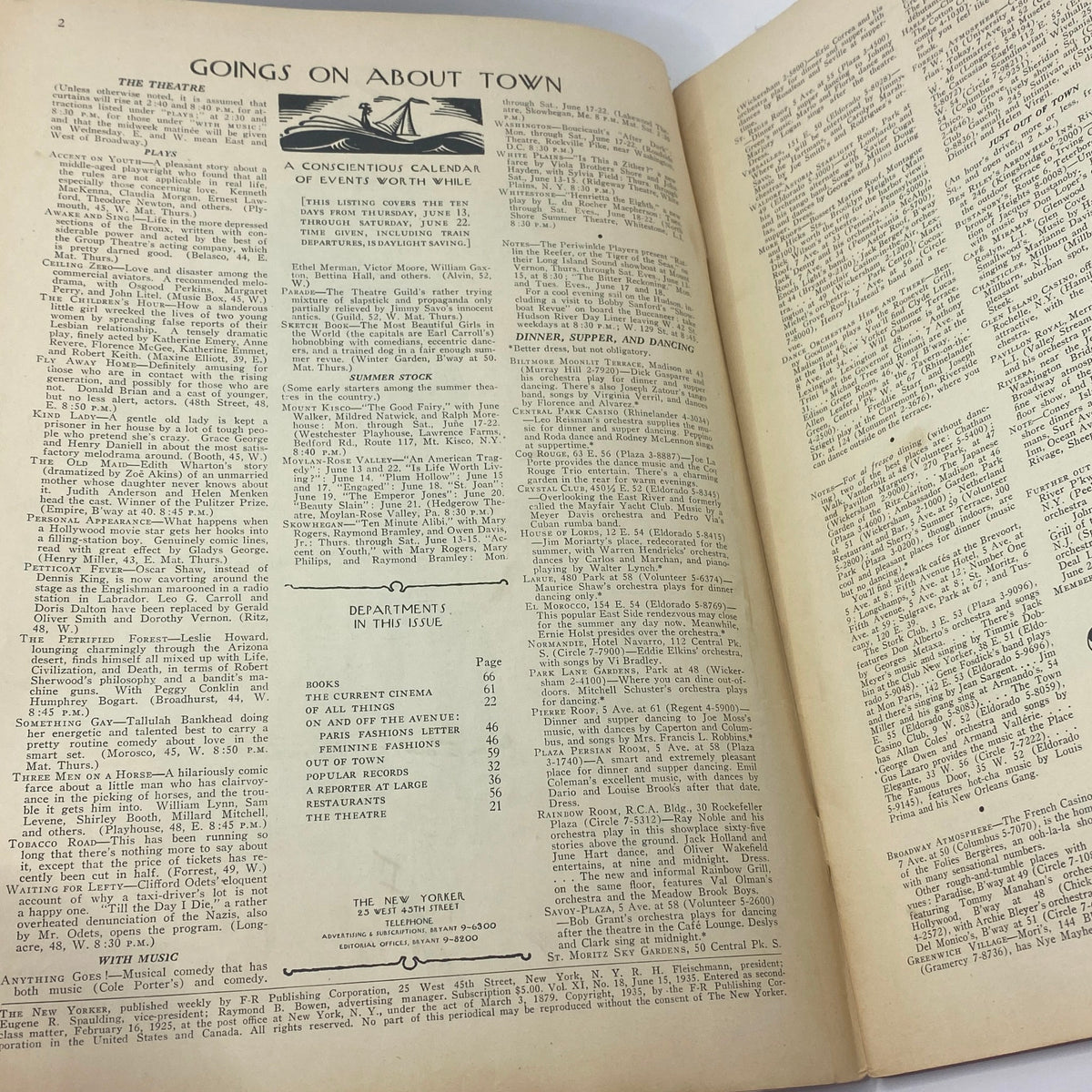
Note: Specific article titles, bylines, and interior content for this exact issue have not been independently confirmed beyond what appears in the listing. The highlights above reflect only what is verifiable from the cover credit, publication date, and the magazine's well-documented editorial format during this period.
Condition & Rarity
A surviving copy of a weekly newsstand magazine from June 1935 presenting in very good condition — with minor edge wear as the only noted imperfection — is a strong preservation result for a publication now ninety years old. The New Yorker was printed on acidic wood-pulp paper stock standard for weekly periodicals of this era, a material that degrades predictably over time through toning, brittleness, and structural fatigue. Edge wear of the kind described is entirely consistent with honest age and does not suggest neglect or poor storage history. When evaluating any surviving copy of this issue, the meaningful criteria are the integrity and color fidelity of Price's cover art, the completeness of all interior pages, the absence of subscription label adhesive residue or moisture damage, and whether the spine remains structurally sound enough to allow the issue to be examined without further stress. A copy meeting the standard described — visually strong at nine decades of age, with wear confined to the margins — is a legitimate and desirable survivor by any serious collector's measure.
Looking for More Issues Like This?
Garrett Price covers from the mid-1930s are genuinely rewarding finds, and this specific June 1935 date is not one that comes up with any regularity in the collector market. If it is no longer available, the extensive original New Yorker collection at OriginalMagazines.com is one of the deepest archives of the magazine accessible to collectors anywhere, with issues spanning many decades of the publication's history. For those with a particular interest in the Depression-era magazine, the full 1935 magazine collection is worth exploring thoroughly — it's a year whose historical and cultural density shows up clearly in every issue that has survived to the present day.