




Description
Collector's Note – Why This Issue Matters
June 21, 1941 is a date of extraordinary historical precision. Germany invaded the Soviet Union the following day — Operation Barbarossa launched on June 22, 1941, transforming the entire character and scale of the Second World War in a single morning. This issue of The New Yorker went to press on the last day before that transformation. It is, in the most literal sense, a document produced at the final hour of one phase of the war and the eve of another — the moment before the conflict became truly global in its dimensions and before the strategic calculus that would eventually determine its outcome came into focus. For collectors assembling a serious historical archive through original magazines from 1941, a June 21 issue carries a historical specificity that very few other dates in the magazine's entire run can match. It is not merely a document of its era — it is a document of its exact day, in a way that only the rarest magazine dates can claim.
The cover by Rea Irvin gives this issue a significance that compounds its historical weight with genuine artistic and institutional importance. Irvin was the founding art editor of The New Yorker — the person who designed the masthead typeface that defined the magazine's visual identity for decades, who established the aesthetic conventions of its covers and interior illustrations, and who created Eustace Tilley, the monocled dandy of the inaugural February 1925 issue who became the publication's enduring cultural mascot. By June 1941, Irvin had been the dominant creative force in the magazine's art department for sixteen years. A cover from this specific date represents the absolute final chapter of his pre-war output — work produced in the last hours before the invasion of the Soviet Union reshaped the world that his visual language had been built to observe and comment upon. For collectors tracing the complete visual history of the magazine through original New Yorker issues, this is among the most precisely situated Irvin covers in the entire archive.
The broader context of late June 1941 in the United States adds further layers. America was still formally neutral, but that neutrality had been steadily eroding — Lend-Lease was in operation, American ships were engaged in an undeclared Atlantic war, and the political debate between interventionists and isolationists had reached its most intense pitch. The New Yorker's editorial staff, deeply attuned to the European situation through its cultural and intellectual ties to the continent, was producing journalism and commentary of unusual gravity. A June 21 issue captures that editorial voice at the last moment before the war's next seismic shift, and that timing gives it a documentary quality that no amount of careful reading could have anticipated at the moment of its publication.
About the Publication
Founded in February 1925 by Harold Ross, The New Yorker was by the summer of 1941 one of the most editorially distinguished and internationally attentive weekly publications in the English-speaking world. Its readership was urban, educated, and expected the combination of wit, literary quality, and serious engagement with world affairs that Ross enforced with legendary editorial discipline. The magazine's format was consistent and fully mature: "Talk of the Town" commentary opened each issue, followed by reported features, fiction, poetry, and critical reviews spanning theater, books, art, and film, all interwoven with cartoons and spot illustrations representing the first fully mature generation of the magazine's celebrated visual tradition. Covers were individually commissioned works of illustration, each a complete artistic statement, produced by a rotating roster of contributing artists whose collective interwar output constitutes one of the most significant bodies of American periodical art from the twentieth century.
Key Highlights Inside
- Rea Irvin cover illustration: The cover is the defining collectible and historical feature of this issue — original artwork by the magazine's founding art editor, the designer of its masthead typeface, the creator of Eustace Tilley, and the central figure in establishing The New Yorker's visual identity across its first three decades of publication.
- Eve of Operation Barbarossa: This issue went to press on June 21, 1941 — the day before Germany invaded the Soviet Union, the single largest military operation in history and the event that transformed the scale and ultimate trajectory of the Second World War. No other contextual fact about this date requires elaboration.
- Peak of the American neutrality debate: By late June 1941, the political argument between American interventionists and isolationists had reached its most acute intensity — a debate that The New Yorker's editorial voice engaged with characteristic intelligence and increasing urgency.
- Final pre-Barbarossa summer issue: As an early summer number produced in the last hours of the pre-Barbarossa war, this issue captures the magazine's editorial voice at a moment of historical threshold whose significance was not yet visible to anyone reading it on the day of its publication.
- Period cartoons and advertising: Issues from this specific week in June 1941 are among the most historically precise documents of American civilian life available in any periodical format — produced at the exact threshold of a transformation whose consequences would define the following four years.
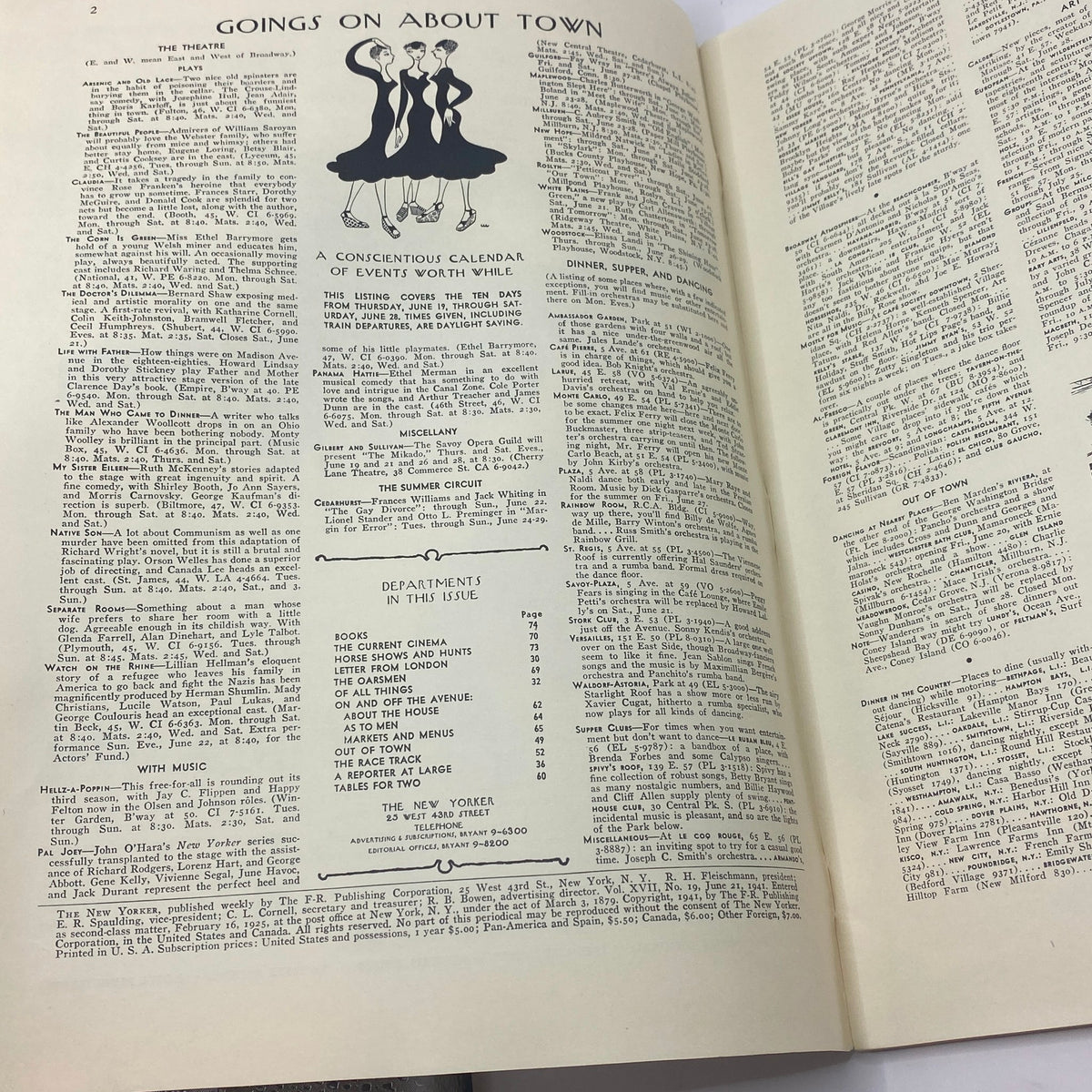
Note: Specific article titles, bylines, and interior content for this exact issue have not been independently confirmed beyond what appears in the listing. The highlights above reflect only what is verifiable from the cover credit, publication date, and the magazine's well-documented editorial format during this period.
Condition & Rarity
A surviving copy of a weekly newsstand magazine from June 1941 presenting in very good condition — with minor edge wear as the only noted imperfection — is a sound and genuinely desirable preservation result for a publication now more than eighty years old. The New Yorker was printed on acidic wood-pulp paper stock standard for weekly periodicals of this era, a material inherently prone to toning, brittleness, and structural fatigue over time. Edge wear of the kind described is the natural and expected consequence of honest age and does not indicate mishandling or poor storage. When evaluating any surviving copy of this issue, the meaningful criteria are the integrity and color fidelity of Irvin's cover art, the completeness of all interior pages, the absence of subscription label adhesive residue or moisture damage, and the structural soundness of the spine. A copy meeting the standard described — visually strong at over eight decades of age, with wear confined to the margins — represents precisely the preservation grade that serious collectors of pre-war and wartime periodicals seek when pursuing issues of this specific historical weight.
Looking for More Issues Like This?
A Rea Irvin cover dated June 21, 1941 — the day before Operation Barbarossa — is one of the most historically precise objects in the entire New Yorker collector market, and it is not a date that comes up with any regularity. If this issue is no longer available, the extensive original New Yorker collection at OriginalMagazines.com is one of the deepest archives of the magazine accessible to serious collectors, spanning many decades of its publishing history. For those drawn to the charged and irreversible atmosphere of the months before American entry into World War II, the full 1941 magazine collection rewards the most careful and unhurried exploration — every issue from this year sits at a different point on the same arc toward a transformation that, by December, would change everything.