




Description
Collector's Note – Why This Issue Matters
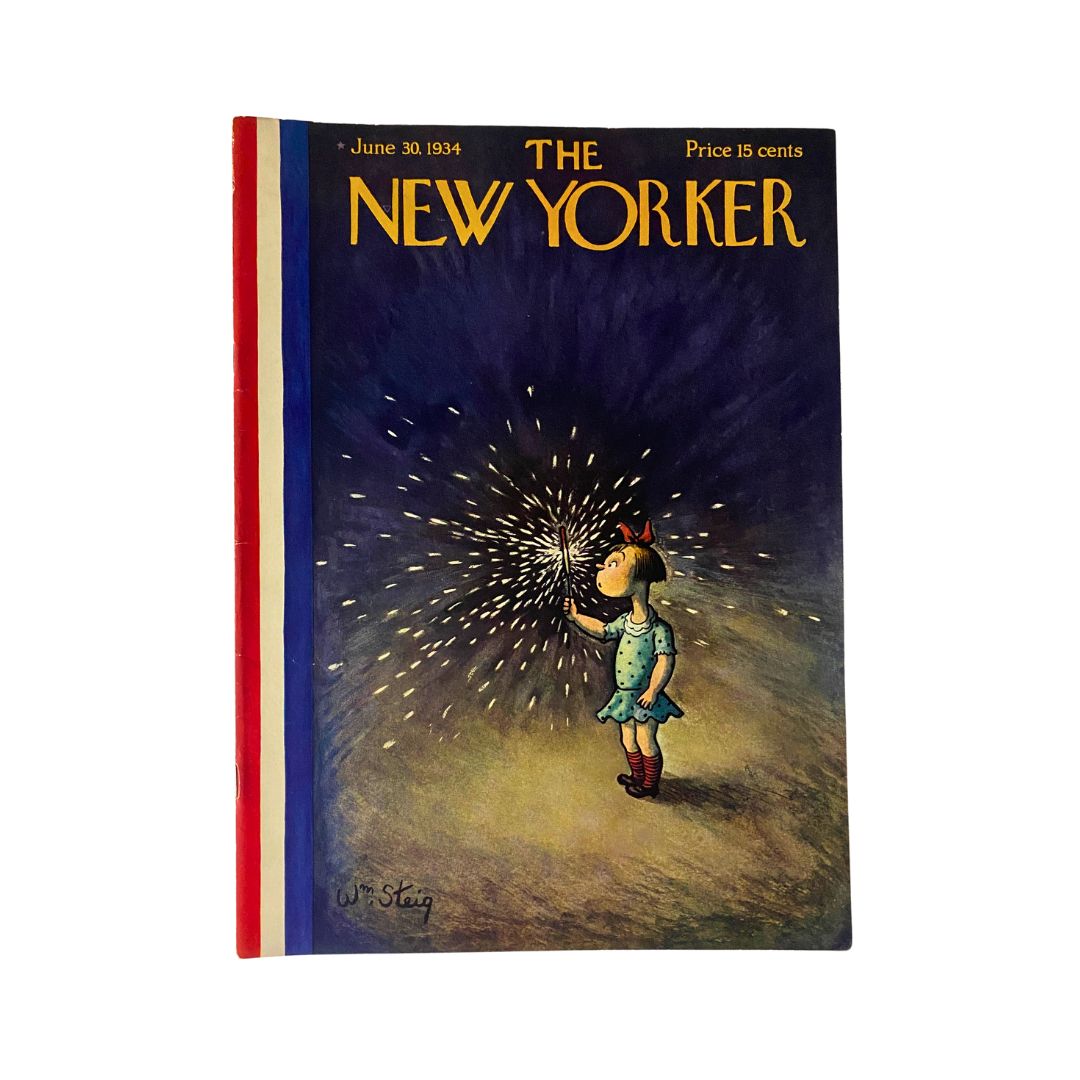
The June 30, 1934 issue of The New Yorker with a cover by William Steig is a document of the very beginning of one of the most remarkable careers in the history of American cartooning and illustration. Steig's relationship with The New Yorker began in 1930, when he sold his first cartoon to the magazine at the age of twenty-three — a sale driven in part by financial necessity, as his family had been hard hit by the Depression and his earnings were supporting them. By June 1934, Steig had been contributing to the magazine for four years and was already establishing the human observation and emotional honesty that would define his work. But he was also still very much in his early period, developing the style and vocabulary that would eventually make him one of the magazine's most celebrated and longest-running contributors — his work appeared in The New Yorker for over seven decades, into the 2000s. A cover from 1934 therefore captures Steig at the genuine beginning of an extraordinary creative life, and for collectors who value the early work of artists whose later careers became legendary, this issue is a primary document of that origin. The full arc of the magazine's visual program across its long history is documented throughout the New Yorker collection at OriginalMagazines.com.
William Steig's cultural legacy extends well beyond his New Yorker work. He published his first children's book at the age of sixty and went on to produce some of the most beloved picture books in American publishing history — Sylvester and the Magic Pebble won the Caldecott Medal in 1970, and Shrek!, published in 1990, became the basis for one of the most successful animated film franchises in cinema history. But all of that came later. In June 1934, Steig was a twenty-seven-year-old cartoonist doing cover work for the most prestigious humor and literary magazine in the country, in the depths of the Depression, supporting his family with his pen. The cover work he produced for The New Yorker during this period reflects both the constraints and the particular creative energy of that situation. The broader cultural and historical context surrounding this issue is documented in the 1934 magazines collection, which captures a country in its fifth year of the Depression and engaged in the early implementation of Roosevelt's New Deal — a moment of genuine national uncertainty that shaped everything being written, drawn, and published in New York during this period.
About the Publication
The New Yorker was founded in New York in 1925 by Harold Ross with the explicit intention of creating a magazine of sophisticated urban wit and literary quality aimed at a cosmopolitan readership rather than the rural mainstream. By June 1934, the magazine had survived the early years of the Depression — which had devastated much of the American magazine industry — and had emerged as a genuinely established institution with a stable readership and a clear creative identity. Its format combined long-form journalism, short fiction, poetry, and cultural criticism with the "Talk of the Town" section, cartoons, and the weekly cover, all governed by Harold Ross's exacting editorial standards. Its readership was educated, urban, and self-consciously sophisticated, and by the mid-1930s the magazine's roster of regular contributors — including E. B. White, James Thurber, Dorothy Parker, and the young William Steig — was producing some of the finest American comic and literary writing of the century.
Key Highlights Inside
- William Steig cover art — A cover by one of the most significant cartoonists and illustrators in American cultural history, produced during the fourth year of his association with the magazine and decades before the children's books and films that would make him a household name.
- Early Depression-era New York cultural context — Published in late June 1934, the issue documents The New Yorker's sustained urbane wit during a period of genuine national economic stress, at a moment when the magazine's particular blend of sophistication and humanity was both a commercial product and a cultural act of resilience.
- Mid-1930s literary and editorial content — Consistent with the magazine's well-documented format of this period, the issue would have included short fiction, poetry, cultural criticism, Talk of the Town observations, and cartoons from the roster of contributors who defined the magazine's Depression-era golden period.
- Note: Specific interior article titles, fiction contributors, and additional content have not been independently confirmed for this issue. The highlights above reflect the well-documented editorial format of The New Yorker during this period and the verifiable identity of the cover artist and historical moment.
Condition & Rarity
Issues of The New Yorker from June 1934 are ninety-one years old, and the paper stock used in the magazine's weekly production during the Depression era was not manufactured with archival longevity in mind. When evaluating any surviving copy of this issue, the attributes that matter most to serious collectors are the condition of the Steig cover art — its color integrity, surface cleanliness, and freedom from significant staining, tearing, or fading — the structural integrity of the spine and staple binding, and the completeness of interior pages. The good condition noted for a publication of this age indicates a survivor in the better range of what typically circulates for early-1930s New Yorker issues, which are among the more challenging to find in any collectible condition given the paper quality constraints of Depression-era production and nine decades of subsequent existence. Any edge wear or minor tanning consistent with authentic age is an expected characteristic and does not meaningfully diminish the issue's value as a primary document of Steig's early career or as a collectible artifact of American magazine history.
Looking for More Issues Like This?
Early-1930s issues of The New Yorker featuring cover art by William Steig — before his Caldecott Medal, before Shrek!, when he was a young cartoonist at the beginning of a seven-decade association with the magazine — are among the more genuinely uncommon finds in American illustration collecting, and the June 30, 1934 issue is a particularly early and historically situated example. If it is currently unavailable, the New Yorker collection at OriginalMagazines.com is the best place to browse what has recently surfaced from across the magazine's remarkable publishing history. Collectors with a broader interest in the Depression-era print landscape should also explore the 1934 magazines collection for a wider view of American media during one of the country's most challenging and creatively productive decades.