


Description
Collector's Note – Why This Issue Matters
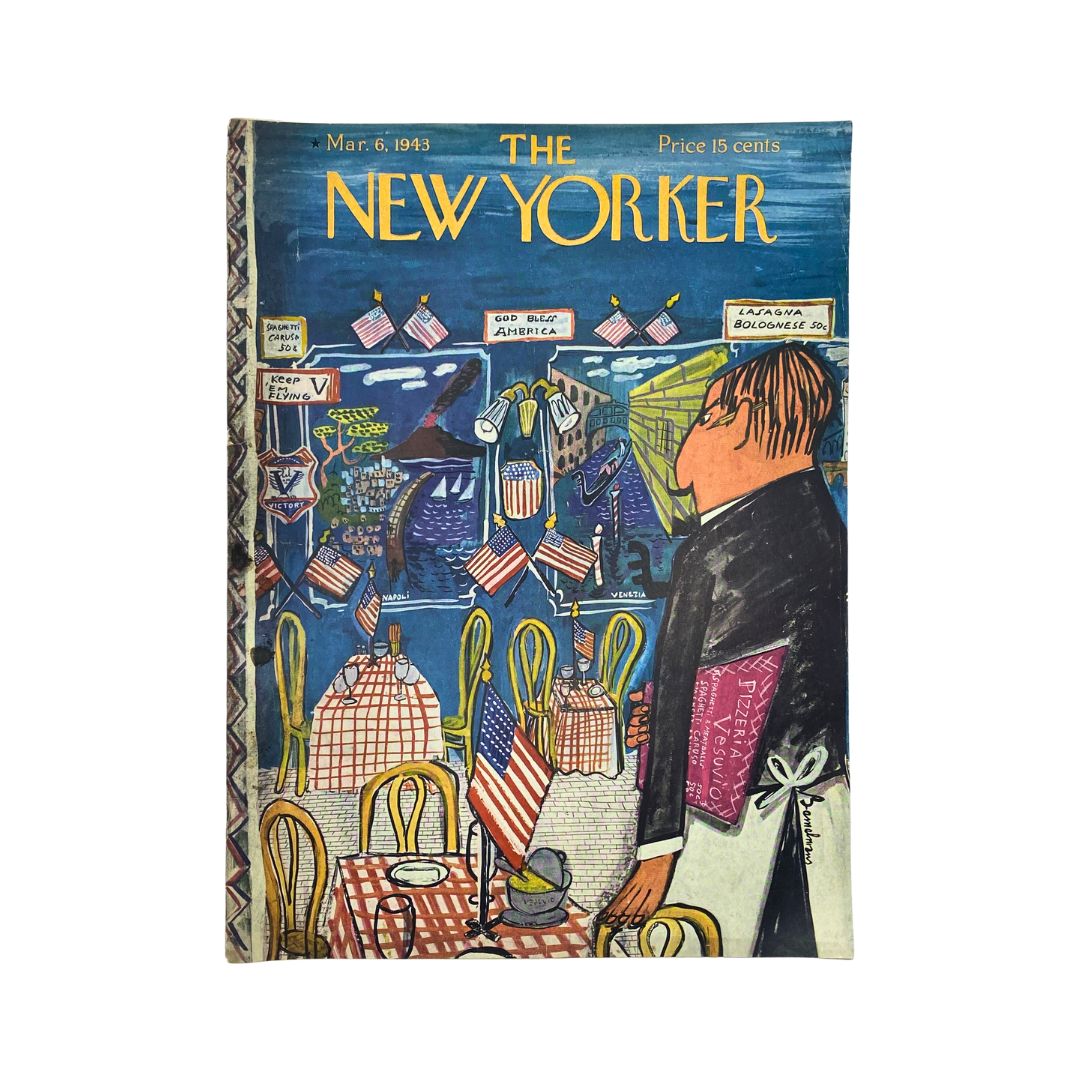
The March 6, 1943 issue of The New Yorker, featuring a cover by Ludwig Bemelmans, is a document of two intersecting histories that give it unusual depth as a collector artifact. The first is the history of the magazine itself during the war years — a period when The New Yorker produced some of the most celebrated journalism, fiction, and visual art in American publishing history, and when its covers reflected the particular challenge of maintaining wit, beauty, and the spirit of civilized life in the midst of a global catastrophe. The second is the history of Ludwig Bemelmans himself, an Austrian-born writer and illustrator whose relationship with The New Yorker produced some of his most accomplished adult work alongside the Madeline books that would eventually make him one of the most recognized names in children's literature. Bemelmans contributed covers to The New Yorker across the 1940s, and his visual sensibility — that particular combination of European elegance, comic warmth, and slightly melancholic whimsy — gave his covers a distinctive quality that is immediately recognizable and that collectors of his work specifically seek out in the New Yorker archive. Collectors building a focused archive of wartime New Yorker issues and their visual art will find the New Yorker magazine collection the most comprehensive resource for the full range of covers and complete issues from this remarkable period in the publication's history.
March 1943 places this issue in the heart of World War II — fifteen months after Pearl Harbor, eighteen months before D-Day — when the war's eventual outcome was still genuinely uncertain and when American civilian life was being profoundly shaped by rationing, military service, war work, and the specific anxieties of a society whose men were fighting on two ocean fronts simultaneously. The New Yorker's response to the war was one of the most significant editorial achievements in American magazine history: rather than abandoning its characteristic tone of sophisticated urban wit, it found ways to bring that sensibility into direct contact with the war's human reality, producing journalism, fiction, and art that addressed the conflict without losing the qualities that made the magazine distinctive. Bemelmans's cover for this issue would have been part of that effort — a visual statement that whatever its specific subject, reflected the magazine's ongoing commitment to the pleasures and meaning of art even under wartime conditions. The complete magazine format documented here — as opposed to the cover-only format of other listings — means that whatever journalism, fiction, poetry, and criticism appeared in this March 6 issue is preserved in its entirety, providing a complete primary document of The New Yorker's wartime editorial program on this specific date. Collectors focused on the wartime period specifically will find that 1943 magazine issues are among the most historically charged primary documents in the American periodical archive.
Ludwig Bemelmans deserves specific attention as a figure whose New Yorker cover work represents a distinct and historically significant chapter in his artistic career. By 1943 he had already published the first Madeline book (1939) and was established as both a children's book author-illustrator and a contributor to The New Yorker's adult literary and visual culture. His covers for the magazine demonstrate a range and sophistication that his children's book reputation sometimes obscures — the adult New Yorker work shows an artist fully at home in a more ironic and cosmopolitan register than the Madeline books inhabit, and the specific visual vocabulary he brought to the magazine's covers reflects his European cultural formation and his Viennese artistic heritage in ways that make individual covers from this period genuine primary documents of mid-century American illustration history. A complete 1943 New Yorker with a Bemelmans cover is therefore an artifact of interest to collectors of his work specifically, not only to general New Yorker collectors.
About the Publication
The New Yorker was founded in 1925 by Harold Ross and had established itself by 1943 as the most culturally significant weekly magazine in the United States, combining long-form journalism, fiction, poetry, criticism, and the distinctive visual identity — cartoons, covers, and illustrations — that made it immediately recognizable to its educated, urban readership. During the World War II years, the magazine produced some of the most enduring American journalism of the twentieth century — including the reporting that would eventually be published as John Hersey's Hiroshima — while maintaining the wit, sophistication, and commitment to quality that had defined it from its founding. The cover art program remained central to its identity throughout the wartime period: individual covers were serious artistic commissions, and contributing artists like Ludwig Bemelmans were understood as genuine participants in the magazine's cultural project rather than simply decorative service providers. Complete issues from the wartime years are primary documents of both the publication's editorial program and the broader American cultural life of the 1940s, and they are among the most historically significant surviving examples of the weekly magazine format from this period.
Key Highlights Inside
- Cover painting by Ludwig Bemelmans — a primary artifact of this Austrian-born artist's New Yorker cover work from the 1940s, representing the adult visual register of a figure whose Madeline books had already established him as a major American illustrator, and whose New Yorker covers demonstrate a sophistication and cosmopolitan sensibility that his children's book reputation sometimes overshadows.
- March 6, 1943 complete issue — a full surviving example of The New Yorker's wartime editorial program, preserving whatever journalism, fiction, poetry, criticism, and cartoons appeared in this specific issue at a moment when the magazine was producing some of its most historically significant work in direct response to the war and its human dimensions.
- Complete magazine format — distinguishing this artifact from cover-only examples of the same issue, meaning the full editorial content of this date's New Yorker is preserved and accessible for research, including the surrounding journalism and fiction that provides the complete context for Bemelmans's cover art.
- World War II period documentation — placing this issue within the most historically charged chapter of The New Yorker's publishing history, during the years when the magazine's editorial response to the war established its reputation for serious journalism alongside its characteristic sophisticated wit.
- Note: Specific interior article titles, fiction contributors, poetry, criticism, and additional editorial content from this issue are unconfirmed beyond what is indicated by the cover artist and date. The above reflects what is verifiable from the cover artist, date, complete magazine format, and the thoroughly documented wartime history of The New Yorker's editorial program.
Condition & Rarity
Good condition for a complete New Yorker issue from March 1943 is a meaningful and realistic grade for a publication now more than eighty years old. The wartime New Yorker was produced under paper rationing constraints that affected the stock quality of American magazines during this period — wartime paper allocations required publishers to use lower-grade materials and reduce page counts, which means 1943 issues are somewhat more physically fragile than their prewar predecessors and have aged accordingly. Good condition accurately describes a complete issue that retains its full structural integrity, legible cover art, and complete interior editorial content despite the expected yellowing, edge wear, and minor physical deterioration that paper of this age and wartime quality inevitably shows across eight decades. For collectors of complete wartime New Yorker issues specifically, good condition for an eighty-plus-year-old magazine with a named cover artist is a genuinely preservable primary document that accurately represents the publication as it appeared on newsstands and in subscribers' mailboxes in March 1943. Collectors should evaluate the provided photographs to assess specific condition details relevant to their display and research requirements.
Looking for More Issues Like This?
Complete New Yorker issues from the World War II years with named cover artists — particularly those featuring work by figures like Bemelmans whose New Yorker output represents a significant and sometimes underappreciated dimension of their artistic careers — are among the more specifically valuable items in the wartime New Yorker collector market. The broader New Yorker magazine collection is the most reliable starting point for finding other significant complete issues and covers from across the publication's history, including other wartime issues from the 1940s that document the magazine at one of its most editorially ambitious and historically consequential periods. Collectors building a focused archive of 1943 across American cultural and journalistic publications will find the complete 1943 magazine collection an invaluable resource for locating other titles and issues that document this extraordinary wartime year from the multiple perspectives that serious archival research requires.