



Description
Collector's Note – Why This Issue Matters
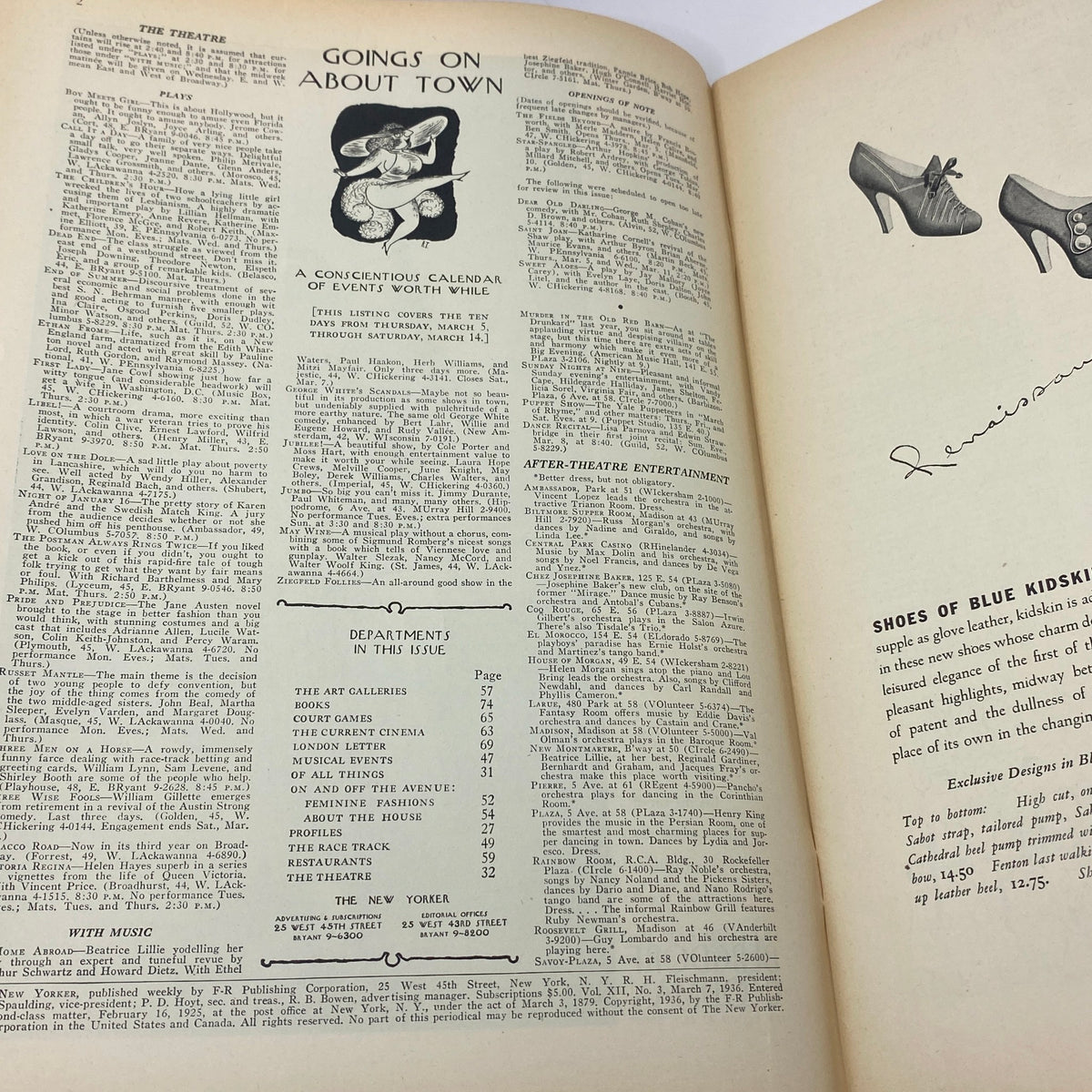
The March 7, 1936 issue of The New Yorker arrives at a moment when the magazine was operating at genuine creative peak. Eleven years into its existence, Harold Ross's publication had assembled the contributors, the editorial rhythm, and the visual sensibility that would define American literary culture for the rest of the century. A March issue in 1936 would have carried the particular energy of the city emerging from winter — the cultural season in full stride, the theaters and galleries active, the social life of New York at its most concentrated. The New Yorker documented that world with a precision and wit that no other publication attempted, and each issue from this period is a specific and irreplaceable window into it.
The cover by Constantin Alajalov places this issue in distinguished company. Alajalov was one of the most accomplished and prolific cover artists in The New Yorker's history, contributing covers across several decades beginning in the late 1920s. Born in Russia and trained in the European artistic tradition, he brought a cosmopolitan sensibility and a gift for vivid color and social observation to his work for the magazine. His covers frequently depicted the theater of New York social life — the opera, the restaurant, the street corner — with an affectionate irony that suited The New Yorker's editorial voice exactly. For collectors who follow vintage New Yorker magazine issues, Alajalov covers are among the most sought within the publication's rich artistic legacy, and a March 1936 example represents him at the height of his association with the magazine.
The historical context of early March 1936 gives this issue additional weight for collectors attuned to the period. Europe was accelerating toward crisis — Hitler had remilitarized the Rhineland on March 7, 1936, the precise date of this issue's publication, an act that would later be recognized as a pivotal moment on the road to the Second World War. Whether The New Yorker's interior content addressed that development directly or not, the coincidence of date is historically striking, and it situates this issue at a moment of genuine geopolitical consequence. Collectors building focused archives around magazines from 1936 will find that this particular date — March 7th — carries a historical resonance that distinguishes it within the year's full run.
About the Publication
The New Yorker was founded by Harold Ross in February 1925 and had by 1936 developed into the definitive American magazine of urban literary and cultural sophistication. Its weekly format combined long-form journalism, short fiction, poetry, criticism, cartoons, and the Talk of the Town section in a package that treated its readership as intelligent, curious, and engaged with the full range of cultural life. The magazine's cover tradition — commissioning independent artistic works from a rotating group of illustrators rather than producing generic commercial packaging — gave it a visual identity unlike any other American periodical of the era. Constantin Alajalov was among the artists most closely identified with that tradition, and his covers from the 1930s are recognized today as significant contributions to the history of American illustration.
Key Highlights Inside
- Cover artwork by Constantin Alajalov — one of The New Yorker's most accomplished and enduring cover artists, working in his characteristic style of colorful, socially observant illustration that defined the magazine's visual identity across multiple decades.
- Publication date of March 7, 1936 — the same date on which Hitler remilitarized the Rhineland, marking one of the most consequential acts of European geopolitics in the years leading to the Second World War, and giving this issue an inadvertent historical specificity within the 1936 calendar.
- The issue was produced during the height of the New Deal era, when American cultural and political life was being reshaped by Depression-era policy and the broader anxieties of a world moving toward conflict.
- Specific interior articles, fiction, criticism, cartoons, and other features are unconfirmed from the listing; the full contents would reflect The New Yorker's characteristic editorial range for the period, including contributions from the writers and artists who defined the magazine's voice in the mid-1930s.
Condition & Rarity
Very good condition is a strong and meaningful grade for a magazine now approaching ninety years old. New Yorker issues from the mid-1930s were printed on standard commercial paper stock with inherent acidity — the same material that makes surviving copies from this era prone to toning, brittleness, and structural fragility over time. A very good grade with only minor edge wear implies that this issue has been stored with sufficient care to resist the most common forms of deterioration, and that the interior pages retain their integrity rather than showing the advanced tanning or crumbling that poorly stored copies of this vintage typically exhibit. For any surviving copy of this issue, the primary evaluation points are the condition and color retention of the Alajalov cover, spine integrity, and the state of the interior pages. Minor edge wear at this age is an honest and expected note rather than a significant detraction. The listing does not specify label status, which collectors for whom cover presentation is a priority should confirm when evaluating specific copies.
Looking for More Issues Like This?
Constantin Alajalov covers from the 1930s are among the most visually striking and historically rooted issues in The New Yorker's long publishing history, and mid-decade examples in very good condition surface less frequently than collectors working in this area would prefer. If this March 1936 issue is no longer available, the full vintage New Yorker collection at OriginalMagazines.com is the best place to browse for other issues spanning the magazine's history, including additional covers from the 1930s. The 1936 magazine archive covers the full year across multiple titles for collectors building a focused pre-war or Depression-era library.