




Description
Collector's Note – Why This Issue Matters
November 11, 1939 is a date whose resonance with history is immediate and layered. It is Armistice Day — the anniversary of the end of the First World War on November 11, 1918 — a date that in 1939 carried a particular and devastating irony. The world was ten weeks into a second global war. Germany had invaded Poland on September 1, Britain and France had declared war on September 3, and by November 11 the Phoney War on the Western Front had settled into an uneasy and portentous quiet while the Soviet Union had just invaded Finland, opening yet another front and expanding the conflict's geographic scope. To observe Armistice Day in November 1939 — the twenty-first anniversary of a peace that had barely lasted two decades — was to mark one of the most painfully ironic dates in modern history, a day commemorating a war to end all wars at the precise moment a new one was demonstrating that no such thing had been achieved. For collectors assembling a serious historical archive through original magazines from 1939, a November 11 issue is among the most historically resonant specific dates available in the entire pre-war archive — Armistice Day, 1939, with the world already at war again.
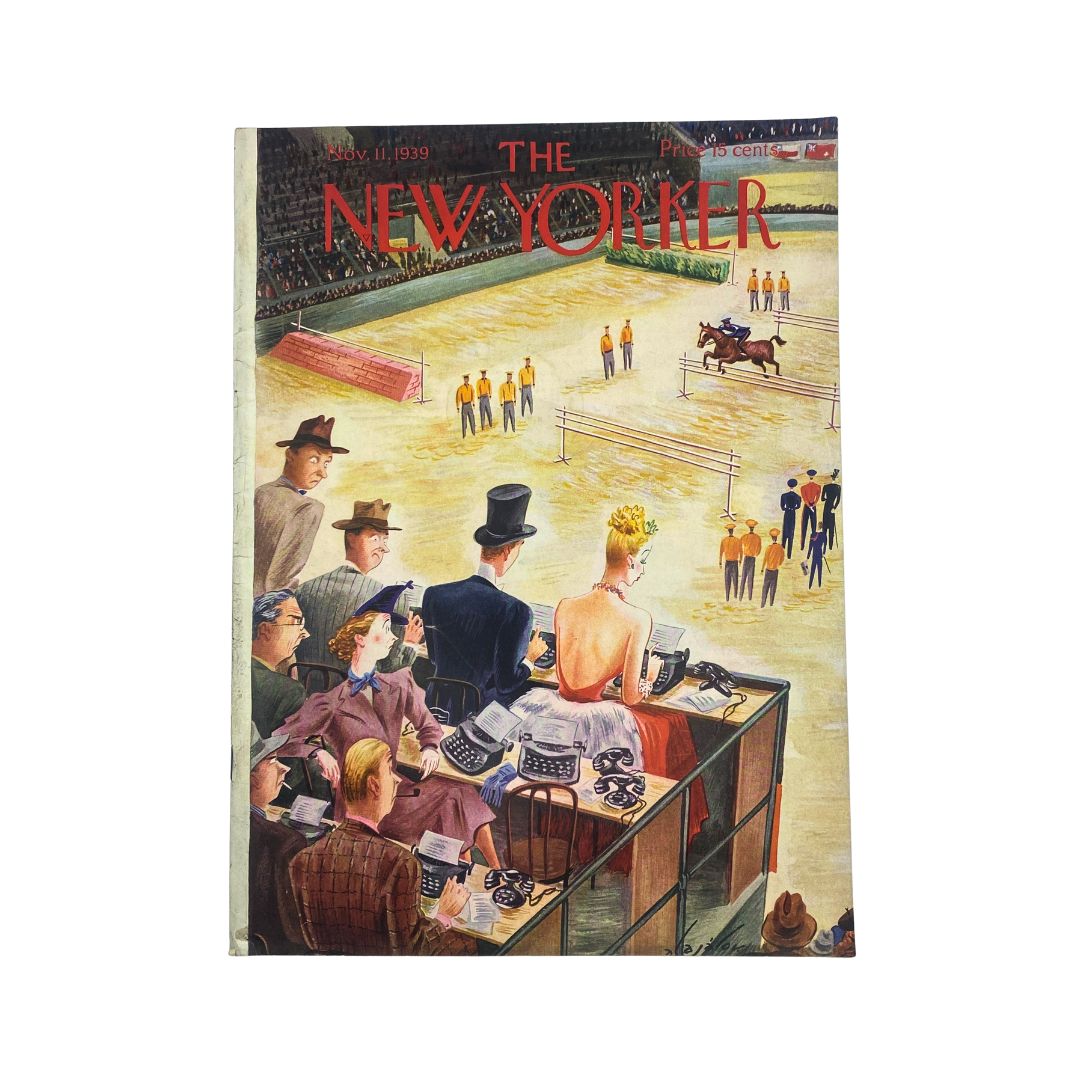
The cover by Constantin Alajalov makes this issue a particularly distinguished object within the magazine's late pre-war visual archive. Alajalov was one of the most celebrated and prolific cover artists in The New Yorker's history, contributing covers to the publication from the late 1920s through the 1950s — a run of nearly three decades that produced some of the most recognized images in the magazine's visual record. His style was defined by exactly the qualities the listing identifies: witty, engaging illustrations that captured the essence of American life with a draftsmanship that was precise, humorous, and socially observant in equal measure. The listing also notes his contributions to The Saturday Evening Post, which underscores his position as one of the most prominent commercial illustrators of the mid-twentieth century — an artist whose work appeared in the two most widely read magazines in America and whose cover art defined the visual culture of a generation. For collectors tracing the visual history of the publication through original New Yorker issues, an Alajalov cover on Armistice Day 1939 is an artifact of unusual historical and artistic depth.
The convergence of Alajalov's characteristic social comedy — his ability to find humor and humanity in the rituals of American civilian life — with the devastating irony of Armistice Day 1939 gives this specific issue a quality that is genuinely difficult to locate elsewhere in the magazine's pre-war archive. It is a document of cultivated American wit produced on the most painful anniversary in modern memory, and that combination is not accidental. It is precisely what The New Yorker was built to do: hold the surface of civilized life steady against the forces that were working to destroy it.
About the Publication
Founded in February 1925 by Harold Ross, The New Yorker was by November 1939 one of the most editorially distinguished and internationally attentive weekly publications in the English-speaking world, fourteen years into its run and operating with the full confidence of a publication that had established itself as the standard of American literary and journalistic excellence. Its readership was urban, educated, and expected the combination of wit, literary quality, and serious engagement with the world that Ross enforced with legendary editorial discipline. The magazine's format was mature and consistent: "Talk of the Town" commentary opened each issue, followed by reported features, fiction, poetry, and critical reviews spanning theater, books, art, and film, all interwoven with cartoons and spot illustrations representing the full flowering of the magazine's interwar visual tradition. Covers were individually commissioned works of illustration, produced by a rotating roster of contributing artists whose collective late-1930s output constitutes one of the most visually accomplished and historically resonant periods in the publication's history.
Key Highlights Inside
- Constantin Alajalov cover illustration: The cover is the defining collectible and historically significant feature of this issue — original artwork by one of The New Yorker's most celebrated and longest-serving cover artists, whose contributions to both the magazine and The Saturday Evening Post made him one of the most prominent commercial illustrators in mid-twentieth century America.
- Armistice Day 1939: November 11, 1939 was the twenty-first anniversary of the end of the First World War — observed in the tenth week of a second global conflict that had already made the peace of 1918 appear as one of history's most tragic failures. No date in the pre-war archive carries this particular historical irony more directly.
- Soviet invasion of Finland: The Soviet Union's invasion of Finland — the Winter War — began on November 30, just nineteen days after this issue's publication, and the diplomatic and military preparations that preceded it were underway as this issue went to press, adding to the charged international atmosphere of this specific week.
- Phoney War atmosphere: November 1939 coincided with the Phoney War on the Western Front — the period of eerie quiet between the fall of Poland and the German offensive of May 1940 — an atmosphere of suspended dread that pervaded the editorial and cultural consciousness of the period.
- Pre-war social observation: The listing notes Alajalov's ability to capture the essence of American life — and issues from November 1939 document that life at one of its most self-conscious and anxiety-laden moments, with the magazine's characteristic social comedy operating against a backdrop of genuine historical crisis.
Note: Specific article titles, bylines, and interior content for this exact issue have not been independently confirmed beyond what appears in the listing. The highlights above reflect only what is verifiable from the cover credit, publication date, and the magazine's well-documented editorial format during this period.
Condition & Rarity
A surviving copy of a weekly newsstand magazine from November 1939 presenting in very good condition — with minor edge wear as the only noted imperfection — is a sound and genuinely desirable preservation result for a publication now eighty-six years old. The New Yorker was printed on acidic wood-pulp paper stock standard for weekly periodicals of this era, a material inherently prone to toning, brittleness, and structural fatigue over time. Edge wear of the kind described is entirely consistent with honest age and careful storage rather than mishandling or neglect. When evaluating any surviving copy of this issue, the meaningful criteria are the integrity and color fidelity of Alajalov's cover art, the completeness of all interior pages, the absence of subscription label adhesive residue or moisture damage, and the structural soundness of the spine. A copy meeting the standard described — visually strong at over eight decades of age, with wear confined to the margins — represents the preservation grade that serious collectors of pre-war and early wartime periodicals actively seek when pursuing issues from this historically singular year.
Looking for More Issues Like This?
A Constantin Alajalov cover on Armistice Day 1939 — the twenty-first anniversary of the peace that ended the First World War, observed in the tenth week of a second — is one of the most historically resonant and personally meaningful objects in the entire pre-war New Yorker collector market, and November 11, 1939 is a date whose significance rewards the collector who understands it fully. If this issue is no longer available, the extensive original New Yorker collection at OriginalMagazines.com is one of the deepest archives of the magazine accessible to collectors anywhere, spanning many decades of its publishing history. For those drawn to the charged and irreplaceable atmosphere of the final pre-war and early wartime months, the full 1939 magazine collection rewards the most careful and unhurried exploration — it is a year whose historical gravity is unlike any other in the magazine's long and distinguished run.