



Description
Collector's Note – Why This Issue Matters
November 14, 1942 places this issue of The New Yorker squarely in the middle of one of the most consequential years of the twentieth century. The United States was barely a year into World War II, and American culture — its humor, its anxieties, its art — was bending under the weight of global conflict. That The New Yorker continued to publish with wit, sophistication, and genuine artistic ambition during this period is itself a remarkable fact. Cover art from this era carries a documentary weight that goes well beyond illustration: it is a snapshot of what American intellectual culture chose to look at, and laugh at, in the middle of catastrophe.
What makes this particular issue exceptional is the cover artist. Charles Samuel Addams — known universally as Chas Addams — was already a fixture at The New Yorker by 1942, having debuted in its pages in 1938. His darkly comic sensibility, populated by ghoulish suburbanites and crumbling mansions, was utterly unlike anything else appearing in American print media. A Chas Addams cover in The New Yorker's wartime run represents a fascinating collision of eras: the macabre rendered elegant, the sinister made charming, at a historical moment when real horror was front-page news. Addams would not name or formally codify his recurring family of characters until later, but the visual vocabulary he was developing through covers like this one was already laying the groundwork for what would eventually become the Addams Family — first as a formal cartoon household in The New Yorker, and later as a television institution.
For collectors focused on the intersection of American cartooning history and wartime publishing, this issue occupies a specific and well-documented niche. Covers bearing Addams' signature from the early 1940s predate the full crystallization of his most famous characters, making them documents of an artist in the act of invention. Anyone building a serious archive of 1942 American periodicals will recognize immediately that a complete, intact Addams cover issue from this year is not a routine find.
About the Publication
The New Yorker, founded in 1925 by Harold Ross, was by 1942 firmly established as the defining journal of American urban intellectual life. Its editorial model was distinctive and demanding: long-form journalism, short fiction of the highest order, poetry, criticism, and — critically — single-panel cartoons and painted covers that were treated as genuine fine art rather than commercial decoration. Its readership was educated, cosmopolitan, and largely based in the northeastern United States, though its cultural reach extended far beyond. Unlike mass-market magazines of the era, The New Yorker resisted the sensationalism of wartime publishing, maintaining an editorial voice that was ironic, precise, and deeply literary even as it addressed the world at war.
Key Highlights Inside
- Chas Addams cover art: The cover is the primary artifact of this issue — a signed work by one of American cartooning's most influential figures, created during the formative years of his career at the magazine.
- Wartime editorial context: Issues published in November 1942 appeared as the Allied invasion of North Africa (Operation Torch) was underway, meaning the editorial and journalistic content almost certainly engaged with the war's rapidly shifting landscape.
- Cartoons and interior illustration: The New Yorker's cartoon roster in 1942 included some of the most celebrated cartoonists of the century. Interior cartoon content from this period is itself collectible independent of the cover.
- Fiction and criticism: The magazine's literary sections in this era regularly featured writers of lasting significance. Specific bylines for this issue are unconfirmed, but the editorial standard of the period is well documented.
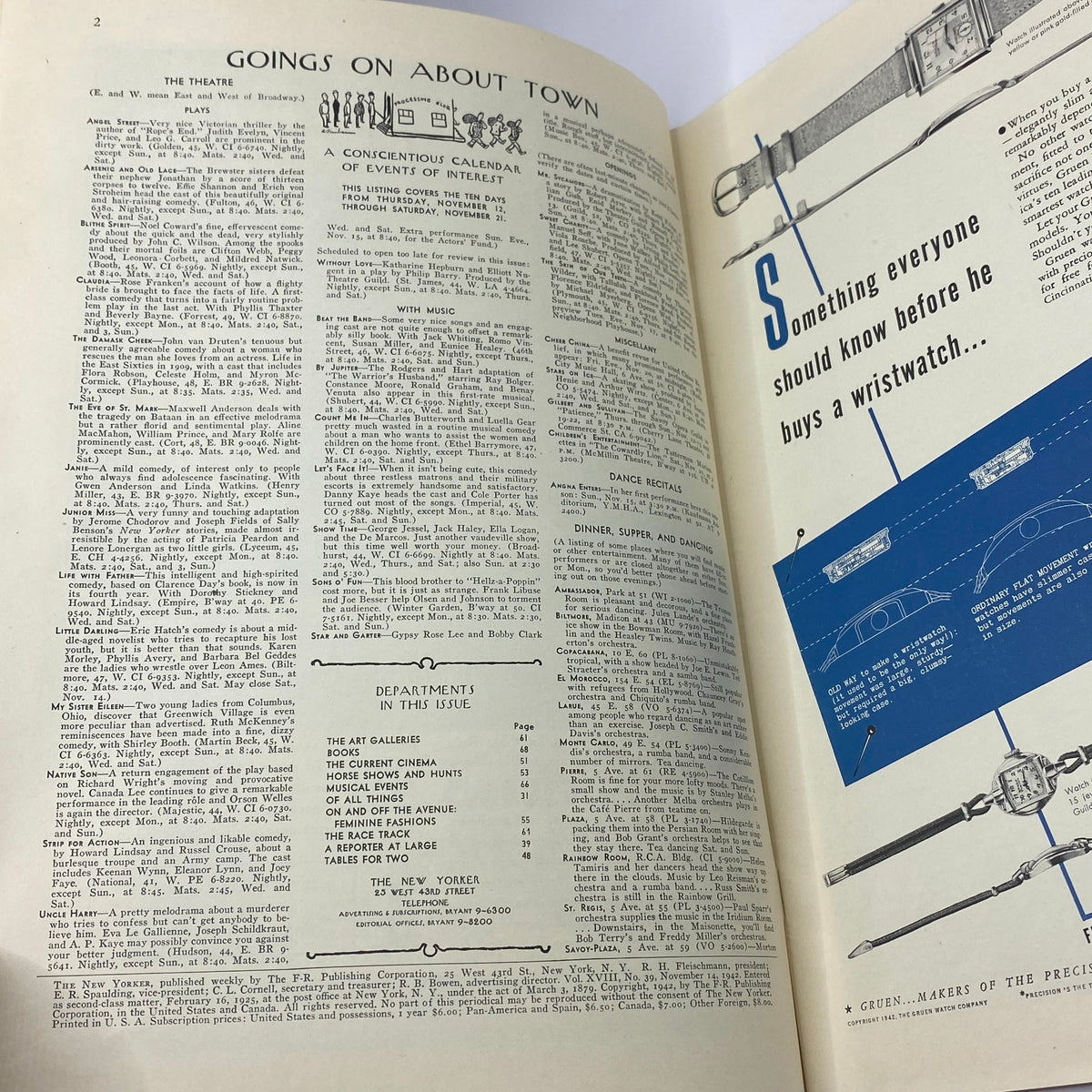
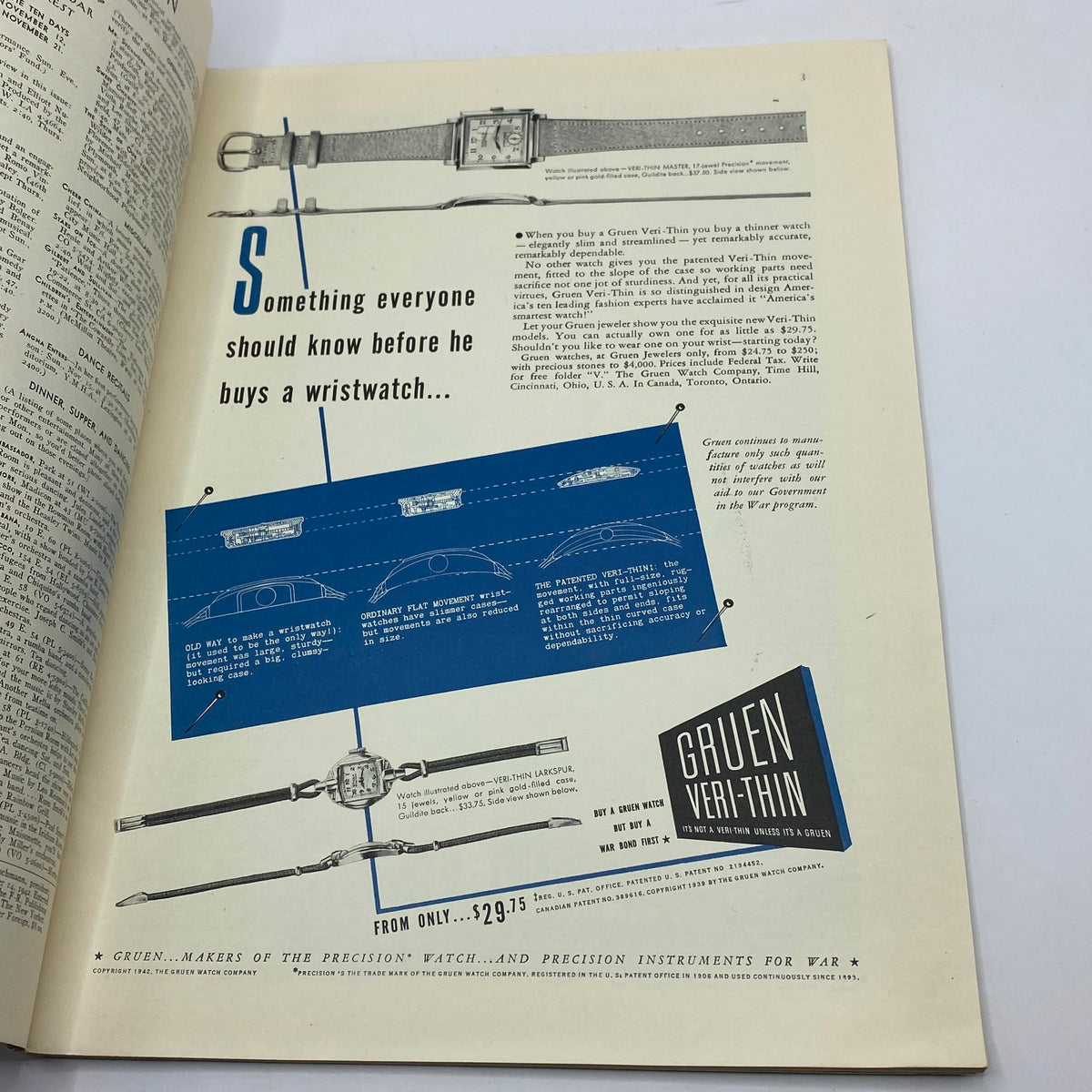
- Period advertising: Wartime advertising in The New Yorker is a subject of serious historical study — the ads aimed at this magazine's affluent readership during 1942 are culturally distinct from mass-market contemporaries and add documentary value to complete issues.
Condition & Rarity
A Very Good grade on an issue from 1942 is a meaningful designation. Eighty-plus years of existence present specific hazards for newsprint-based periodicals: toning, brittleness, moisture damage, spine splitting, and label adhesion from library or personal ownership marks are all common degradation patterns. An issue assessed as Very Good with minor edge wear and no noted structural compromise — complete, with pages intact — represents a survival rate that is genuinely uncommon for this format and this age. The New Yorker's coated cover stock has historically fared better than cheaper newsprint publications of the same era, which is one reason surviving copies tend to hold their color and cover integrity better than comparable wartime magazines. When evaluating any surviving copy of this issue, the priorities for a serious collector are cover color retention, spine integrity, and the absence of subscription label adhesion or library stamps — all of which directly affect the Addams artwork as the primary collectible element.
Looking for More Issues Like This?
A complete, Chas Addams-covered issue of The New Yorker from 1942 is genuinely difficult to locate in collector-grade condition, and this specific date may not surface again quickly. If you're building a deeper archive, the full New Yorker collection at OriginalMagazines.com spans decades of issues and is one of the largest available concentrations of the title in the collector market. For those whose focus is the wartime period more broadly, the 1942 magazine collection offers a wide range of titles from this pivotal year — an invaluable resource for anyone documenting American print culture at the height of the Second World War.