



Description
Collector's Note – Why This Issue Matters
November 18, 1939 is a date that carries extraordinary historical weight. Europe had been at war for ten weeks. Germany had invaded Poland on September 1, Britain and France had declared war on September 3, and by mid-November the full implications of what had begun were becoming impossible to minimize or defer. The Soviet Union had just invaded Finland on November 30 — the Winter War was days away. In the United States, the Neutrality Acts were being debated and revised in Congress, and the country was engaged in a profound internal reckoning about its relationship to the conflict unfolding across the Atlantic. New York, with its massive European immigrant population and its dense network of cultural, financial, and familial ties to the continent, felt the weight of these events more acutely than perhaps any other American city. A November 1939 issue of The New Yorker is not simply a cultural artifact — it is a document produced in the immediate aftermath of the world changing. For collectors building a serious historical archive through original magazines from 1939, issues from this autumn represent some of the most charged and consequential material in the entire decade.
The cover by Beatrice Tobias gives this particular issue a significance that extends beyond its historical moment. Tobias was one of a small number of women contributing cover art to The New Yorker during the late 1930s and early 1940s, working in a field dominated almost entirely by male illustrators. The listing's description of her work as colorful and expressive is consistent with what is documented about her approach — a style that brought warmth and visual energy to the magazine's cover format at a moment when the world outside was darkening considerably. That contrast between the vibrancy of the cover art and the gravity of the historical context gives this issue a particular resonance that collectors who study the period tend to find compelling. For those assembling a comprehensive visual record through original New Yorker issues, covers by women artists from this era are among the more historically interesting and less commonly encountered objects in the magazine's pre-war archive.
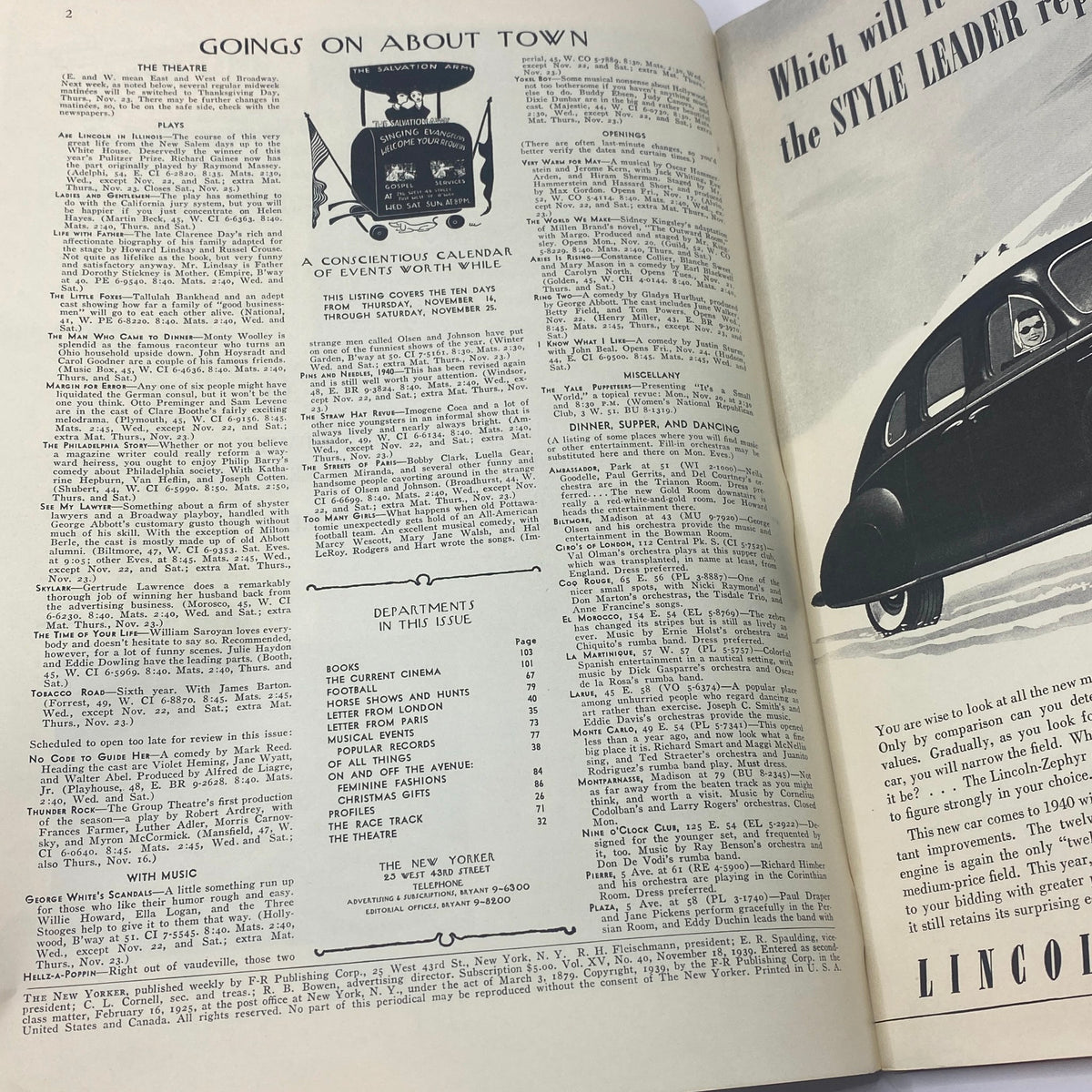
There is also something worth noting about the specific position of November 18 within the magazine's autumn calendar. By mid-November, The New Yorker's editorial rhythm had fully shifted from the lighter register of its summer and early fall numbers into the more substantive, critically engaged mode that characterized its winter issues. The theater season was active, the literary calendar was full, and the magazine's writers and critics were operating at full intensity — all while processing, in real time, the implications of a war that had begun less than three months before this issue went to press.
About the Publication
Founded in February 1925 by Harold Ross, The New Yorker was by the autumn of 1939 one of the most editorially distinguished publications in the English-speaking world. Its readership was urban, educated, and expected both the wit and the intellectual seriousness that Ross maintained with unusual editorial discipline. The magazine's format was consistent and mature by this point: "Talk of the Town" commentary opened each issue, followed by reported features, fiction, poetry, and critical reviews of theater, books, art, and film, all interwoven with cartoons and spot illustrations representing one of the most celebrated traditions in American periodical art. Covers were individually commissioned works of illustration, each a complete artistic statement in its own right, produced by a rotating roster of contributing artists whose collective output defined the visual culture of sophisticated American publishing across the interwar decades.
Key Highlights Inside
- Beatrice Tobias cover illustration: The cover is the most historically documentable feature of this issue — original artwork by one of the relatively few women contributing cover art to The New Yorker during this period, known for a colorful and expressive style that stood apart from the work of her contemporaries.
- First autumn of World War II: Published ten weeks after the German invasion of Poland and the British and French declarations of war, this issue appeared at a moment when the full reality of a new world war was only beginning to be absorbed by the American public and press.
- American neutrality debate: The political atmosphere of November 1939 in the United States was dominated by the question of neutrality and the revision of the Neutrality Acts — a debate that The New Yorker's editorial voice engaged with characteristic intelligence and precision.
- Full autumn editorial season: Mid-November issues from this period reflect the magazine at its most critically engaged — the theater and literary seasons fully active, the writing staff operating at full intensity, the editorial content at its most substantive.
- Period cartoons and advertising: Issues from late 1939 are valuable to collectors and cultural historians for the cartoons, spot illustrations, and advertising that together document the texture of New York life at the precise moment the world entered a second global war.
Note: Specific article titles, bylines, and interior content for this exact issue have not been independently confirmed beyond what appears in the listing. The highlights above reflect only what is verifiable from the cover credit, publication date, and the magazine's well-documented editorial format during this period.
Condition & Rarity
A surviving copy of a weekly newsstand magazine from November 1939 presenting in very good condition — with minor edge wear as the only noted imperfection, and with vibrant cover colors described as still standing out — is a notably strong preservation outcome for a publication now eighty-five years old. The New Yorker was printed on acidic wood-pulp paper stock standard for weekly periodicals of this era, a material prone to toning, brittleness, and color fading over time. The retention of cover color vibrancy after more than eight decades is a meaningful indicator of careful storage history. When evaluating any surviving copy of this issue, the key criteria are the integrity and color fidelity of Tobias's cover art, the completeness of all interior pages, the absence of subscription label adhesive residue or moisture damage, and the structural soundness of the spine. Edge wear confined to the margins, with the cover art and interior pages intact, represents the standard that serious collectors of pre-war periodicals actively seek.
Looking for More Issues Like This?
Beatrice Tobias covers are among the less commonly encountered in the late 1930s New Yorker market, and a November 1939 date — carrying the full weight of the war's first autumn — makes this a genuinely distinctive find. If it is no longer available, the deep original New Yorker collection at OriginalMagazines.com remains one of the most extensive archives of the magazine accessible to collectors, with issues spanning many decades of its history. For those drawn specifically to the charged atmosphere of the pre-war and early war years, the full 1939 magazine collection is worth exploring with care — it is a year whose historical gravity is unlike almost any other in the magazine's long and distinguished run.