


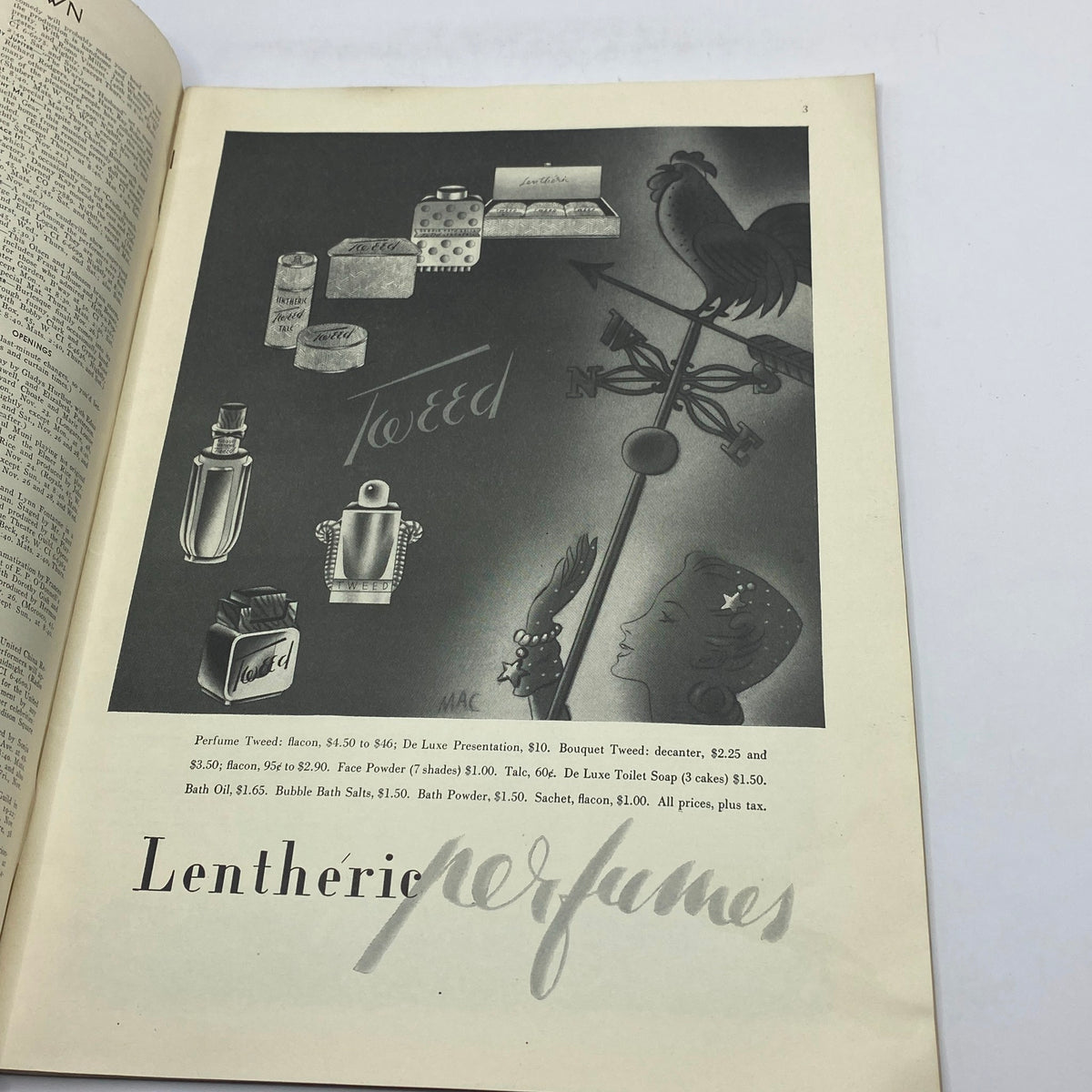


Description
Collector's Note – Why This Issue Matters
The November 21, 1942 issue of The New Yorker, featuring a cover by Perry Barlow, is a primary document of the wartime magazine at a historically significant moment and a testament to the work of one of the publication's most warmly regarded cover contributors. Perry Barlow had been contributing to The New Yorker since the late 1920s, and his covers occupied a specific and valued register within the magazine's visual program — where artists like Peter Arno brought sophisticated urban edge and Charles Addams brought macabre wit, Barlow brought a quality of gentle domestic comedy and heartwarming observation that documented the textures of middle-class American family and social life with particular affection and precision. His covers were among the most immediately accessible in the magazine's visual program, communicating their humor and warmth to readers across a broader demographic range than some of his more sophisticated colleagues, and they are now recognized as primary documents of mid-century American domestic life rendered with genuine artistic care. November 21, 1942 falls just before Thanksgiving — the traditional holiday of domestic gathering and American family life — and a Barlow cover for this Thanksgiving-week issue would have been an exercise in precisely the kind of warmly observed family comedy that was his most characteristic territory. Collectors building a focused archive of wartime New Yorker issues and their visual art will find the New Yorker magazine collection the most comprehensive resource for identifying covers and complete issues from across the publication's most historically rich and visually distinguished decades.
November 1942 places this issue at one of the most consequential moments of World War II. American forces had landed in North Africa in Operation Torch just two weeks earlier, on November 8, 1942, marking the first major American offensive operation of the war in the European and Mediterranean theater. The battle of Guadalcanal was still ongoing in the Pacific. Stalingrad was being fought. The full course and outcome of the war were genuinely uncertain, and American civilian life in November 1942 was defined by the specific emotional landscape of a nation newly and fully committed to a global conflict whose duration and cost were still unknown. A Thanksgiving-week issue of The New Yorker in this context — with a Barlow cover documenting the pleasures of domestic and family life — carried a particular resonance between the holiday's traditional emphasis on gratitude and abundance and the wartime reality of rationing, separation, and loss. The complete magazine preserved here offers access to the full editorial program The New Yorker assembled for this specific week, including whatever journalism, fiction, poetry, and cartoons its editors chose to place alongside Barlow's cover during one of the war's most intense periods. Collectors focused on the wartime period will find that 1942 magazine issues represent some of the most historically charged primary documents in the American periodical archive, capturing a year that witnessed the full American entry into the war and the beginning of the long Allied march toward victory.
Perry Barlow's specific contribution to The New Yorker's visual identity during the wartime years deserves recognition beyond his general reputation as a warm and accessible cover artist. His covers from the 1940s document the American domestic and social landscape of the wartime home front with a combination of humor, affection, and observational accuracy that makes them genuinely valuable as primary documents of civilian experience alongside the more directly war-focused journalism and photography of the period. The family gathering, the neighborhood, the small social comedy of everyday life — these were Barlow's subjects, and in the context of 1942 they carried the additional weight of being the things that the war was being fought to preserve. A complete November 1942 New Yorker with a Barlow cover is therefore not simply a holiday collectible but a document of how American civilian culture was maintaining its identity and its pleasures under wartime pressure, as seen through the eyes of one of the most perceptive domestic illustrators of his generation.
About the Publication
The New Yorker was founded in 1925 by Harold Ross and had established itself by 1942 as one of the most culturally significant weekly magazines in the world, combining long-form journalism, fiction, poetry, criticism, and the distinctive visual identity — cartoons, covers, and illustrations — that had made it immediately recognizable and that had given it a particular place in American cultural life for nearly two decades. During the World War II years under Harold Ross's editorship, the magazine produced some of the most enduring American journalism of the century while maintaining the wit, sophistication, and commitment to quality that had defined it from its founding. The cover art program remained central to its identity throughout the wartime period, and artists like Perry Barlow who contributed covers that documented the warmth and humor of domestic American life were understood as playing an essential role in the magazine's commitment to maintaining the pleasures of civilized life even under the pressures of global conflict.
Key Highlights Inside
- Cover painting by Perry Barlow — a primary artifact of this warmly regarded New Yorker cover artist's wartime work, produced for the Thanksgiving-week issue of 1942 and representing the domestic comedy and affectionate social observation that made his covers among the most immediately accessible and most representative of American home-front life in the publication's wartime visual program.
- November 21, 1942 publication date — two weeks after the Allied landings in North Africa marked the first major American offensive operation in the European theater, placing this issue at a specific and historically important transitional moment in the war when American forces were first engaging the Axis powers in direct combat on the other side of the Atlantic.
- Thanksgiving-week issue — a holiday publication carrying the particular emotional resonance of a Thanksgiving celebrated under wartime conditions, when the traditional themes of gratitude, family, and domestic abundance were charged with the specific awareness of separation, rationing, and the ongoing global conflict that gave every American holiday in 1942 a quality of bittersweet poignancy.
- Complete magazine format — preserving the full editorial program of this specific issue, including whatever journalism, fiction, poetry, criticism, and cartoons The New Yorker assembled for the week of November 21, 1942, providing a complete primary document of the magazine's wartime editorial voice during one of the most consequential weeks of the war.
- Small rip noted — a condition detail addressed specifically below, which affects the physical integrity of surviving copies of this issue in a specific and localized way that collectors should evaluate against the provided photographs.
Condition & Rarity
Good condition with a small rip is a transparent and honest assessment for a complete New Yorker issue from November 1942 now more than eighty years old. A small rip on a publication of this age is a specific and localized condition issue whose significance depends on its location — a rip to a peripheral edge or back cover area has considerably less impact on display and research value than a rip that affects the cover image, the spine, or interior pages. Collectors should examine the provided photographs carefully to assess the rip's specific location and size relative to Barlow's cover art and the interior editorial content that constitute the primary values of this issue. Good overall condition for the rest of the publication — which the listing implies — indicates that the rip is the primary condition concern rather than a more systemic deterioration, which is a more favorable profile than it might initially appear. Wartime New Yorker issues were produced under paper rationing constraints that affected stock quality, and eighty-plus years of storage have been kind to surviving copies that have been kept in stable environments. A complete issue with one specific, localized condition issue remains a genuine primary document of its era whose research and collector value is not eliminated by a single rip that may be peripheral to its most significant content.
Looking for More Issues Like This?
Complete New Yorker issues from the wartime autumn of 1942 featuring Perry Barlow covers — particularly holiday-week issues that capture the specific emotional texture of civilian life during the war's most intense early period — are among the more specifically valuable items for collectors working to document the full range of The New Yorker's wartime visual and editorial program. The broader New Yorker magazine collection is the most reliable starting point for finding other significant complete issues and covers from across the publication's history, including other wartime issues from 1942 that document the magazine during its most historically consequential period. Collectors building a focused archive of this pivotal wartime year will find the complete 1942 magazine collection an invaluable resource for locating other titles and issues that document this extraordinary year from the multiple perspectives that serious historical research requires.