



Description
Collector's Note – Why This Issue Matters
The November 22, 1969 issue of The New Yorker carries a date that resonates with unavoidable historical weight: it is the sixth anniversary of the assassination of President John F. Kennedy in Dallas on November 22, 1963. Whether or not the issue's editorial content addressed that anniversary directly, the date itself gives any New Yorker published on November 22 a particular resonance for collectors and historians. But the issue's historical significance extends well beyond the calendar. November 1969 was one of the most politically charged months of the Vietnam era: the My Lai massacre had been publicly revealed just two weeks earlier, on November 12–13, generating national shock and moral crisis; the Moratorium to End the War in Vietnam on October 15 had been the largest single-day protest in American history; and the Nixon administration was navigating its "silent majority" speech of November 3 against a backdrop of mounting antiwar pressure. Richard Harris's "Annals of Politics: The Department of Justice — III" — the third installment of what appears to be a serialized examination of the Justice Department — was produced in this specific atmosphere, and its placement in this issue connects the magazine's institutional journalism to one of the most contested moments in American legal and political history. Collectors building archives of The New Yorker's late-1960s run will find the fall 1969 issues among the most historically saturated in the magazine's modern archive.
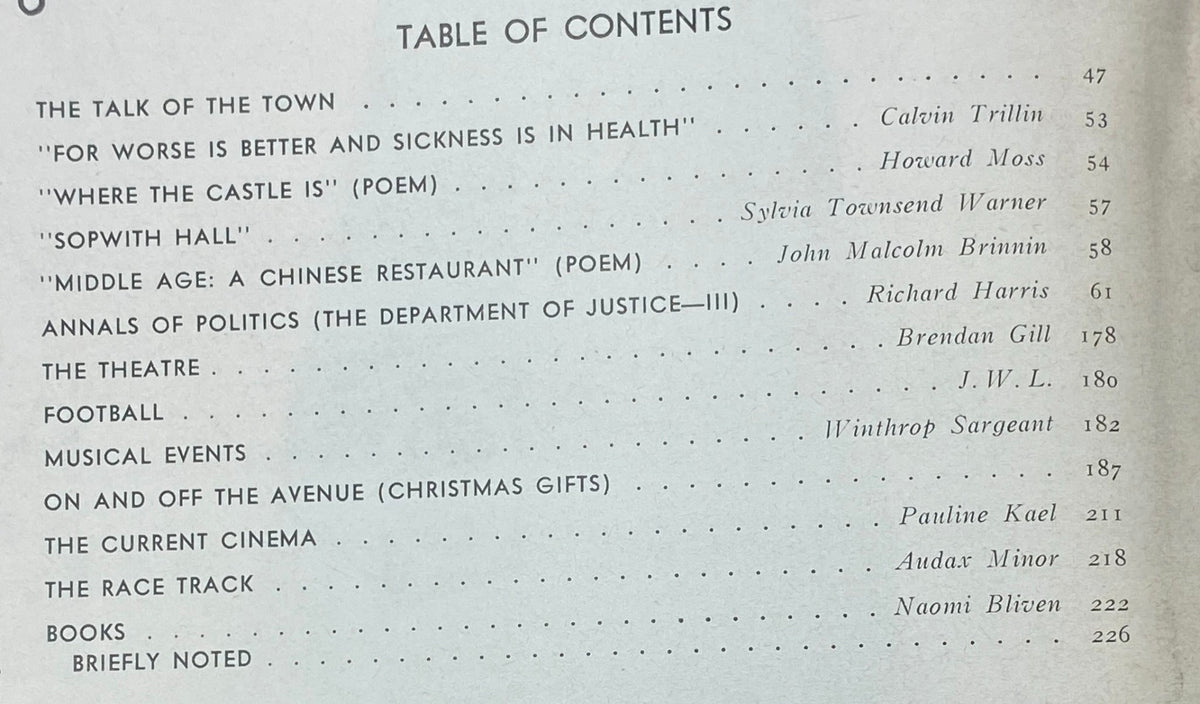
The editorial content of this issue is unusually well-documented for a listing of this type, and the table of contents rewards close attention. Calvin Trillin contributes to "The Talk of the Town" — his distinctive comic journalism voice was one of the magazine's most recognizable contributions of the era. Sylvia Townsend Warner's fiction piece "Sopwith Hall" places one of Britain's most distinctive twentieth-century prose stylists in the same issue as Howard Moss's poetry and John Malcolm Brinnin's verse. Pauline Kael's film column appears under "On and Off the Avenue (Christmas Gifts)" — an unusual placement that suggests the column was functioning in a gift-guide capacity for this pre-Christmas issue, reflecting Kael at the height of her New Yorker influence. Brendan Gill on theatre, Winthrop Sargeant on musical events, and the racing coverage round out an issue that captures the magazine's full editorial range in a single pre-Thanksgiving week. For collectors documenting 1969 through its print culture, this issue provides a primary source of unusual density from the final weeks of one of the most historically consequential years in modern American history.
About the Publication
The New Yorker was operating in November 1969 under the editorship of William Shawn, whose tenure from 1952 to 1987 is widely regarded as the magazine's second and perhaps greatest creative peak. Under Shawn, the publication had expanded its long-form journalism to engage seriously with Vietnam, civil rights, and the social upheavals reshaping American life, while maintaining its foundational commitments to fiction, poetry, and cultural criticism. The late-1960s issues reflect the magazine at its most politically engaged and its most literarily ambitious simultaneously — holding Calvin Trillin's comic journalism alongside Richard Harris's legal reporting, Sylvia Townsend Warner's fiction alongside Pauline Kael's film criticism, within the same weekly format. The cover art program under Shawn continued its tradition of commissioning significant illustrators, with Donald Reilly representing the publication's mid-century visual identity at its most accomplished.
Key Highlights Inside
- Cover illustration by Donald Reilly: Reilly was a regular New Yorker contributor across cartoons and cover art, and his November 22, 1969 cover was produced at one of the most politically turbulent moments in the magazine's postwar history — two weeks after the My Lai revelations and three weeks after the Vietnam Moratorium.
- Calvin Trillin — "The Talk of the Town" (p. 47): Trillin's distinctive comic journalism voice, one of the magazine's most recognizable contributions of the late-1960s and 1970s era, is represented in the issue's signature opening department.
- Richard Harris — "Annals of Politics: The Department of Justice — III" (p. 61): The third installment of Harris's serialized examination of the Justice Department — long-form institutional journalism produced during the Nixon administration's first year, in a month dominated by Vietnam, protest, and political contestation.
- Sylvia Townsend Warner — "Sopwith Hall" (p. 57): Fiction by one of Britain's most distinctive twentieth-century prose writers — Warner's New Yorker appearances across several decades are among the magazine's most significant literary contributions from the British tradition.
- Pauline Kael — "On and Off the Avenue: Christmas Gifts" (p. 187) and poetry by Howard Moss (p. 54) and John Malcolm Brinnin (p. 58): Kael's film column in a pre-Christmas gift-guide context, alongside two named poets — Moss was the magazine's poetry editor and one of its most important mid-century literary contributors; Brinnin was a significant American poet and literary biographer of the era.
- Brendan Gill on theatre (p. 178) and Winthrop Sargeant on musical events (p. 182): Two of the magazine's most established cultural critics representing the full performing arts coverage in a pre-Thanksgiving issue produced during an exceptionally charged cultural moment.
Condition & Rarity
The no-label status of this issue is its most significant positive condition attribute. The New Yorker had a large subscriber base in 1969, and clean, label-free copies — indicating newsstand rather than subscriber distribution — present the Donald Reilly cover artwork without the disruption that mailing labels cause. The listing confirms that the photographed item is the exact item to be received, allowing direct condition assessment from the provided images. The plastic protective covering indicates deliberate preservation. When evaluating any surviving copy of this issue, the Reilly cover's surface condition is the primary grading variable, followed by interior page completeness — confirmed by the paginated table of contents — and degree of toning. The New Yorker's uncoated interior stock from this era ages to moderate tanning under average storage conditions over fifty-five years, while the cover's coated surface retains color considerably better. The complete paginated editorial content, confirmed by the listing's table of contents, is the paramount condition attribute for this format and era.
Looking for More Issues Like This?
No-label copies of late-1969 New Yorker issues with documented complete editorial content — particularly from November, when the year's political turbulence was at its most acute — are among the more historically layered finds in the vintage magazine market. If this one has already found a home, the full archive of The New Yorker issues is the essential destination for collectors working through the magazine's remarkable run across the decades. The 1969 magazine collection is also worth exploring for anyone building a broader documentary picture of American print culture during one of the most consequential years of the twentieth century.