




Description
Collector's Note – Why This Issue Matters
The November 7, 1931 issue of The New Yorker, featuring a cover by Margaret Schloeman, arrives from one of the most historically significant years in twentieth-century American life. By November 1931, the Great Depression was deepening into something that was beginning to look less like a recession and more like a structural collapse — unemployment was climbing toward record levels, bank failures were accelerating, and the Hoover administration's responses were proving inadequate to the scale of the crisis. The New Yorker of 1931 navigated this reality in its characteristic oblique fashion, maintaining the sophisticated urban voice that Harold Ross had spent six years constructing while the world outside its pages was undergoing profound and painful transformation. Issues from this year occupy a specific and historically charged position in the magazine's archive — they document the publication holding to its editorial identity under conditions that were testing every American institution, and the tension between the magazine's cultivated wit and the Depression's grinding reality gives the editorial content of 1931 issues a retrospective depth that cannot be manufactured. Collectors who specialize in the Depression-era run of The New Yorker will find the New Yorker magazine archive at OriginalMagazines.com an essential resource for building a comprehensive archive of this period.
The cover is the work of Margaret Schloeman, one of the female artists who contributed to The New Yorker's visual identity during the early 1930s. Women artists were a meaningful presence in the magazine's early cover roster — alongside better-known names like Helen Hokinson, whose cartoons were already a fixture — and Schloeman's contributions represent a specific thread in the broader tapestry of the magazine's visual history that rewards attention. Her covers are associated with the sophisticated, elegantly observed aesthetic that art editor Rea Irvin was cultivating: cosmopolitan, visually confident, and attuned to the particular character of New York City life at a moment when that life was being complicated by economic forces that the city's cultural elite was processing with varying degrees of awareness and discomfort. A November 1931 Schloeman cover is both a document of that visual culture and an object of genuine collector interest for those who study the women artists of early American magazine illustration. The broader cultural landscape of this year can be explored through the 1931 magazine archive at OriginalMagazines.com, which offers primary sources across American print culture during the Depression's most acute early phase.
About the Publication
The New Yorker was founded in New York City in February 1925 by editor Harold Ross, with financial backing from Raoul Fleischmann, and by November 1931 had completed six and a half years of publication as the defining weekly journal of American urban literary and cultural life. Its format — Talk of the Town, fiction, poetry, criticism, cartoons, and commissioned cover art — was fully established by this point, and its contributor roster in 1931 represented a concentration of American literary and artistic talent that the Depression had not yet significantly disrupted. Rea Irvin's art direction continued to set a high standard for the magazine's visual identity, commissioning covers from a rotating roster of artists — including Schloeman — whose work collectively defined what sophisticated American magazine illustration looked like in the early 1930s.
Key Highlights Inside
- Cover art by Margaret Schloeman — one of the female artists contributing to The New Yorker's early visual identity, working in the sophisticated and elegantly observed style that art editor Rea Irvin was cultivating as the magazine's graphic signature during the Depression era.
- Editorial content consistent with The New Yorker's November 1931 format, including Talk of the Town, fiction, poetry, criticism, and cartoon content produced by the magazine's Depression-era contributor roster at the height of its early creative period.
- Interior cartoons and illustrations by the broader stable of artists contributing to the magazine in 1931 — a roster that included some of the most significant figures in the history of American magazine cartooning, working at a moment of considerable historical tension.
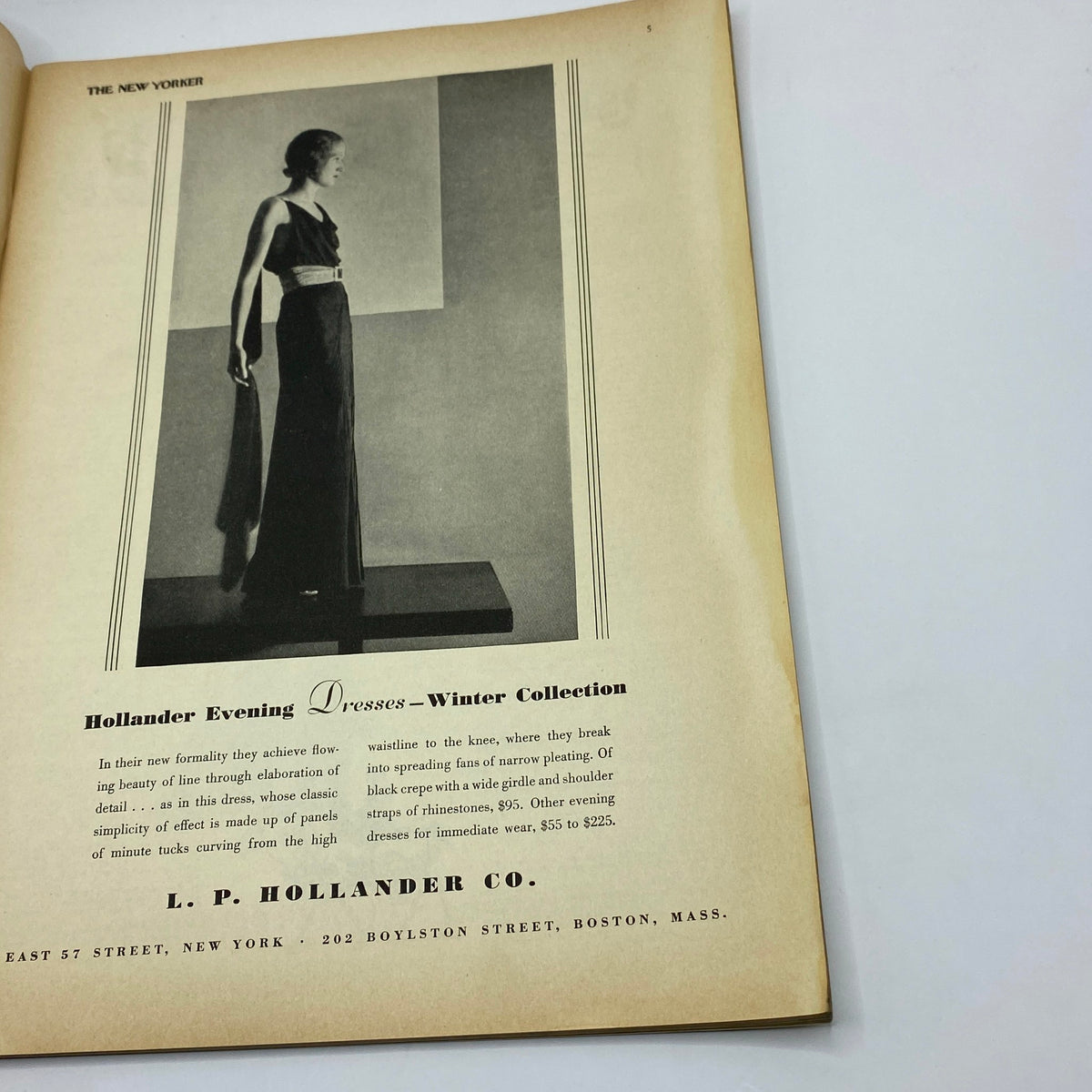
- Period advertising pages reflecting the commercial culture of New York in November 1931 — a primary-source document of the luxury and consumer economy in the second full year of the Great Depression, as advertisers navigated a contracting market while maintaining their appeals to The New Yorker's affluent readership.
- Note: Specific article titles, fiction contributors, and additional interior features beyond what is documented above are not confirmed in available listing details. The above reflects what is verifiable from the cover, artist attribution, publication date, and the well-documented editorial format of the period.
Condition & Rarity
Very good condition for a New Yorker issue from November 1931 is a meaningful and collector-relevant grade — this is a publication now approaching its ninety-fifth year of existence, and very good condition implies intact covers with retained color and surface quality in Schloeman's cover illustration, a complete interior page block in sound structural condition, and a spine that has not been compromised by rolling or moisture damage. For a weekly magazine of this vintage, achieving this grade without institutional archiving represents genuinely careful survival over more than nine decades. The listing does not specify label status, which collectors should confirm directly; label-free newsstand copies are preferred over subscriber copies in serious collector grading for issues of this period, as label removal risks surface damage that cannot be reversed. Complete, well-preserved New Yorker issues from 1931 are among the more historically significant and less commonly encountered survivors in the magazine collector market — the print runs of the era were modest relative to the magazine's later circulation, and nine decades of attrition have substantially reduced the surviving population of any given issue from this window.
Looking for More Issues Like This?
A very good condition New Yorker from November 1931 with a Margaret Schloeman cover is the kind of material that serious collectors of early American magazine illustration and Depression-era publishing history pursue deliberately — these issues don't surface often in this grade, and the combination of Schloeman's relative obscurity and the historical significance of the year makes this one particularly worth noting. If it's no longer available, the New Yorker archive at OriginalMagazines.com is the deepest available source for the magazine across its full publishing history, with strong depth in issues from the founding decade. Collectors drawn to the broader cultural richness of the Depression's early years will also find the 1931 magazine archive worth exploring for primary sources from one of the most consequential years of the twentieth century.