


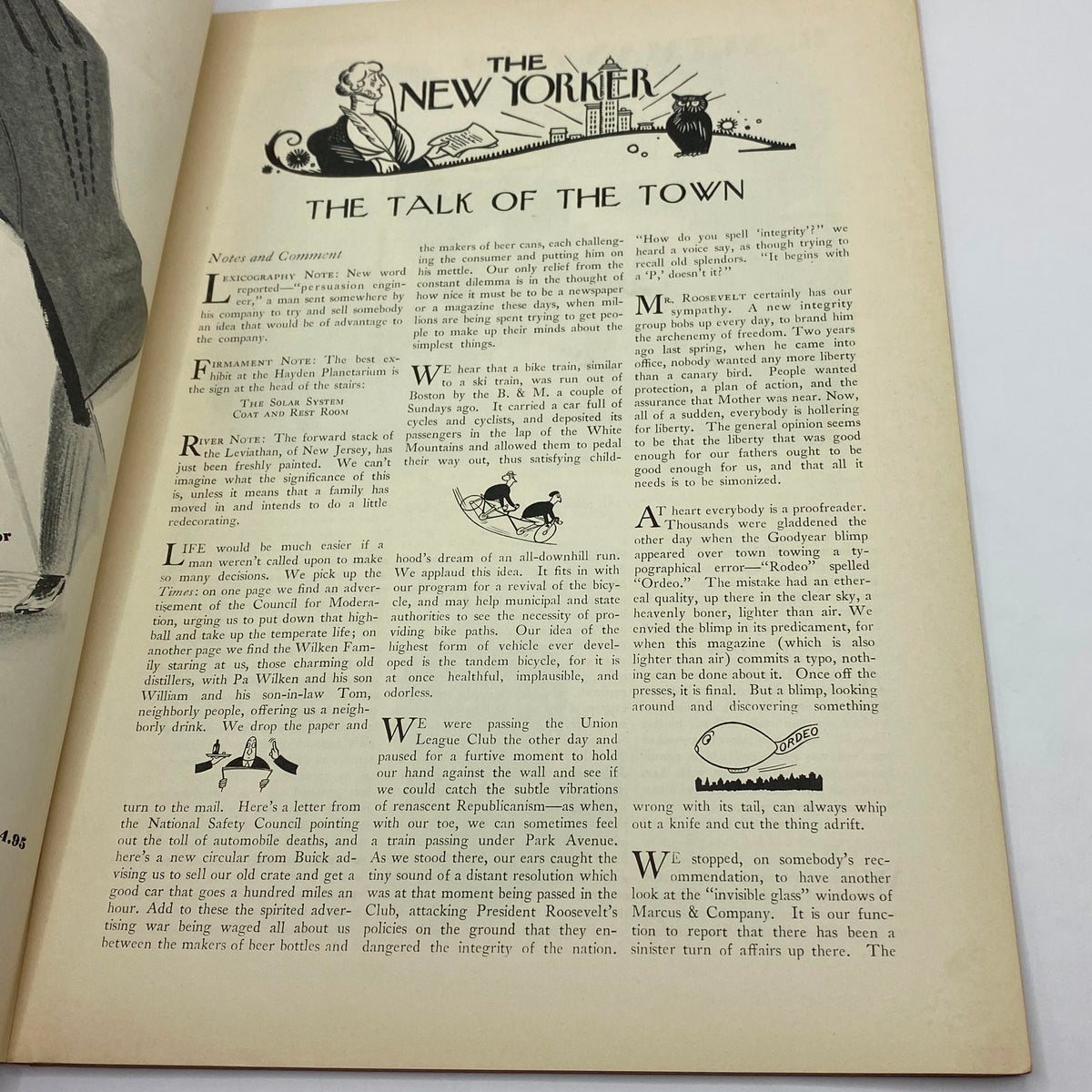


Description
Collector's Note – Why This Issue Matters
October 19, 1935 places this issue of The New Yorker at a moment of considerable historical significance and cultural urgency. The Italian invasion of Ethiopia had begun sixteen days earlier, on October 3, marking one of the most consequential acts of fascist military aggression of the entire interwar period. Mussolini's attack on a member state of the League of Nations had exposed the international organization's fundamental inability to restrain authoritarian power, and the implications for the stability of the post-Versailles order were being absorbed with growing alarm by the attentive observers who comprised The New Yorker's readership. In the United States, the Second New Deal had just completed its most productive legislative phase — the Social Security Act had been signed in August, the National Labor Relations Act in July — and the domestic political landscape was being reshaped by these transformations even as the international situation darkened. For collectors building a serious documentary archive through original magazines from 1935, a mid-October issue published sixteen days into the Ethiopian crisis documents the American cultural and editorial moment at a specific and consequential threshold — the domestic achievements of the New Deal's most productive summer giving way to the first fascist military aggression that would define the late 1930s.
The cover by William G. Crawford gives this issue a specific place within the magazine's mid-Depression visual tradition. Crawford contributed cover art to The New Yorker during this period, working in the tradition of humorous, elegant illustration that the magazine's art department had cultivated under founding art editor Rea Irvin. The listing's description of his work as blending humor and elegance — detailed, engaging artwork that made his covers a highlight for readers — is consistent with the broader sensibility that characterized the magazine's contributing cover artists of this period: illustrators who brought individual visual personalities to a format that demanded both wit and formal sophistication. A Crawford cover from October 1935 is a relatively uncommon artifact in the collector market, representing the work of a contributing artist whose output during this period is encountered less frequently than that of the publication's most celebrated names. For collectors tracing the complete visual history of the publication through original New Yorker issues, covers by contributing artists of this kind — skilled, characteristic of their moment, and less frequently competed for — represent some of the most historically honest and least commonly available material in the archive.
October 19 also falls within the opening weeks of The New Yorker's most intensive annual editorial season. By the third week of October, the autumn theater calendar was in full swing, the literary year was building toward its year-end intensity, and the magazine's critical and reportorial voice was operating with its fullest engagement. In October 1935, that editorial energy was running alongside the Ethiopian crisis and the ongoing domestic debates of the New Deal's aftermath, giving the issue a layered quality that rewards attention from both the historical and the cultural perspectives.
About the Publication
Founded in February 1925 by Harold Ross, The New Yorker was by the autumn of 1935 a fully established institution of American cultural life, ten years into its run and operating with the editorial confidence and literary ambition that would define its reputation for generations. Its readership was urban, educated, and expected the combination of wit, critical intelligence, and serious engagement with the world that Ross enforced with unusual editorial discipline. The magazine's format was mature and consistent: "Talk of the Town" commentary opened each issue, followed by reported features, fiction, poetry, and critical reviews spanning theater, books, art, and film, all interwoven with cartoons and spot illustrations that had developed by mid-decade into one of the most celebrated creative traditions in American periodical publishing. Covers were individually commissioned works of illustration, produced by a rotating roster of contributing artists whose collective Depression-era output constitutes a remarkable visual record of American urban life during one of its most complex and creative periods.
Key Highlights Inside
- William G. Crawford cover illustration: The cover is the most historically documentable feature of this issue — original artwork by a contributing illustrator known for detailed, elegant work that blended humor and sophistication, working within the visual tradition that defined The New Yorker's mid-Depression cover aesthetic.
- Sixteen days after the Italian invasion of Ethiopia: Published on October 19, 1935 — sixteen days after Mussolini's invasion of Ethiopia on October 3 — this issue appeared as the international response to that invasion was being assessed and the League of Nations' inadequacy was becoming undeniable, marking a watershed moment in the deterioration of the pre-war international order.
- Post-Second New Deal legislative autumn: October 1935 followed the most legislatively productive summer of Roosevelt's presidency, with the Social Security Act, National Labor Relations Act, and Banking Act all recently enacted — a transformation of American social and economic policy whose implications were still being absorbed and debated as this issue circulated.
- Opening of the autumn editorial season: Mid-October issues mark the full resumption of The New Yorker's most intensive editorial engagement — theater and literary seasons active, the magazine's critical and journalistic voice at its fullest — in October 1935 operating against the backdrop of the Ethiopian crisis and the New Deal's legislative aftermath.
Note: Specific article titles, bylines, and interior content for this exact issue have not been independently confirmed beyond what appears in the listing. The highlights above reflect only what is verifiable from the cover credit, publication date, and the magazine's well-documented editorial format during this period.
Condition & Rarity
A surviving copy of a weekly newsstand magazine from October 1935 presenting in very good condition — with minor edge wear as the only noted imperfection — is a strong preservation result for a publication now ninety years old. The New Yorker was printed on acidic wood-pulp paper stock standard for weekly periodicals of the era, a material inherently prone to toning, brittleness, and structural degradation over time. Edge wear of the kind described is entirely consistent with honest age and careful storage rather than mishandling or neglect. When evaluating any surviving copy of this issue, the meaningful criteria are the integrity and color fidelity of Crawford's cover art, the completeness of all interior pages, the absence of subscription label adhesive residue or moisture damage, and the structural soundness of the spine. A copy meeting the standard described — visually strong at nine decades of age, with wear confined to the margins — represents the preservation grade that serious collectors of Depression-era periodicals actively seek.
Looking for More Issues Like This?
William G. Crawford covers from the mid-1930s are among the less commonly encountered in the New Yorker collector market, and this specific October 1935 date — sixteen days into the Ethiopian crisis and at the close of the New Deal's most productive legislative summer — gives it a historical precision that rewards the collector who understands it. If it is no longer available, the extensive original New Yorker collection at OriginalMagazines.com is one of the deepest archives of the magazine accessible to collectors anywhere, spanning many decades of its publishing history. For those drawn to the mid-Depression era at its most historically charged, the full 1935 magazine collection rewards careful and unhurried exploration — it is a year whose legislative ambition, cultural vitality, and darkening international horizon are present in every issue that has survived to the present day.