


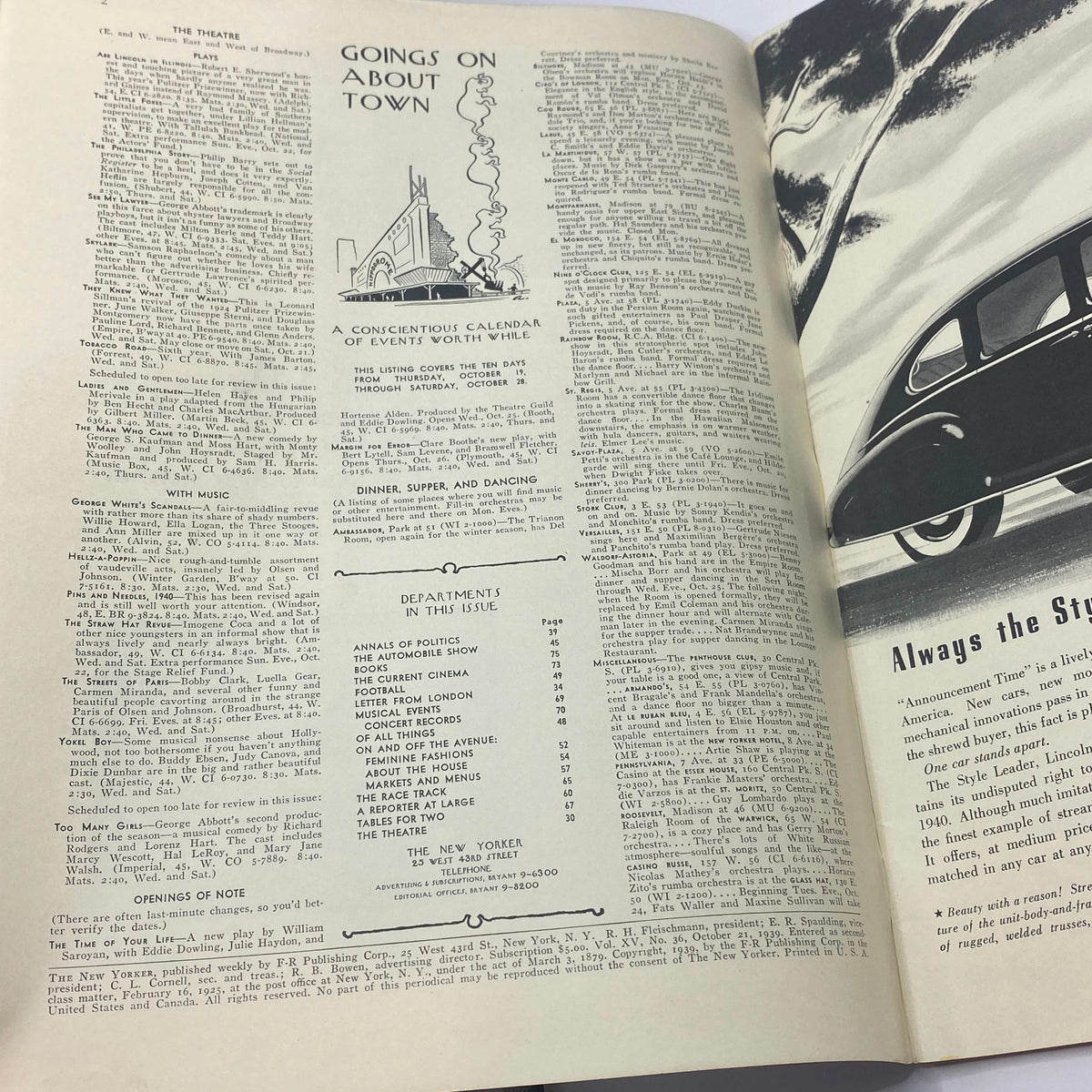


Description
Collector's Note – Why This Issue Matters
The October 21, 1939 issue of The New Yorker with a cover by Susanne Suba is a document of American cultural life at one of its most historically weighted moments. Germany had invaded Poland on September 1, 1939 — seven weeks before this issue's publication date — and Britain and France had declared war two days later. The Second World War had begun. October 21, 1939 falls in what historians sometimes call the "Phoney War" — the period between the formal declarations of war and the catastrophic German offensives of spring 1940 — but for New Yorkers reading their weekly magazine in late October 1939, the world had already fundamentally changed. The New Yorker under Harold Ross was navigating a readership that was simultaneously maintaining the routines of urban life and confronting the reality that the conflict engulfing Europe might not remain at a safe distance. The magazine's particular genius during this period was its ability to hold those two registers simultaneously — the wit and sophistication of its cartoons and fiction alongside a growing engagement with events that no amount of urbanity could fully contain. Collectors who follow the magazine's evolution across this pivotal era will find the full arc of its response to the approaching war documented throughout the New Yorker collection at OriginalMagazines.com.
Susanne Suba was a Hungarian-American artist who contributed covers and interior illustrations to The New Yorker during a period when the magazine was actively cultivating a distinctive visual identity through the work of a carefully selected group of artists. Born in Budapest in 1913, Suba came to the United States as a child and studied at the Art Students League in New York. Her style — described in the listing as minimalist and elegant — reflected the broader modernist influences that were reshaping American illustration in the 1930s, and her work for The New Yorker demonstrated the kind of refined draftsmanship and compositional intelligence that Ross demanded from the magazine's visual contributors. A Suba cover from October 1939 represents her work during what was arguably the most historically charged period of her early career, and for collectors of American illustration history, it is a primary document of her contribution to the magazine's visual legacy. The broader print culture of this extraordinary year is documented in the 1939 magazines collection, which encompasses the full arc of a year that began in an uncertain peace and ended with the world at war.
About the Publication
The New Yorker was founded in New York in 1925 by Harold Ross with the explicit intention of creating a magazine of sophisticated urban wit and literary quality aimed at a cosmopolitan readership rather than the rural mainstream. By October 1939, under Ross's continued editorship, it had established itself as the most prestigious literary and cultural weekly in the United States, renowned for its fiction, poetry, criticism, and reporting as well as its cartoons and cover art. Its editorial format combined long-form journalism with short fiction, poetry, and the "Talk of the Town" section of brief urban observations, all anchored by the weekly cover — which functioned as a standalone work of art rather than a headline illustration. The magazine's readership was educated, urban, and self-consciously sophisticated, making its cultural responses to the outbreak of war in 1939 particularly revealing as documents of how America's intellectual class was processing the European crisis.
Key Highlights Inside
- Susanne Suba cover art — A cover by the Hungarian-American illustrator who contributed regularly to The New Yorker during the 1930s and 1940s, representing her minimalist, elegant visual style at the precise moment the Second World War began reshaping the magazine's editorial context.
- October 1939 cultural and literary content — Published seven weeks after Germany's invasion of Poland and Britain and France's declarations of war, the issue's editorial content would have reflected the magazine's characteristic effort to maintain its urbane, literary voice while the world outside New York was being remade by force.
- Period fiction, criticism, and cartoons — Consistent with The New Yorker's well-documented format of this era, the issue would have included short fiction, poetry, cultural criticism, Talk of the Town observations, and cartoons reflecting the wit and literary standards of Harold Ross's editorial program.
- Note: Specific interior article titles, fiction contributors, and additional content have not been independently confirmed for this issue. The highlights above reflect the well-documented editorial format of The New Yorker during this period and the verifiable identity of the cover artist and historical moment.
Condition & Rarity
Issues of The New Yorker from October 1939 are now eighty-six years old, and the paper stock used in the magazine's weekly production during this era was not manufactured with archival longevity in mind. When evaluating any surviving copy of this issue, the attributes that matter most to serious collectors are the condition of the Suba cover art — its color integrity, surface cleanliness, and freedom from significant staining, tearing, or fading — the structural integrity of the spine and staple binding, and the completeness of interior pages. The good condition noted in the listing for a publication of this age indicates a survivor in the better range of what typically circulates for late-1930s New Yorker issues. Any edge wear, tanning, or minor foxing consistent with eighty-six years of existence is expected and should be understood as authentic characteristics of a publication of this age rather than meaningful detractions from its collectible value. The Suba cover's color quality and surface condition are the primary variables collectors should evaluate through available photographs.
Looking for More Issues Like This?
Late-1930s issues of The New Yorker from the first weeks of the Second World War are historically situated documents that serious collectors of American magazine history and illustration actively seek out, and a Susanne Suba cover from October 1939 is a particularly specific piece of that history. If this issue is currently unavailable, the New Yorker collection at OriginalMagazines.com is the best place to browse what has recently surfaced from across the magazine's remarkable publishing run. Collectors with a broader interest in this extraordinary year should also explore the 1939 magazines collection for a wider view of American print culture during the year the world went to war.