

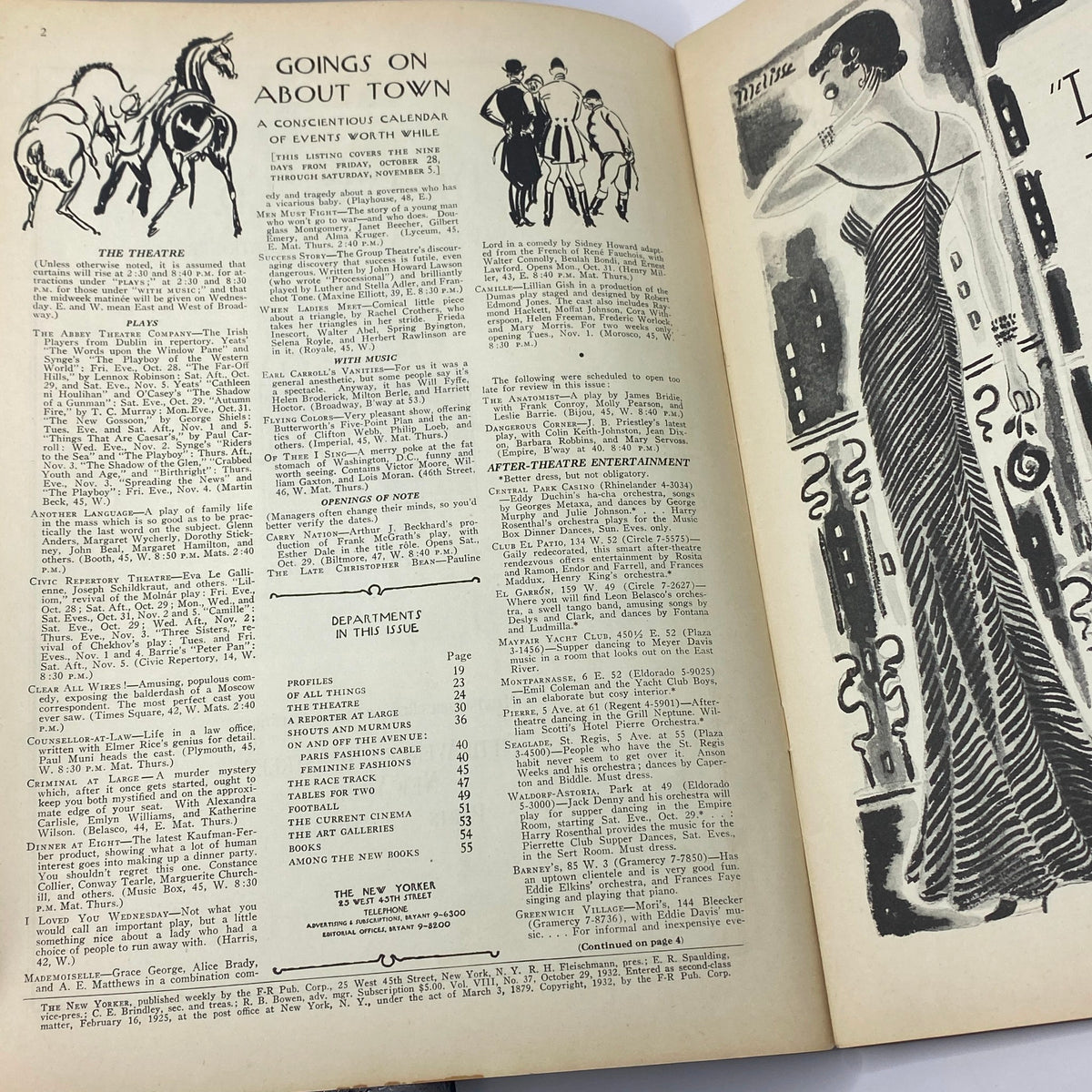
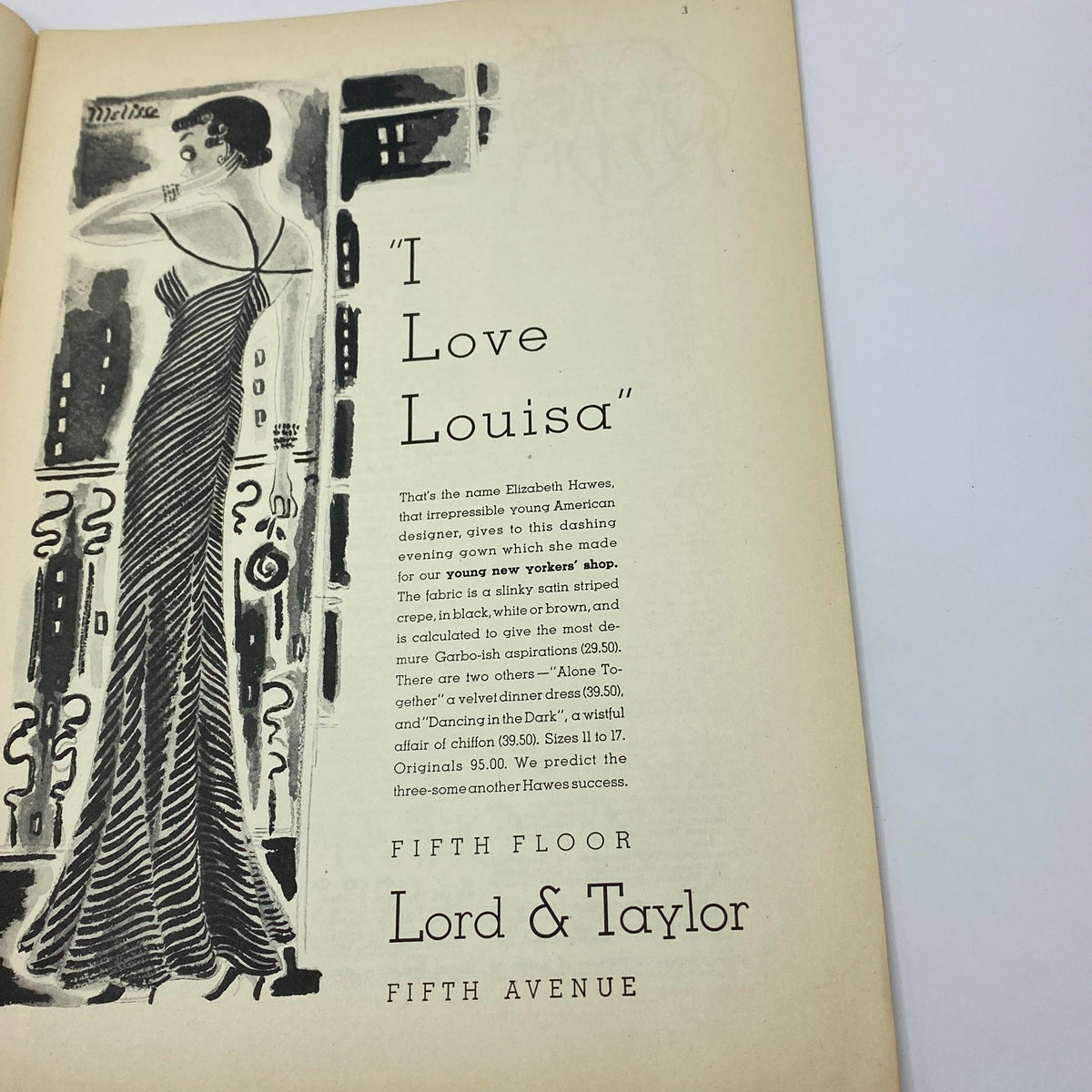


Description
Collector's Note – Why This Issue Matters
The October 29, 1932 issue of The New Yorker featuring a cover by Adolph Kronengold arrives at one of the most consequential moments in twentieth-century American political history. The presidential election of 1932 — Franklin Roosevelt versus Herbert Hoover — was just ten days away from this issue's cover date. The country was in the depths of the Great Depression: unemployment was near twenty-five percent, the banking system was under severe stress, and the Hoover administration's response had failed catastrophically in the public's estimation. The outcome of the November 8 election would bring Roosevelt to the presidency and initiate the New Deal, fundamentally reshaping the relationship between the federal government and American society. A New Yorker issue published in the final days of that campaign captures a specific and unrepeatable cultural atmosphere — the last week of a political era, documented in real time through the fiction, commentary, cartoons, and cover art of a publication that was simultaneously above the fray and deeply embedded within it. Collectors building archives of The New Yorker's Depression-era run will find that the October and November 1932 issues carry a historical charge that no other cluster of issues from the decade quite replicates.
Adolph Kronengold was a contributor to The New Yorker's cover program during the magazine's early years, working within the tradition of socially observant illustration that Harold Ross had cultivated from the magazine's founding. The cover artists of this period — a group that included Kronengold alongside more frequently cited figures like Rea Irvin, Constantin Alajalov, and Leonard Dove — were producing work that functioned simultaneously as seasonal decoration, social commentary, and visual wit. An October cover would have engaged with the autumn setting while the political atmosphere of an election week pressed in from every direction. The cover of a late October 1932 New Yorker is, in that sense, a document produced under specific historical pressure, even if its subject matter appears entirely removed from electoral politics. For anyone assembling a documentary picture of 1932 through its print culture, a complete New Yorker from this exact week offers a density of cultural documentation — fiction, criticism, cartoons, and editorial commentary together — that no single-subject publication of the era can match.
About the Publication
The New Yorker was founded by Harold Ross in 1925 with an editorial mandate to produce sophisticated urban humor and commentary for a literate, cosmopolitan readership. By October 1932 — seven years into its existence — the magazine had fully consolidated the format and voice that would define it for the rest of the century: a distinctive full-color illustrated cover, "Talk of the Town" commentary, short fiction and poetry, long-form journalism, cultural criticism, and the cartoons and spot illustrations that had become as central to its identity as its prose. Ross's exacting editorial standards attracted the most accomplished writers, cartoonists, and illustrators working in America, and the early 1930s represent a period of genuine creative richness in the magazine's history — the Depression sharpening rather than dulling the satirical intelligence that had always been its core asset. Issues from this period are among the most historically significant in the magazine's nearly century-long archive.
Key Highlights Inside
- Cover illustration by Adolph Kronengold: Kronengold contributed covers to The New Yorker during the magazine's formative years, working in the tradition of socially observant illustration that defined the publication's visual identity — his October 29, 1932 cover produced in the final days before one of the most consequential American elections of the twentieth century.
- Pre-election atmosphere of November 1932: Published ten days before the Roosevelt-Hoover election, this issue documents the cultural atmosphere of the Depression's most politically charged moment — the final week of an administration widely judged to have failed, and the anticipation of the fundamental political realignment that followed.
- Complete issue from the Depression's deepest year: 1932 represents the nadir of the Great Depression by most economic measures, and a complete New Yorker from this year — with its fiction, criticism, cartoons, and commentary intact — constitutes a primary document of how American cultural life processed that extreme circumstance.
- Early 1930s fiction, cartoons, and criticism: A complete October 1932 New Yorker would contain the full range of the magazine's editorial content, produced by writers and artists working at what illustration and literary historians regard as one of the most creatively fertile periods in the magazine's history. Specific authors and titles featured in this issue are unconfirmed beyond what is stated in the listing.
Condition & Rarity
Very good condition on a ninety-plus-year-old New Yorker is a substantive grading claim that warrants careful assessment. The magazine's uncoated interior stock from this era ages to significant tanning under average storage conditions — bright, lightly toned interior pages in a copy of this age indicate either exceptional original storage or deliberate archival preservation. The cover's coated stock typically holds color somewhat better than interior pages, making the two surfaces separate grading considerations. The listing specifies complete condition, which is the single most important attribute for issues from this era: intact, unabridged copies are considerably less common than partial survivors, as cartoons, cover art, and fiction pages were routinely removed for framing or scrapbooking across the nine decades since publication. When evaluating any surviving copy of this issue, page completeness, cover attachment and surface condition, and degree of interior toning are the three primary grading variables. A complete, very good copy of a 1932 New Yorker is a meaningful preservation achievement by any honest assessment.
Looking for More Issues Like This?
Complete New Yorker issues from the early 1930s in very good condition are among the most rewarding and demanding finds in the vintage magazine hobby — the historical weight of the Depression era combined with the magazine's creative richness at this period makes each issue a genuinely layered collectible. If this one has already found a home, the full archive of The New Yorker issues is the essential destination for collectors working through the magazine's remarkable run across the decades. The 1932 magazine collection is also worth exploring for anyone building a broader documentary picture of American print culture during one of the most consequential years of the twentieth century.