

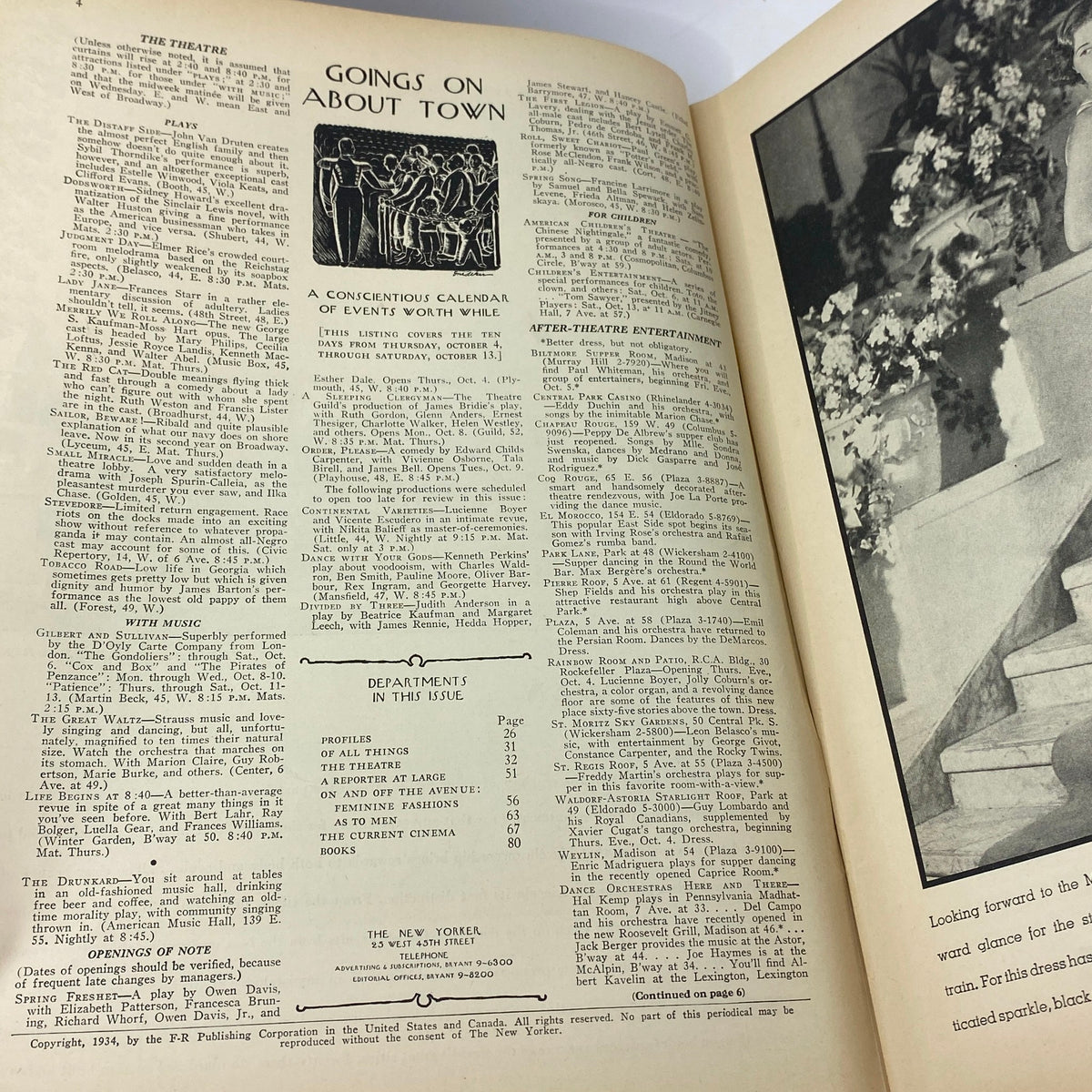


Description
Collector's Note – Why This Issue Matters
The October 6, 1934, issue of The New Yorker featuring a cover by Charles Alston is a document of exceptional historical significance that operates on at least two distinct levels simultaneously. The first is the history of The New Yorker itself, then in its ninth year of publication and still in the process of assembling the roster of artists who would define its visual identity across the mid-twentieth century. The second — and rarer — is the history of Charles Alston, whose presence on the cover of one of America's most prestigious magazines in 1934 represents a meaningful moment in the broader story of African American artists navigating and penetrating the mainstream institutions of American cultural life during the Harlem Renaissance era. Alston was a central figure in that movement: a muralist, painter, illustrator, and teacher whose work at the Harlem Art Workshop and later at the WPA-funded Harlem Hospital murals made him one of the most influential artistic presences in New York's Black cultural community during precisely this period. A New Yorker cover credit in 1934 placed him in the company of the magazine's most celebrated illustrators at a moment when such institutional recognition for African American artists was far from guaranteed. For collectors building a serious archive of vintage New Yorker issues, this cover represents an intersection of art history and social history that very few single issues can claim.
Alston's broader biography gives this cover additional depth. Born in Charlotte, North Carolina, in 1907 and educated at Columbia University, he was by 1934 in his late twenties and already recognized within New York's art world as an exceptional talent. His mural work at Harlem Hospital — completed between 1936 and 1937 and notable for depicting African American figures in historical and scientific contexts at a time when such representation in public art was actively contested — would come just a few years after this cover. His later career included work as a commercial illustrator, a founding faculty member at what became the City University of New York, and continued recognition as a painter and sculptor until his death in 1977. The October 1934 New Yorker cover is an early document of a career that would prove both artistically distinguished and historically important. Among collectors focused on publications from 1934, this issue carries a significance that extends well beyond the standard parameters of vintage magazine collecting into the fields of African American art history, Harlem Renaissance studies, and the history of American cultural institutions.
The year 1934 itself is worth contextualizing. The country was five years into the Great Depression, the New Deal was in its first year of implementation, and the WPA arts programs that would employ Alston and many of his Harlem contemporaries were being developed. The New Yorker under Harold Ross was producing some of its most confident early work, its editorial identity sharpening through the contributions of the artists and writers who would come to define it. An October 1934 cover sits within that moment of creative ferment — a magazine finding its voice and an artist finding his platform, intersecting in a single illustrated cover that has aged into something considerably more historically resonant than its original newsstand presentation could have suggested.
About the Publication
The New Yorker was founded in February 1925 by Harold Ross and had by October 1934 completed nearly a decade of publication, surviving the Depression years that had shuttered many of its contemporaries and establishing itself as the most intellectually and artistically ambitious weekly magazine in the United States. Its cover art tradition — a fresh original illustration commissioned for each issue, entirely independent of the interior editorial content — was a defining feature of the magazine's identity from its earliest numbers. The cover artists of the 1930s included some of the most significant illustrators of the era, and the selection of artists for cover assignments reflected both aesthetic and, occasionally, social judgments about who belonged in the magazine's visual world. By 1934 the magazine's format combined original covers with fiction, poetry, criticism, humor pieces, and the single-panel cartoons that would become its most widely imitated feature — all aimed at an educated, cosmopolitan readership centered on but not limited to New York City.
Key Highlights Inside
- Cover illustration by Charles Alston — an early career document of one of the Harlem Renaissance's most significant visual artists, representing a meaningful moment of institutional recognition within one of America's most prestigious cultural publications during a period when such recognition for African American artists was historically significant.
- Editorial content consistent with The New Yorker's October 1934 format under Harold Ross, combining fiction, poetry, criticism, humor, and the magazine's signature cartoon panels — produced during the Depression era and reflecting the cultural preoccupations of that moment.
- Advertising pages from October 1934 documenting the consumer culture and commercial aesthetics of Depression-era New York — independently valuable to social historians and graphic design researchers working in this period.
- Specific articles, fiction, and columns for this issue are unconfirmed beyond the cover attribution; interior content details should be verified against the physical copy.
Condition & Rarity
A surviving copy of this issue in good condition for its age represents a meaningful preservation outcome for a publication that is approaching its ninety-first year. Good condition on a 1934 weekly magazine implies structural integrity — a bound and intact page block, a legible cover illustration, and readable interior content — alongside the distributed wear, tanning, and edge deterioration that honest survival through nine decades inevitably produces. The specific condition variables most relevant to this issue's value — cover surface clarity, the degree of tanning on interior pages, spine integrity, and the presence or absence of a subscription label on the cover — should be assessed against the accompanying photographs, as the listing notes good condition for age without itemizing individual variables. For a 1934 New Yorker with a cover by an artist of Alston's historical significance, even good-condition examples carry research and collecting value that transcends cosmetic grade, as the issue's importance to African American art history and Harlem Renaissance scholarship makes any intact surviving example a legitimate primary source document.
Looking for More Issues Like This?
New Yorker issues from the 1930s are among the most historically significant and physically demanding to locate in any presentable condition, and a cover with the specific art-historical provenance of the Alston October 1934 issue narrows the field considerably. The full archive of vintage New Yorker issues at OriginalMagazines.com is the most comprehensive resource for exploring covers across different artists, decades, and editorial eras. For collectors and researchers drawn to the specific cultural and historical richness of the mid-1930s, the 1934 magazine collection offers a broader view of American print culture from one of the most consequential years of the Depression decade.