




Description
Collector's Note – Why This Issue Matters
The September 5, 1936 issue of The New Yorker arrives at a moment when the magazine had fully consolidated its identity as the defining voice of American literary and cultural sophistication. Founded just eleven years earlier by Harold Ross in 1925, The New Yorker had by the mid-1930s assembled the writers, cartoonists, and visual artists who would shape its character for generations. The cover by Adolph Kronengold is part of that visual tradition — a tradition that treated the magazine's exterior as a genuine artistic statement rather than a commercial hook, and that gave its cover artists the freedom to pursue illustration as a form of expression rather than mere decoration.
Adolph Kronengold contributed covers to The New Yorker during the 1930s and was part of the broader cohort of illustrators whose work defined the magazine's visual personality in its formative decade. His modernist sensibility and distinctive graphic approach were well suited to The New Yorker's editorial aesthetic — which valued wit, elegance, and a certain knowing sophistication over the more aggressive commercial illustration style prevalent in mass-market publications of the era. A September cover would typically have engaged with the particular mood of the transition from summer to autumn in New York — the return of the social season, the reopening of the cultural calendar, the specific atmosphere of the city at summer's end. For collectors who follow vintage New Yorker magazine issues, 1930s covers by named artists represent the publication at its most historically rooted and visually distinctive.
The broader historical context of September 1936 deepens the significance of any issue from this moment. The United States was in the midst of the Great Depression's long middle chapter — Roosevelt's New Deal was in its second term, the Spanish Civil War had broken out in July, and American cultural life was carrying on with the particular intensity that difficult times tend to produce. The New Yorker of 1936 was simultaneously a refuge from that anxiety and a precise recorder of the urban intellectual world navigating it. The fiction, criticism, reportage, and cartoons inside any issue from this year constitute a primary document of that navigation. Collectors building focused archives around magazines from 1936 will find that New Yorker issues from this period carry unusual literary and historical weight alongside their considerable visual appeal.
About the Publication
The New Yorker was founded by Harold Ross in February 1925 with a specific and ambitious editorial vision: a sophisticated weekly magazine aimed at the urban intellectual readership of New York and, by extension, the culturally literate American audience that identified with that world. By 1936 it had developed the format and the stable of contributors that would define it for the rest of the century — long-form journalism, short fiction, poetry, criticism, cartoons, and the Talk of the Town section that documented New York life with a particular blend of observation and wit. Its covers, commissioned from a rotating group of artists rather than produced by a single art director's vision, were understood as independent artistic works from the magazine's earliest years, and they constitute one of the most consistently distinguished bodies of commercial illustration in American publishing history.
Key Highlights Inside
- Cover artwork by Adolph Kronengold — a named artist contribution to The New Yorker's distinctive cover tradition, reflecting the modernist illustration sensibility that characterized the magazine's visual identity in the 1930s.
- Publication date of September 5, 1936 places this issue at the opening of the autumn social and cultural season in New York — a moment the magazine traditionally marked with particular editorial attentiveness.
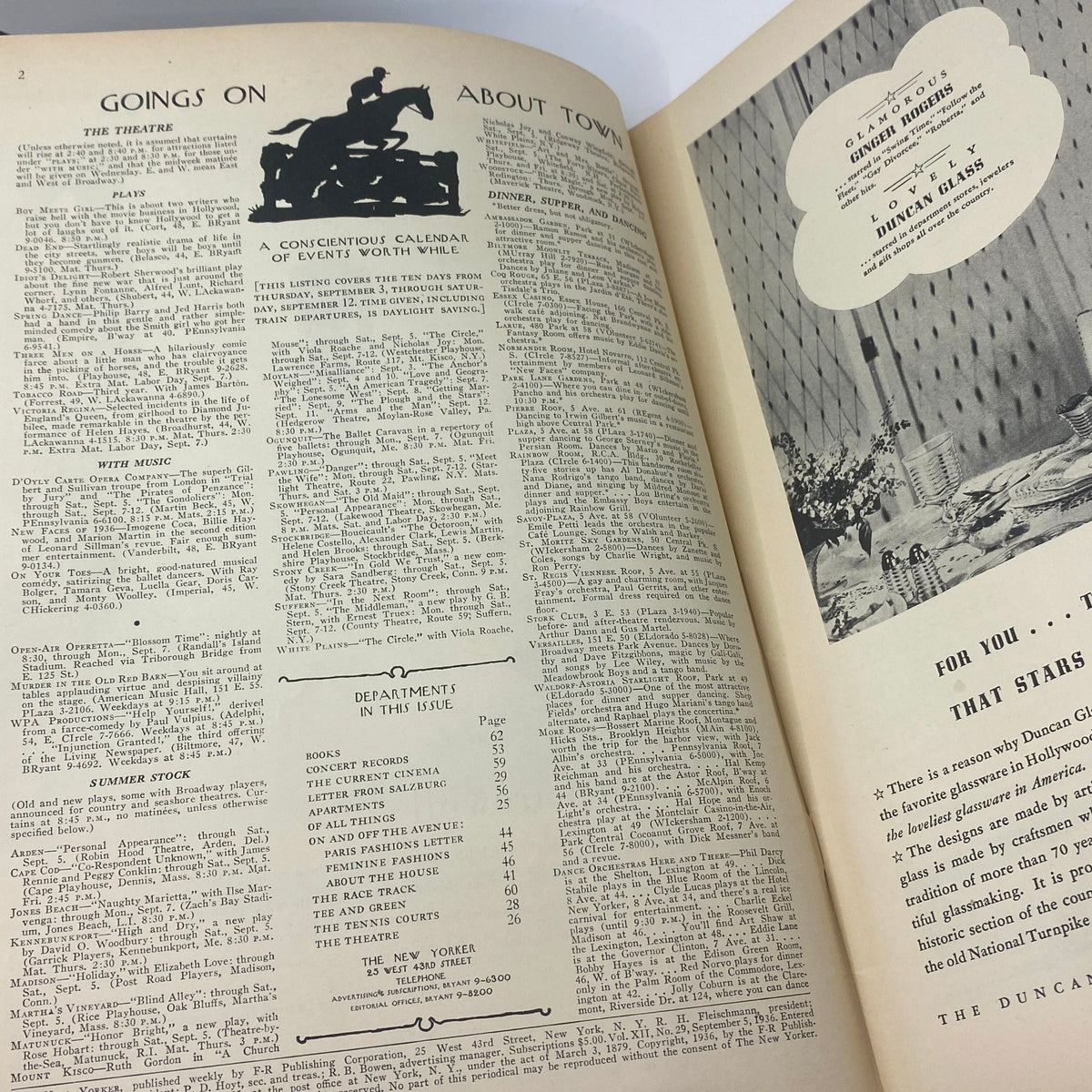
- Specific interior articles, fiction, criticism, cartoons, and other features are unconfirmed from the listing; the full contents would reflect The New Yorker's characteristic editorial range for the period, including contributions from the writers and cartoonists who defined the magazine's voice in the mid-1930s.
Condition & Rarity
Very good condition is a meaningful grade for a magazine now approaching ninety years old, and for New Yorker issues from the 1930s it represents the upper range of what the collector market typically encounters. The magazine was printed on standard commercial paper stock rather than archival material, and the combination of age, the acidity inherent in that paper, and the simple passage of nearly a century means that surviving copies in genuinely sound condition are the exception rather than the rule. Minor edge wear on a 1936 issue is an honest and expected note — it speaks to storage and handling history rather than neglect. The key condition factors to evaluate in any surviving copy of this issue are the state of the Kronengold cover image and its color retention, spine integrity, and the degree of interior page toning or brittleness. A very good grade with only minor edge wear suggests careful long-term storage and represents a preservation outcome that most copies of this vintage will not have achieved.
Looking for More Issues Like This?
Pre-war New Yorker issues with named cover artists in very good condition are among the more rewarding finds in the vintage magazine market — the combination of literary history, visual art history, and sheer age makes them genuinely compelling objects. If this September 1936 issue is no longer available, the full vintage New Yorker collection at OriginalMagazines.com is the best place to browse for other issues spanning the magazine's long history. The 1936 magazine archive covers the full year across multiple titles for collectors building a focused Depression-era or pre-war library.