



Description
Collector's Note – Why This Issue Matters
December 17, 1973 is a publication date of considerable historical and literary weight, and this New Yorker issue documents it with a table of contents of exceptional quality. Jean-Michel Folon's cover places this issue within one of the most distinctive and most collected visual traditions in the magazine's history. Folon — the Belgian surrealist illustrator whose atmospheric, melancholy imagery was distinguished by its combination of visual wit and existential undertow — had developed through the early-to-mid-seventies one of the most recognizable individual aesthetics in the New Yorker's cover tradition. His covers from this period are now among the most actively sought in the publication's visual archive, their dreamlike quality and specific emotional register making them collector objects independent of the editorial content they accompany. A December 17 Folon cover — a Christmas season issue with the particular emotional charge that his imagery brought to holiday subjects — represents the Belgian artist's work at its most contextually resonant, the warmth and melancholy of his visual sensibility perfectly calibrated to the specific emotional register of a December New Yorker. For collectors building an archive of New Yorker issues from the early seventies, this December 17, 1973 Folon cover is among the most specifically valued visual entries in the publication's holiday catalog from this period.
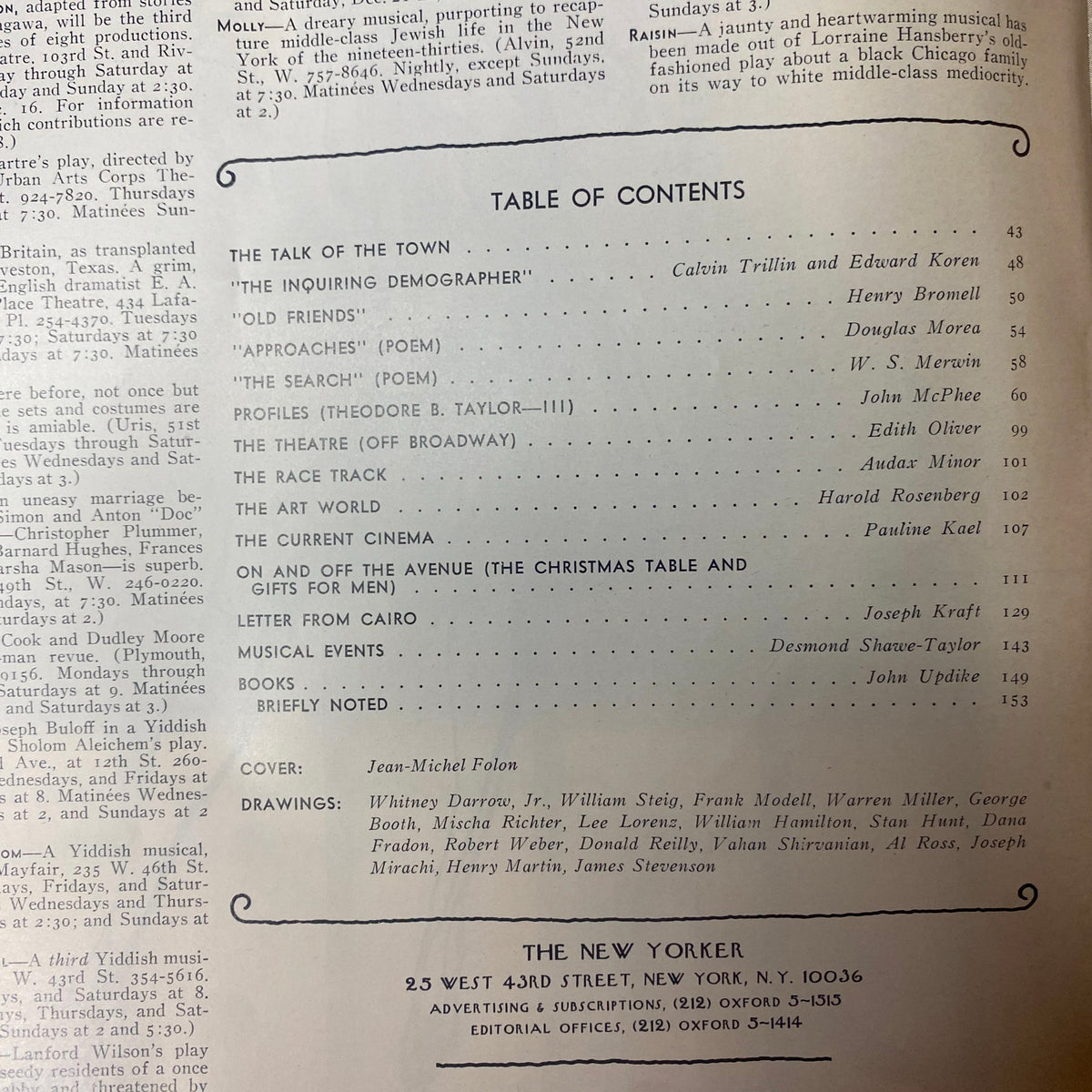
The editorial contents documented in the full table of contents make this issue extraordinarily significant as a primary literary and critical historical document. John McPhee's "Profiles (Theodore B. Taylor—III)" is the third installment of McPhee's profile of nuclear physicist Theodore B. Taylor, which would eventually become the book The Curve of Binding Energy (1974) — one of the most important works of long-form science journalism in the twentieth century, addressing the specific dangers of nuclear weapons proliferation and the vulnerability of commercial nuclear material to theft for weapons construction. McPhee's nuclear material profile was published in December 1973, in the specific atmosphere of the Oil Crisis — OPEC's embargo had begun in October 1973 — that was making energy and nuclear questions matters of acute public urgency. A confirmed third installment of this landmark serialization in December 17, 1973 is a bibliographically specific primary document of one of the most important works in the history of American long-form journalism at its original serial publication moment. John Updike's Books column and W. S. Merwin's poem add further layers of literary primary source significance — both figures were at specific career peaks in late 1973, and their New Yorker contributions from this period are documented elements of their respective bodies of work. Collectors researching New Yorker issues from 1973 will find this December 17 edition a primary source document of unusual density across visual art, literary journalism, poetry, and critical history.
The supporting cultural criticism in this issue is itself a primary source record of considerable value. Pauline Kael's cinema column, Harold Rosenberg's "The Art World," and Edith Oliver's theater reviews constitute three of the most authoritative cultural criticism voices in American letters simultaneously documented in a single December 1973 issue. Rosenberg — who coined the term "Action Painting" and was one of the most significant art critics of the twentieth century — was writing his regular Art World column at a specific moment in the New York art scene's transition from the Abstract Expressionism he had championed toward newer movements whose relationship to his critical framework was actively contested. The Letter from Cairo by Joseph Kraft documents the specific post-Yom Kippur War Egyptian perspective in December 1973, two months after the October war, when the specific diplomatic and political landscape of the Middle East was being shaped by the events that had just occurred. Calvin Trillin and Edward Koren's Talk of the Town piece and the full roster of cartoon contributors — William Steig, George Booth, Frank Modell, Warren Miller, and thirteen additional artists — complete a weekly package of extraordinary depth and historical significance.
About the Publication
The New Yorker was founded in 1925 by Harold Ross and by December 1973 had been publishing for forty-eight years under the editorships of Ross and William Shawn, whose tenure since 1952 had deepened the magazine's commitment to long-form journalism, literary fiction, poetry, and cultural criticism of the highest standard. The December 17, 1973 issue represents the Shawn-era publication at a specific editorial peak — its engagement with the Oil Crisis, the Watergate investigation, and the decade's cultural and social upheavals was producing some of the most significant journalism in the magazine's history. John McPhee's Theodore B. Taylor serialization was itself a product of Shawn's specific editorial vision: the conviction that the most important stories required the space and depth that only long-form serialization in the New Yorker could provide.
Key Highlights Inside
- Jean-Michel Folon cover — a primary visual document of one of the New Yorker's most distinctive and most collected early-seventies cover artists, whose atmospheric surrealist imagery is documented here in its original December publication context with the full visual integrity of the newsstand format preserved, representing Folon's specific emotional register at its most contextually resonant seasonal moment.
- John McPhee "Profiles (Theodore B. Taylor—III)" on page 60 — a confirmed third installment of the serialization that became The Curve of Binding Energy, one of the most important works of American long-form science journalism and a primary document of nuclear weapons proliferation concerns published in December 1973 during the specific atmosphere of the Oil Crisis that was making energy and nuclear questions matters of acute public urgency.
- W. S. Merwin "The Search" (poem) on page 58 — a documented contribution from one of the most significant American poets of the postwar period, constituting a primary bibliographic record of his New Yorker work at a specific late-1973 career moment, and John Updike's Books column on page 149 representing the novelist's ongoing critical engagement with American literature in the same issue.
- Pauline Kael "The Current Cinema" on page 107 and Harold Rosenberg "The Art World" on page 102 — two of the most authoritative cultural criticism voices in American letters documented simultaneously in a single December 1973 issue, with Rosenberg writing at the specific moment of the New York art scene's contested transition from Abstract Expressionism toward newer movements, and Kael at the height of her most productive New Yorker film criticism period.
- Joseph Kraft "Letter from Cairo" on page 129 — a documented New Yorker diplomatic correspondence from Egypt in December 1973, two months after the Yom Kippur War, providing contemporaneous primary source documentation of the specific post-war Egyptian political and diplomatic landscape at the moment when the Middle East's new configuration was being actively shaped.
- Calvin Trillin and Edward Koren "The Inquiring Demographer" on page 48, Edith Oliver theater criticism, Desmond Shawe-Taylor musical events, and cartoon contributions from William Steig, George Booth, Warren Miller, Frank Modell, and thirteen additional artists — the full editorial and visual humor architecture of a December 1973 New Yorker documenting the magazine's complete creative range at a historically specific late-Shawn-era moment.
Condition & Rarity
New Yorker issues from December 1973 are approaching their fifty-third year of existence, and the condition landscape for surviving copies of this specific issue reflects both the general attrition of that age and the specific collecting significance of a Jean-Michel Folon December cover combined with the John McPhee Theodore B. Taylor serialization. Very Good condition with only minor edge wear is an honest and strong grade for a fifty-two-year-old weekly literary magazine, indicating a copy that retains full structural integrity, displays cleanly, and shows no significant cover damage or interior page loss beyond the minimal evidence of its age. The Folon cover illustration — the primary visual asset for display-focused collectors — is preserved in this grade with sufficient visual clarity to convey both the illustrator's specific aesthetic and the magazine's visual identity. The plastic protective sleeve provides ongoing archival protection for a publication whose paper chemistry benefits from continued careful storage. Collectors evaluating surviving examples of this issue should prioritize the Folon cover image integrity, the completeness of the McPhee Theodore B. Taylor serialization pages, and overall structural soundness as primary condition criteria most directly relevant to this issue's exceptional visual and literary historical significance.
Looking for More Issues Like This?
A Very Good copy of The New Yorker from December 17, 1973 with the Jean-Michel Folon Christmas cover, confirmed John McPhee nuclear journalism serialization, W. S. Merwin poetry, John Updike criticism, Pauline Kael cinema, and Harold Rosenberg art criticism is among the most literarily and visually significant single issues in the magazine's early-seventies archive — the convergence of Folon's collected cover art, McPhee's landmark serialization, and the full roster of critical voices documented here gives this issue a collector profile extending across visual art, American literary journalism, poetry, film criticism, and art history simultaneously. If this issue is no longer available, the full New Yorker collection at OriginalMagazines.com is the most comprehensive place to browse surviving issues from across the publication's history and locate other Folon covers, McPhee serialization issues, or significant entries from the Shawn era's early-seventies run. The 1973 magazine collection brings together surviving issues from across that year's major publications for collectors working to document the full breadth of American print culture during the Watergate era's most historically consequential months.