



Description
Collector's Note – Why This Issue Matters
January 15, 1972 places this issue of The New Yorker at a specific and historically charged moment in the early 1970s. The Vietnam War was in its most politically contested phase — the anti-war movement had produced the largest demonstrations in American history, the Pentagon Papers had been published by the New York Times in June 1971, and the Nixon administration's response had set in motion the sequence of events that would lead to Watergate. The 1972 presidential election was eleven months away, and the political atmosphere of early January was already shaped by the coming campaign's intensity. Culturally, American cinema and theater were in a period of unusual creative ambition — the New Hollywood was in full flower, and the New York theater scene that The New Yorker's critics covered with such authority was producing some of its most significant work of the decade. For collectors assembling a serious archive through original magazines from 1972, this January 15 issue documents the magazine at the opening of one of the most politically consequential years of the postwar period — Nixon's re-election year, the year of Watergate's beginning, the year American combat involvement in Vietnam was finally winding toward its end.
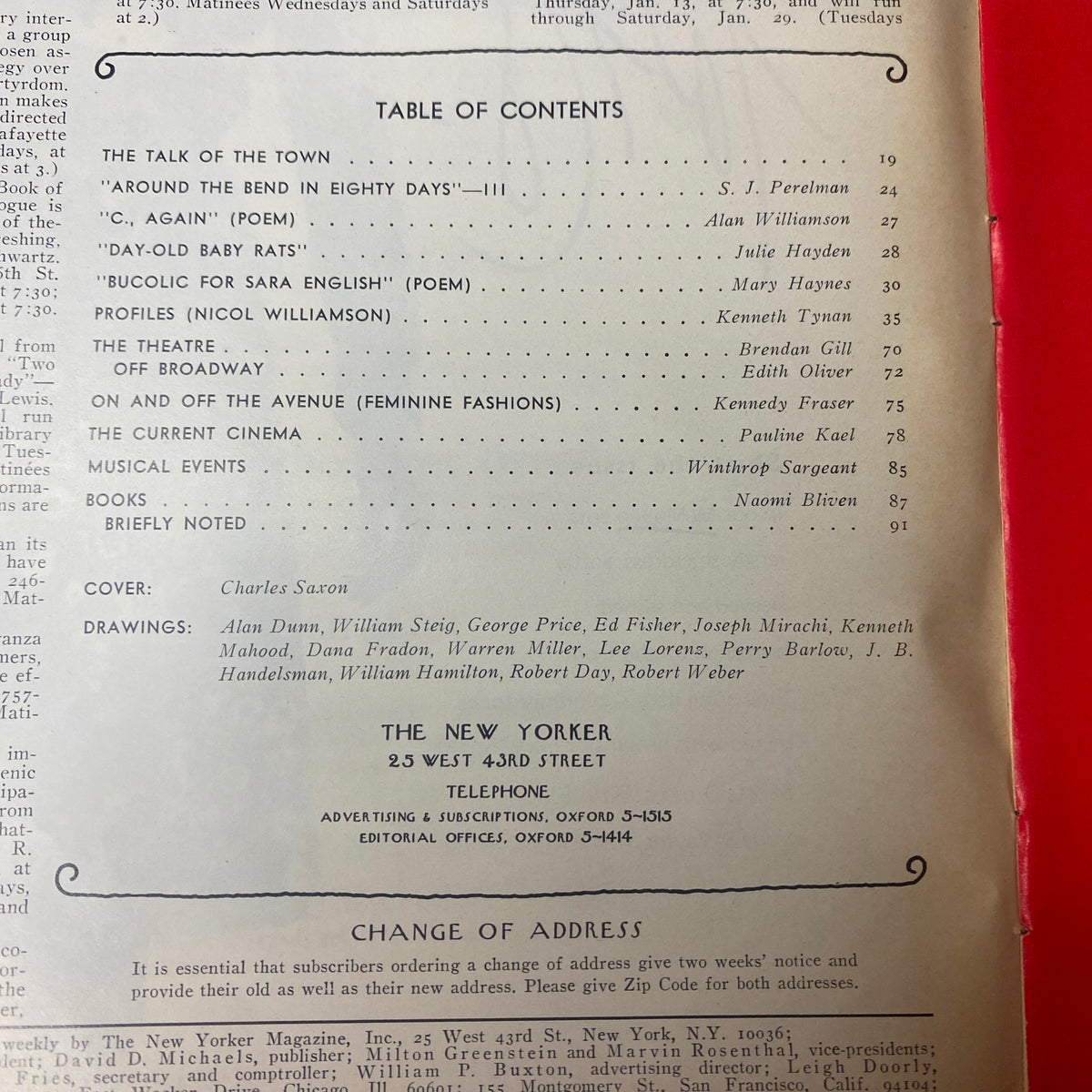
The cover by Charles Saxon — the listing notes the title as "Charles Saxxon" but the artist is Charles Saxon — makes this issue a distinctive and historically valued object within the magazine's early-1970s visual archive. Saxon was one of The New Yorker's most celebrated and long-serving contributing artists, whose satirical illustrations of upper-middle-class American life — rendered with an elegance and wit that made his work immediately recognizable — were central to the magazine's visual identity from the 1950s through the 1980s. His style occupied a specific register: not the broad comedy of some of his contemporaries but a more precise, gently devastating social observation that found the self-deception and pretension in comfortable American life with a sophistication that fit the magazine's editorial voice exactly. The table of contents deepens the issue's significance considerably, confirming contributions from S. J. Perelman, Pauline Kael, Kenneth Tynan, and Brendan Gill — a roster that represents the magazine's critical and literary voice at the height of its postwar authority. For collectors tracing the visual and editorial history of the publication through original New Yorker issues, a Saxon cover with this specific contributor lineup is an object of genuine documentary value.
The drawing roster listed in the table of contents deserves specific attention from the historically minded collector. Alan Dunn, William Steig, George Price, Perry Barlow, Lee Lorenz, Warren Miller, and William Hamilton together represent several generations of the magazine's cartooning tradition — from artists who had been contributing since the Depression era to those who would define its later decades. A single issue with this concentration of named cartoonists is a document of the magazine's visual tradition at one of its most generationally layered moments.
About the Publication
Founded in February 1925 by Harold Ross and edited from 1952 by William Shawn, The New Yorker of the early 1970s was at a period of deep editorial seriousness and cultural authority, engaging with the Vietnam War, the civil rights movement's evolution, and the social upheavals of the era with the long-form journalistic commitment that Shawn had made central to the magazine's identity. Its readership was educated, culturally engaged, and expected the combination of literary quality, serious criticism, and distinctive humor that had defined the publication across nearly five decades. The critical voices confirmed in this issue's table of contents — Kael on cinema, Tynan on theater, Gill on theater, Sargeant on music — represent the magazine's critical tradition at its most authoritative and personally distinctive.
Key Highlights Inside
- Charles Saxon cover illustration: Original artwork by one of The New Yorker's most celebrated and long-serving contributing artists, whose satirical illustrations of upper-middle-class American life defined the magazine's visual identity across three decades.
- S. J. Perelman — "Around the Bend in Eighty Days," Part III (p.24): As confirmed in the table of contents — a contribution from one of the most celebrated comic prose writers in American literary history, whose long association with The New Yorker produced some of the most distinctive humor writing of the twentieth century.
- Kenneth Tynan — Profile of Nicol Williamson (p.35): As confirmed in the table of contents — a profile by the era's most celebrated and provocative English theater critic, writing about one of the most respected and volatile stage actors of the period, for a magazine whose theater coverage was the most authoritative in America.
- Pauline Kael — The Current Cinema (p.78): As confirmed in the table of contents — a film review by the most influential American film critic of the era, whose New Yorker column from this period is among the most important primary documents of New Hollywood cinema criticism.
- Brendan Gill — The Theatre (p.70) and Edith Oliver — Off Broadway (p.72): As confirmed in the table of contents — theater criticism from two of the magazine's most characteristic critical voices, covering the New York stage at a period of unusual creative ambition.
- Drawings by William Steig, Perry Barlow, Lee Lorenz, and others: As confirmed in the drawings credit — a generationally layered roster of cartoonists spanning Depression-era contributors to mid-century voices, documenting the magazine's visual tradition at one of its most historically rich moments.
Condition & Rarity
The listing describes this issue as in very good condition with only minor edge wear, a plastic protective covering applied, and photographs provided for detailed assessment. In collector-grade terms, very good condition with minor edge wear is a sound and desirable preservation result for a publication now over fifty years old. The applied protective covering indicates custodial care. The New Yorker from the early 1970s was printed on paper stock that holds reasonably well under proper storage conditions, and minor edge wear of the kind described is entirely consistent with honest age rather than mishandling. When evaluating any surviving copy of this issue, the meaningful criteria are the integrity of Saxon's cover art, the completeness of all interior pages including the full table of contents confirmed in the listing, and the absence of moisture damage or significant toning. A copy meeting the standard described here represents the preservation grade that serious collectors of early-1970s New Yorker material actively seek.
Looking for More Issues Like This?
A Charles Saxon cover with confirmed contributions from S. J. Perelman, Pauline Kael, Kenneth Tynan, and Brendan Gill — at the opening of Nixon's re-election year, with a drawing roster spanning multiple generations of the magazine's cartooning tradition — is exactly the kind of editorially complete and historically situated issue that serious New Yorker collectors pursue with patience. If it is no longer available, the extensive original New Yorker collection at OriginalMagazines.com is one of the deepest archives of the magazine accessible to collectors, spanning many decades of its publishing history. For those drawn to the early 1970s magazine at its most editorially ambitious, the full 1972 magazine collection rewards careful and patient exploration.